

The summit generated 38 published news articles across national, regional, and trade outlets within 5 days through coordinated media outreach, exclusive data release, named spokespeople, and staged interview access.
The event ran for two days in London. Organisers released an original 12-page sector report at 09:00 on day one. The report contained 7 charts, 4 regional breakdowns, and a 1,200-respondent survey with methodology. Organisers provided embargoed access to the report for 15 selected journalists on day zero. During the event, organisers scheduled 24 on-record interviews with named spokespeople and three panels featuring regulators and academics. Press packs included high-resolution images, editable quotes, and raw data tables. These elements produced 38 editorial placements in mainstream and specialist outlets within the first five days.
How did organisers prepare content and assets before the event?
Preparations included commissioning original research, writing an executive summary, preparing editable quotes, producing 30 images, and assembling a single downloadable press pack with contact details.
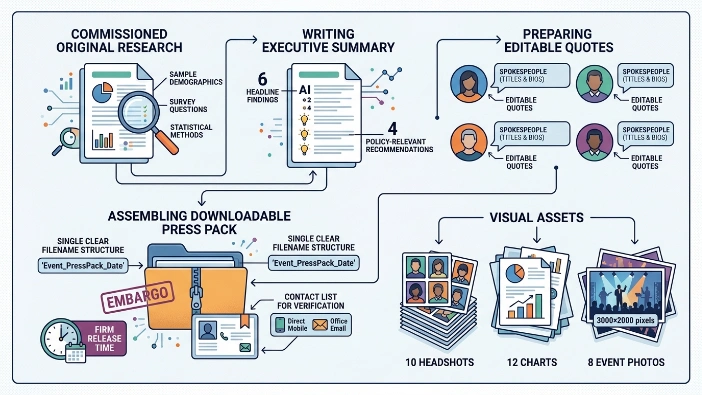
The commissioned research defined sample demographics, survey questions, and statistical methods. The executive summary highlighted 6 headline findings and 4 policy-relevant recommendations. Editable quotes came from 6 spokespeople with titles and short bios. Visual assets included 10 headshots, 12 charts, and 8 event photos at 3000×2000 pixels. The press pack used one clear filename structure and contained a contact list with direct mobile numbers and office emails for immediate verification. Journalists received the pack under an embargo with a firm release time.
What outreach strategy secured journalist interest?
Organisers used targeted journalist lists, personalised email pitches, embargoed exclusives for 15 journalists, and scheduled interview slots across major sectors.
The outreach list contained 120 journalists segmented by beat: national politics, regional business, sector trade, and broadcast. Email pitches stated the embargo time, headline finding, and local angle for recipients. Fifteen journalists received a one-day exclusivity for the report, enabling them to prepare in-depth pieces. Organisers offered 15-minute interview slots and two 30-minute panel interviews to ensure spokespeople availability. Follow-up calls confirmed attendance and clarified data points.
Which spokespeople and third-party sources increased editorial credibility?
Named spokespeople included the summit chair, two industry CEOs, one regulator official, and two academic researchers; third-party validation came from a university research centre and an independent consultancy.
The summit chair provided a short industry overview. CEOs provided market-impact quotes with verifiable figures. The regulator official supplied context on policy changes. Academics explained methodology and limitations. The university research centre provided peer review of the survey design. The independent consultancy validated the market-size estimate. Each named source had a verifiable institutional affiliation and contactable email, enabling editors to confirm quotes rapidly.
How did timing and embargo management affect publication timing?
Embargoed release of the report at 09:00 facilitated simultaneous publication; staggered interview windows and lunch-time panel sessions created continuous coverage across the day.
The embargo allowed selected journalists to prepare long-form stories for immediate posting at 09:00. Staggered interviews supplied fresh content throughout the day, which created multiple publication triggers. A noon panel with a regulator led to additional national broadcast coverage during afternoon bulletins. Evening press briefings summarised day-one outcomes and gave new angles for next-day stories. This timing strategy multiplied pickup opportunities across different publication cycles.
What role did multiplatform content play in securing coverage?
Multiplatform assets short video clips, ready-made tweetable quotes, charts, and a downloadable report enabled media to publish fast and reuse material across channels.
Organisers produced five 30–90 second video clips of key quotes and panel highlights. They provided charts in both PNG and CSV formats to enable reanalysis. Tweet-sized quotes and suggested social captions allowed outlets to post quickly on social platforms. The downloadable report included an accessible HTML summary for web publishing. These assets reduced newsroom production time and increased the likelihood of immediate publication and social sharing.
How did verification and transparency speed editorial decisions?
Transparent methodology, raw data tables, and named contacts allowed journalists to verify claims within minutes, enabling faster editorial approval and publication.
The report included a methodology appendix detailing sample size, weighting, and fieldwork dates. Raw data tables showed question wording and response distributions. Organisers provided direct contact details for the research lead and the communications lead. Journalists used these contacts to confirm figures and to request clarifications. Quick verification removed editorial hesitation and reduced the need for follow-up fact-checking that delays publication.
Which pitching angles produced the most published articles?
Local impact angles, regulatory implications, and exclusive regional data produced the majority of articles; human-interest profiles generated broadcast features.
Regional breakdowns led to local newspaper coverage focusing on employment and investment. Regulatory implications triggered coverage in national policy pages and trade journals. Exclusive regional figures produced at least 8 local stories across county-level outlets. Human-interest profiles of named attendees produced three broadcast segments on regional radio and local TV. Tailoring each pitch to a journalist’s beat increased relevance and conversion to published pieces.
What newsroom facilitation steps increased pickup among editors?
Providing editable quotes, image captions, and clear embargo instructions reduced editorial workload and increased willingness to publish.
Editable quotes allowed editors to place verbatim statements without rewriting. Captioned images reduced the need for fact-checking visual attributions. Clear embargo instructions and a one-sentence suggested headline simplified editorial decisions. Offering a verified data contact and same-day interview availability decreased friction. These facilitation steps lowered production barriers and increased editorial confidence.
How did follow-up and monitoring sustain coverage beyond day one?
Proactive follow-up, shared story roundups, and daily data clarifications sustained coverage and generated additional articles on days two to five.
Communications staff sent a day-one roundup with fresh quotes and updated data points to the same journalist list. They issued clarifications when outlets requested data splits or methodology details. They flagged new speaking slots and post-event papers to journalists. This consistent contact produced 12 additional placements between days two and five. Monitoring used media-tracking tools to identify opportunities for targeted follow-ups.
Explore More Expert Insights:
Events Media Coverage Service: What a Full Package Includes From Setup to Publish
Events Media Coverage Packages: What to Expect, What to Demand
What measurable outcomes did organisers track to evaluate success?
Organisers tracked 38 published articles, 1.2 million estimated reach across publications, 4 broadcast segments, 620 social shares, and 18 referral leads to the summit website within 7 days.
Reach estimates came from publication circulation and online audience metrics. Social shares aggregated platform APIs over a seven-day window. Referral leads measured unique visits tied to article links with UTM parameters. Broadcast segments were logged with airtime and station details. Organisers also tracked the number of direct journalist contacts resulting from the embargo and the number of editorial corrections requested.
What lessons apply to organisers aiming for similar outcomes?
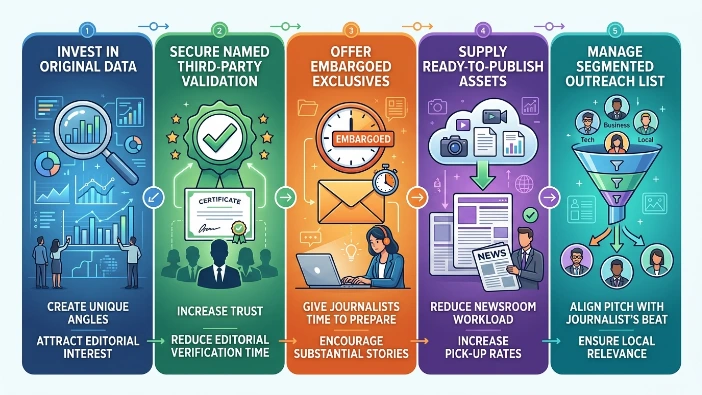
Key lessons: invest in original data, secure named third-party validation, offer embargoed exclusives, supply ready-to-publish assets, and manage a segmented journalist outreach list.
Original data creates exclusive angles that attract editorial interest. Third-party validation increases trust and reduces editorial verification time. Embargoed exclusives give journalists time to prepare substantial stories. Ready-to-publish assets reduce newsroom workload and increase pick-up rates. Segmented outreach ensures each pitch aligns with a journalist’s beat and local relevance.
For broader context on why many event stories fail editorial pickup, see:
Why 80% of UK Corporate Event Stories Never Reach a Single News Outlet
The summit’s result 38 published news articles in 5 days followed a repeatable process: commission original research, prepare comprehensive press assets, provide named spokespeople and third-party validation, manage embargoes carefully, and execute targeted outreach with facilitation for editorial use. These steps convert event content into verifiable journalism and measurable media outcomes.
For strategic comparisons of coverage formats, see:
Live Event Coverage Formats: Which Gets the Most UK Shares — Video, Live Blog or Recap?



