An events media coverage service is a managed offering that plans, executes, and evaluates media outreach for an event, from initial setup through post-event publishing and reporting. The service centralises media strategy, journalist outreach, asset production, on-site handling, and measurement. Entities: “service” = contracted set of deliverables and responsibilities; “media coverage” = earned editorial placements across press, trade, broadcast, and social channels; “event” = any live, virtual, or hybrid convening with agenda, speakers, and attendees. Contracts specify timelines, deliverables, and performance metrics such as placement counts and reach.
Why use a full-package media coverage service for UK events?
A full-package service aligns editorial outreach with event objectives, secures higher-quality placements, and provides measurable business impact tailored to UK media rhythms. UK editorial calendars operate on fixed deadlines and regional priorities.
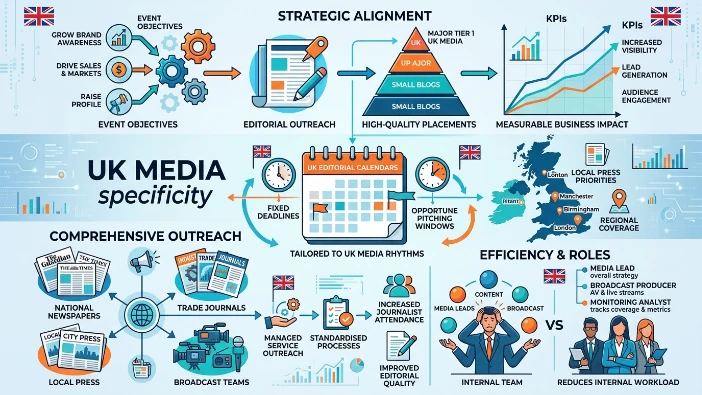
A managed service schedules outreach to match those cycles. The service provides UK-specific outreach to national newspapers, trade journals, local press in London/Manchester/Birmingham, and broadcast teams. The offering standardises processes that increase journalist attendance and editorial quality. It also reduces internal workload by assigning roles such as media lead, broadcast producer, and monitoring analyst.
When should organisations contract a coverage service?
Contract the service 10–16 weeks before the event for planning, or 16–24 weeks for product launches and policy announcements requiring research and executive availability. Longer lead times support data collection, embargo coordination, and exclusive placements. For annual trade shows, include the service in the annual event calendar at least six months ahead. Shorter timelines of four weeks limit national coverage and reduce options for exclusives. Contract terms define start date, milestones, and approval gates for materials.
Who performs the core roles in a full-package service?
Core roles include a media strategist, PR executive, content producer, broadcast producer, on-site media handler, and monitoring analyst, each with defined responsibilities. The media strategist sets objectives and outlet priorities. The PR executive conducts outreach and manages journalist relationships. The content producer writes releases, bios, and factsheets. The broadcast producer prepares video and B-roll. The on-site media handler manages registration and interview logistics. The monitoring analyst collects clippings, calculates reach, and compiles the coverage report. Contracts assign primary contacts and escalation paths.
What is the step-by-step process from setup to publish?
The process follows setup, asset creation, targeted outreach, on-site facilitation, release publishing, and post-event reporting with measurable KPIs at each stage. Setup begins with a 1–2 hour discovery session and a written media brief. Asset creation produces press releases, embargoed fact sheets, high-resolution images, and short video clips. Targeted outreach sends personalised pitches to a segmented media list with follow-ups. On-site facilitation provides a dedicated media desk, interview room, and technical support. Release publishing distributes embargoed releases and publishes post-event summaries within 24–48 hours. Post-event reporting compiles placements, calculates reach, and analyses message accuracy against set KPIs.
Which deliverables does a comprehensive package include?
Deliverables normally include a media brief, media list, three press releases, a media kit, B-roll and stills, journalist scheduling, on-site media management, live publishing, and a coverage report. The media brief outlines objectives and spokespeople. The media list contains 20–40 targeted contacts. Three press releases cover pre-event news, day-one highlights, and post-event outcomes. The media kit bundles bios, factsheets, and assets. B-roll and stills provide broadcast-ready footage. Journalist scheduling reserves interview slots and manages exclusives. On-site media management includes a staffed press desk and Wi‑Fi. The coverage report presents placements, reach, engagement, and lead referrals.
How do pricing models and scopes vary?
Pricing models use fixed packages, modular add-ons, or retainer-based engagements, with scopes defined by outlet count, asset volume, and on-site presence. Fixed packages specify deliverables and price points. Modular add-ons allow extra assets, additional outreach hours, or extended monitoring. Retainers support multiple events across a year with a monthly fee and agreed deliverable cadence. Scope variables: number of target outlets (for example 20, 40, 80), number of press releases (1–5), and level of on-site support (media desk only versus full technical broadcast support). Contracts list payment milestones and cancellation terms.
Which KPIs measure success in a context?
KPIs include placement count, combined audience reach, quality score for outlet tiering, message accuracy percentage, referral traffic from UTM links, and attributable leads. Set numeric targets up front, for example 20 placements, combined reach of 3 million, 85% message accuracy, and 500 referral visits. Classify outlets into tiers such as national, trade, and regional, and weight placements accordingly. Use UTM-tagged links to attribute referral traffic and capture lead forms on event landing pages. Produce a one-page executive summary and a detailed media dashboard for deeper analysis.
How does on-site media management improve outcomes?
On-site media management provides registration priority, interview scheduling, technical support, and rapid asset delivery, which increases journalist productivity and placement speed. A staffed media desk handles badge priority and fast registration. Interview scheduling reserves times for spokespeople and journalists. Technical support ensures upload speed for images and video. Rapid asset delivery sends edited highlights and quotes within 24–48 hours, enabling quick publishing. On-site management also collects immediate journalist feedback for post-event action.
What legal and compliance checks are required?
Legal checks include vetting claims, verifying data sources, securing speaker consents, and confirming embargo terms with documented agreements. Fact-check all data points against primary sources and attach citations in fact sheets. Secure written consent for personal data and image use from speakers and attendees. Confirm embargo acceptance in writing for exclusives. Check competition and advertising rules if sponsors appear in editorial materials. Retain audit logs for each asset and consent record for regulatory review.
What benefits justify a full-package investment?
Benefits include higher editorial pickup, faster publishing, measurable lead attribution, improved sponsor value, and reduced internal resource strain. Managed campaigns deliver placements in target outlets and faster publishing timelines. UTM tracking shows direct referral traffic and leads. Press clippings and broadcast segments create sponsor deliverables for sponsorship agreements. The service frees internal staff from outreach tasks and reduces operational risk through defined roles and processes.
Which use cases suit a packaged coverage approach?
Use cases include product launches, regulatory announcements, executive briefings, industry conferences, and trade-show pavilions where editorial visibility drives commercial outcomes. Product launches require timed embargoes and demo scheduling. Regulatory announcements need vetted fact sheets and accessible spokespeople. Executive briefings benefit from national interview placement. Industry conferences and trade-show pavilions need continuous on-site media handling for multiple spokespeople. Map the package scope to the event type and expected editorial complexity.
Explore More Expert Insights:
Events Media Coverage Packages: What to Expect, What to Demand
How One UK Conference Reached 2M Readers With Multi-Site Media Coverage
How to select and contract a coverage provider?
Select providers based on case studies, outlet relationships, team roles, sample deliverables, pricing transparency, and measurable KPIs in the contract. Request case studies showing quantified placements and reach. Verify media relationships for relevant UK outlets. Confirm team composition and availability. Ask for sample deliverables such as press releases and media kits. Insist on transparent pricing and clear KPI definitions in the contract. Define reporting cadence and approval workflows.
What are the immediate next steps to implement this service?
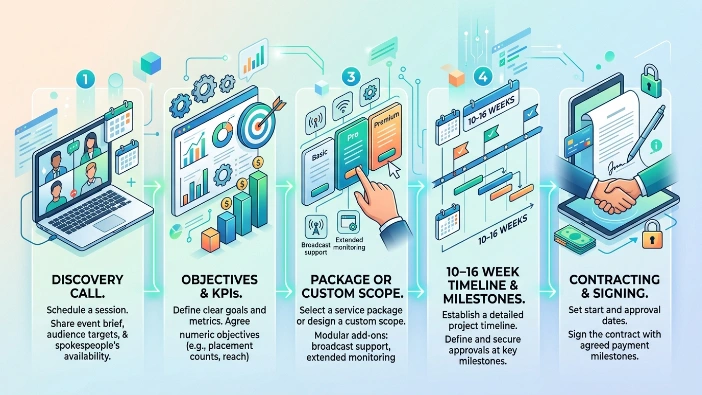
Schedule a discovery call, define objectives and KPIs, select a package or build a custom scope, and set a 10–16 week timeline with milestone approvals. Use the discovery call to share event brief, audience targets, and spokespeople’s availability. Agree numeric objectives such as placement counts and reach. Choose a package or specify modular add-ons for broadcast support or extended monitoring. Set start and approval dates and sign the contract with payment milestones.
Learn Everything About It Here:
Events Are B2B’s Second-Highest Marketing Investment in 2026: Is Coverage Keeping Up?
A full-package events media coverage service delivers end-to-end media strategy, tailored UK outreach, on-site facilitation, legal compliance, and measurable outcomes that link editorial pickup to business objectives.
Explore More Expert Insights:
Events Media Coverage Service: What a Full Package Includes From Setup to Publish