

GEO traffic is user attention captured through geographic and contextual signals without a traditional search-result click; SEO traffic is user visits originating from search-engine results pages via clicks. GEO relies on location data, device signals, and content surfaces; SEO relies on ranking, links, and query relevance.
GEO stands for geographic engagement outcomes produced by location-aware platforms, mapping services, and contextual content placements. GEO surfaces include map packs, knowledge panels, local search widgets, push notifications tied to location, and rich snippets shown directly on search-engine results pages. These surfaces present answers, contact details, directions, or offers without requiring a click to a publisher site.
Search Engine Optimisation is the practice of improving a web property to rank for queries on search engines, producing organic clicks to a site. SEO includes on-page content, structured data, backlinks, technical performance, and user signals. SEO traffic measures sessions that originate when users click search-engine results to land on a website.
GEO delivers information inside the search or map interface using signals like latitude/longitude, IP geolocation, and app-level permissions. GEO reduces the need for navigation to a third-party page. SEO requires a navigation step and depends on ranking position, anchor text relevance, and organic snippets. GEO dominates high-intent, local queries where action (call, route, reserve) is the goal.
Why does 58% of high-intent traffic arrive without a click?
Search engines and platforms now provide direct answers, actions, and local details in results; this shifts high-intent interactions to zero-click experiences. Structured data, local indexing, and integrated action buttons cause users to act inside the results page.
Search engines and mapping platforms expanded rich results and action-oriented features over the last five years. Rich results display phone numbers, hours, booking widgets, and product availability. Mapping platforms integrate live inventory and local-business profiles. These features remove the navigation step by letting users call, request directions, or book inside the interface.
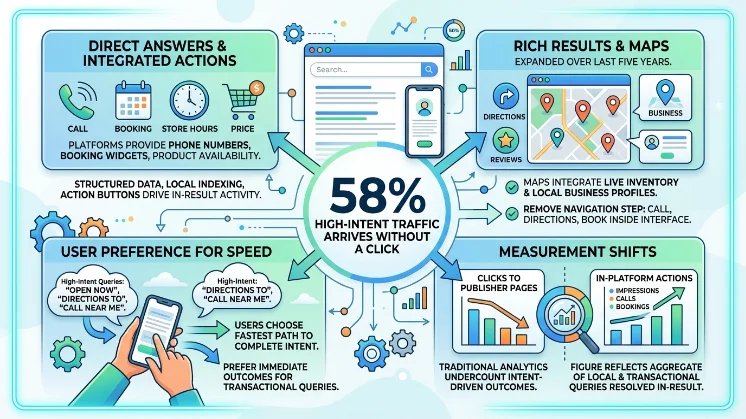
Users prefer immediate outcomes for transactional queries. High-intent queries such as “open now,” “directions to,” or “call near me” have clear action paths. Platforms present those actions directly. Users choose the fastest path to complete an intent. This behavior produces measurable reductions in clicks to publisher pages.
Analytics that count only clicks undercount intent-driven outcomes. Platforms report impression and action metrics separate from publisher referral sessions. When platforms report high rates of in-platform actions, the share of high-intent interactions that do not produce a click rises. The 58% figure reflects an aggregate of local and transactional queries where platforms provide in-result resolution.
How do platforms capture intent without a click?
Platforms capture intent through structured data, API integrations, real-time location signals, and action buttons embedded in results. These elements allow users to complete tasks inside the platform.
Schema markup on websites feeds knowledge panels and entity databases. Platforms ingest business hours, menus, product SKUs, and event details from structured feeds. Platforms then display that data in result cards.
Booking APIs, reservation systems, inventory feeds, and delivery integrations allow platforms to perform transactions. Platforms connect to point-of-sale and reservation systems to confirm availability and finalise actions without redirecting users.
Platforms use device GPS, IP geolocation, and Wi-Fi triangulation to provide hyperlocal results. Device-level permissions allow apps to suggest nearby services proactively. These signals let platforms present immediate, contextually relevant options.
Results include click-to-call, directions, booking, and order buttons. These enable conversion events from the result layer itself. Metrics for these actions exist in platform dashboards rather than publisher analytics.
What are the implications for content and SEO strategies?
Content and SEO must prioritise structured data, local presence signals, and answer-focused content to remain visible within zero-click environments. SEO now includes optimising for in-result actions and entity authority.
Implement authoritative schemas for business, product, event, and FAQs. Use precise fields: operating hours with exception dates, product identifiers like GTIN, availability status, and price ranges. Ensure structured feeds update in real time to match inventory and schedule changes.
Local presence management: Maintain accurate listings across major platforms and mapping services. Confirm consistent NAP (name, address, phone) formatting. Update profile attributes such as service areas, accepted payments, and appointment URLs. Validate listings through platform verification to gain trust signals.
Produce concise, factual answers to high-intent queries. Use clear attributes like “open now,” “appointment required,” and “service duration: 30 minutes.” Place these facts in machine-readable formats and on visible page elements so platforms can extract them for result cards.
Ensure pages load quickly and return consistent structured-data responses. Platforms prefer fresh, fast sources. Optimise server responses and ensure hosted APIs return the same canonical information used in structured data.
Track in-platform action metrics, impressions, and direction requests. Correlate platform action data with business outcomes like calls, visits, or bookings. Adjust success metrics beyond organic clicks to include action completion rates.
Which components form a GEO-optimised presence?
A GEO-optimized presence consists of accurate local listings, structured data feeds, transactional API integrations, verified platform profiles, and consistent identity signals. Each component supports zero-click interactions.
Profiles on mapping platforms with exact addresses, categories, business hours, and service options. Listings must match official registration and local citations.
Structured data feeds: JSON-LD or Microdata exposing entity attributes: address, contact, opening hours, accepted payments, aggregate ratings, and product availability. Use feed automation for frequent updates.
Transactional integrations Booking and ordering APIs connected to platform partners. Confirm secure endpoints, capacity limits, and synchronous status updates for availability.
Platform verification reduces friction and improves placement in result features. Complete verification steps and retain record of verification tokens and ownership proofs.
Uniform business name, address format, and phone number across web properties, directories, and social accounts. Identity consistency reduces ambiguity in entity resolution.
What benefits does prioritising GEO yield for businesses and publishers?
Prioritising GEO increases direct actions, reduces friction in local conversions, and improves discoverability for high-intent queries. This drives measurable outcomes like calls, visits, and bookings even when clicks decline.
Higher action rates: Businesses capture calls, maps directions, and bookings directly from result surfaces. These actions frequently convert at higher rates than organic site visits because intent is explicit.
Users complete tasks without loading external pages. Conversion windows shorten and abandonment from slow pages decline.
GEO optimisation increases chances of appearing in map packs, knowledge panels, and local widgets. Presence in these features raises overall impressions for local queries.
Real-time inventory and booking integrations reduce double-booking and mismatched availability. This improves customer experience and lowers dispute volume.
While click-based traffic may decrease, measurable business outcomes from platform actions provide alternative ROI signals. Businesses shift focus to action completion metrics.
Explore More Expert Insights:
What the £5.87M UK PR Market Growth Means for Brand Visibility in 2026
6 Reasons UK Journalists Delete 90% of Press Releases Before Reading Them
When should publishers and marketers prioritise GEO over traditional SEO?
Prioritise GEO when queries are local, transactional, or tied to immediate physical actions; prioritise SEO for informational, discovery, and long-form content needs. Match optimisation to user intent and conversion pathways.
Local retail and services: Restaurants, clinics, repair shops, and appointment-based businesses should prioritise GEO. Users search for “near me,” “open now,” or “book” with immediate intent.
Time-sensitive inventory: Businesses with perishable availability, like event ticketing or same-day delivery, benefit from real-time GEO integrations.
Franchise and multi-location operations: Chains and franchises need consistent location data, verified profiles, and structured feeds to manage local demand.
Newsrooms, guides, and educational sites should maintain SEO for discovery and depth. SEO remains essential when queries require analysis, comparison, or long-form content.
Many organisations require both approaches. Use structured data and local feeds for transactional intents, and maintain authoritative, indexed content for discovery and long-form queries.
Discover the Full Information:
Newswire vs Managed Distribution: A Side-by-Side Performance Breakdown
How should organisations measure success in a zero-click landscape?
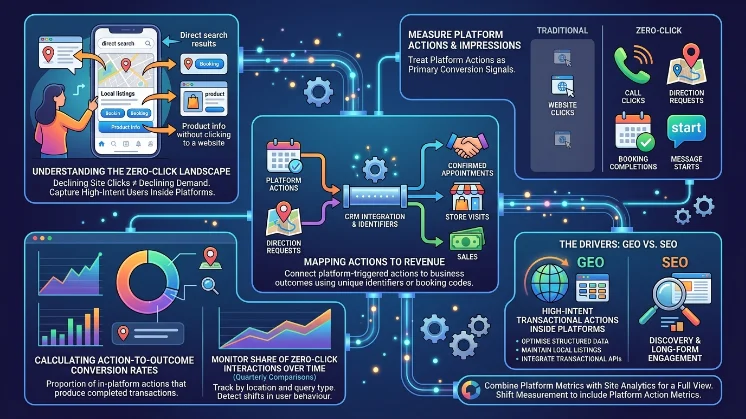
Measure impressions, in-platform actions, direction requests, calls, and bookings in addition to referral clicks; align analytics with platform-provided metrics and business KPIs. Treat platform actions as primary conversion signals for local and transactional queries.
Platform metrics: Use dashboards for action counts such as call clicks, direction requests, booking completions, and message starts. Export platform reports regularly.
Map platform actions to downstream CRM events like confirmed appointments, store visits, and sales. Use unique identifiers or booking codes to connect platform-triggered actions to revenue.
Calculate action-to-outcome conversion rates: proportion of in-platform actions that produce a completed transaction. Track by location and by query type.
Monitor share of zero-click interactions across query cohorts. Compare historical data quarterly to detect shifts in user behaviour.
Combine platform action metrics with site analytics to get a full view of intent capture. Recognise that declining site clicks does not equal declining demand.
GEO captures high-intent user actions inside platform surfaces using structured data, location signals, and transactional integrations. SEO continues to deliver discovery and long-form engagement, but GEO dominates local and transactional intent. Organisations must optimise structured data, maintain accurate local listings, integrate transactional APIs, and shift measurement to include platform action metrics. This approach preserves visibility and captures a larger share of high-intent outcomes even when fewer users click through to publisher sites.
Explore More Expert Insights:
PR Distribution Pricing in the UK: What £500, £2K and £10K Buys You



