
Press releases remain one of the most widely used communication formats between organisations and newsrooms. They provide structured information about announcements, research, events, partnerships, product launches, and public developments. Despite their widespread use, most press releases never receive editorial attention. Many UK journalists delete them before reading beyond the subject line because the content fails to meet newsroom requirements.
Understanding why press releases are ignored helps organisations improve communication quality, produce relevant information, and match editorial expectations. This article explains the most common reasons UK journalists reject press releases before reading them and outlines the characteristics of content that receives attention.
Why do UK journalists delete most press releases before reading them?

UK journalists delete most press releases because the content lacks relevance, contains weak news value, uses poor formatting, targets the wrong audience, arrives at unsuitable times, and fails to provide immediate editorial usefulness. These issues prevent efficient newsroom decision-making and reduce the likelihood of publication.
Modern newsrooms receive hundreds of emails every working day. National publications often receive several hundred press releases before midday. Journalists work under strict editorial deadlines and limited time. Every incoming email competes against breaking news, scheduled reporting, interviews, and editorial planning.
Editors scan subject lines and introductory sentences within seconds. Messages that fail to communicate immediate news value rarely progress beyond this initial review.
Newsrooms prioritise efficiency
Journalists evaluate relevance before reading details. If the headline or opening paragraph fails to explain why the story matters today, the email often leaves the inbox immediately.
Why does weak news value cause immediate rejection?
Press releases without genuine news value fail editorial assessment because they do not present new, relevant, timely, or publicly significant information. Journalists prioritise developments that affect readers, industries, policies, communities, or measurable outcomes instead of routine business activity.
News value determines whether information deserves editorial coverage. Every press release competes against current events, government announcements, economic developments, scientific research, and local community stories.
Examples include office relocations without community impact, minor organisational milestones, unchanged annual activities, or leadership appointments lacking broader significance.
What defines strong news value?
Strong news value includes measurable developments that affect identifiable audiences. Examples include published research findings, verified survey data, economic statistics, regulatory changes, public infrastructure projects, healthcare developments, education policy updates, environmental initiatives, and nationally relevant community programmes.
Why does poor targeting reduce open rates?
Poor targeting causes journalists to ignore press releases because irrelevant content wastes editorial time. Reporters specialise in defined subjects, geographic regions, industries, or publication categories, making accurate audience selection essential for editorial relevance.
Local publications also require geographically relevant stories. A community newspaper serving Manchester rarely publishes routine announcements affecting Cornwall unless national importance exists.
Why does journalist specialisation matter?
Beat reporting improves subject expertise. Technology reporters expect technology developments. Financial correspondents expect economic information. Political journalists expect government policy. When press releases ignore editorial specialisation, they lose relevance before opening.
Readers seeking practical guidance on media targeting can continue with:
How to Build a UK Media Distribution List That Gets 4× More Opens
Why do unclear headlines and introductions lead to deletion?
Unclear headlines and lengthy introductions prevent journalists from identifying the story quickly. Editors require immediate understanding of the announcement, supporting evidence, and public relevance within the opening sentences of every press release.
Subject lines influence whether journalists open an email. The headline inside determines whether they continue reading.
Effective headlines communicate one clear development using precise language. Generic wording delays understanding. Similarly, introductions containing promotional descriptions instead of factual information slow editorial evaluation.
Why does promotional language reduce editorial credibility?
Promotional language weakens editorial credibility because journalists require factual information rather than advertising messages. Objective evidence, measurable data, and verifiable statements support newsroom standards more effectively than exaggerated descriptions or marketing terminology.
Words such as “revolutionary,” “best,” “leading,” “world-class,” or “unmatched” provide opinions instead of verifiable facts. Journalists remove subjective claims during editing or reject material containing excessive promotional language.
Why do formatting and structure influence newsroom decisions?
Poor formatting increases reading time and reduces editorial efficiency. Journalists prefer structured press releases containing informative headings, concise paragraphs, logical sequencing, accurate quotations, and complete contact information that supports rapid editorial assessment. Newsrooms review large volumes of information every day. Missing structure forces editors to search for essential information.
Professional formatting improves readability. The standard structure begins with the headline, followed by a factual introduction, supporting context, quotations, background information, and media contact details.
This structure allows journalists to locate facts quickly, extract quotations efficiently, and edit content for publication without extensive rewriting. Logical sequencing improves comprehension throughout the document.
Explore More Expert Insights:
How AI Search Engines Are Replacing Traditional Newswires for 800M Weekly Users
PR Distribution in the AI Search Era: 5 Brutal Statistics
Why does timing affect whether a press release gets read?
Timing affects editorial attention because journalists work around fixed publication schedules, breaking news, and newsroom deadlines. Press releases arriving during busy editorial periods receive significantly less attention than those delivered during routine planning hours.
Large national news events dominate newsroom resources. Press releases arriving during election coverage, severe weather events, major sporting occasions, government announcements, or national emergencies receive limited attention because editorial priorities shift immediately.
Daily newsroom schedules also affect email review. Morning planning meetings determine coverage priorities. Afternoon deadlines focus on publication. Late evening distribution often remains unread until the following day.
Editorial resources remain limited. When major national stories develop, journalists allocate available time to verified reporting rather than reviewing routine announcements. Timing therefore affects visibility even when press release quality remains high.
How can organisations improve press release quality?
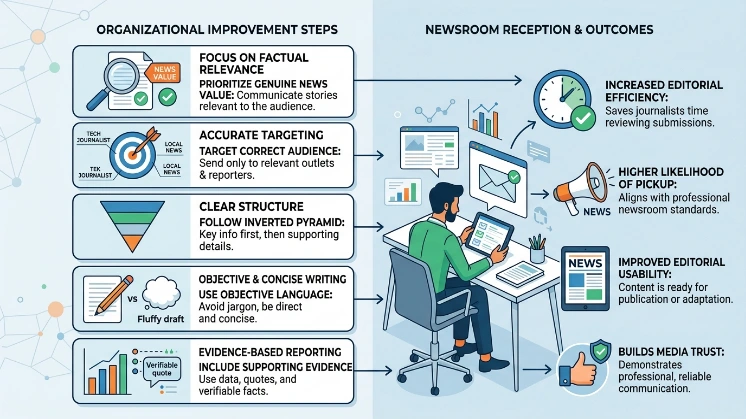
Organisations improve press release quality by focusing on factual relevance, accurate targeting, clear structure, objective language, concise writing, and evidence-based reporting. These characteristics align communication with newsroom workflows and improve editorial usability without changing journalistic standards.
Readers interested in understanding advanced distribution processes can continue with
What a Managed PR Distribution Service Does That Your In-House Team Cannot
UK journalists delete most press releases because newsroom workflows prioritise relevance, speed, clarity, evidence, and editorial usefulness. Press releases that communicate genuine news value, target the correct audience, present factual information, and follow recognised editorial structure match professional newsroom requirements more effectively.
Editorial decisions depend on efficiency rather than volume. Every press release competes for limited newsroom attention. Journalists evaluate subject lines, headlines, introductions, structure, and relevance within seconds. Messages lacking immediate news value, factual clarity, or editorial relevance rarely progress beyond this first review.
Understanding these six reasons provides a clear framework for producing informative press releases that align with UK newsroom expectations. Strong news value, accurate targeting, concise writing, objective language, logical formatting, and appropriate timing form the foundation of effective editorial communication.