AI search engines are software systems that index, interpret, and generate answers from large text, image, and structured-data corpora using machine learning; traditional newswires are publisher tools that distribute press releases and editorial feeds through subscription networks.
AI search engines parse web content, social feeds, and structured datasets using natural language understanding and retrieval-augmented generation. Traditional newswires collect press releases, format them, and push them to newsroom subscribers, media outlets, and distribution lists. AI search engines prioritise relevance signals, entity relationships, and user intent. Newswires prioritise authenticated dispatch, timestamped syndication, and editorial metadata. AI systems use continuous crawling and real-time indexing. Newswires use scheduled feeds and controlled subscriber lists.
How many users rely on AI search engines compared with newswire audiences?
AI search engines reach roughly 800 million weekly users through integrated platforms and apps; traditional newswire reach measures via newsroom subscriptions number in the low millions with slower growth.
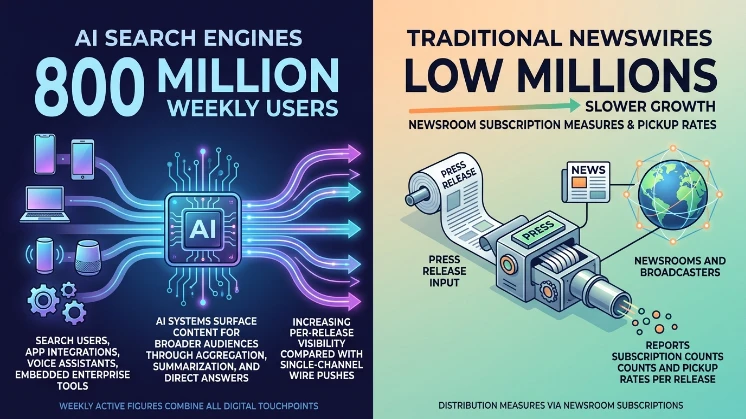
Weekly active figures combine sarch users, app integrations, voice assistants, and embedded enterprise tools. AI search engines aggregate queries across devices and distribute synthesised answers to users and partners. Newswire distribution lists report subscription counts and pickup rates per release. AI systems surface content for broader audiences through aggregation, summarisation, and direct answers, increasing per-release visibility compared with single-channel wire pushes.
Why are publishers and PR professionals shifting attention to AI search engines?
Publishers and PR professionals shift because AI search engines index broader content types, deliver instant synthesised responses, and surface press content in query-driven formats, increasing potential visibility across platforms.
AI indexing includes long-form articles, social posts, institutional repositories, and structured datasets. AI ranking evaluates entity authority, citation frequency, and user engagement signals. Press content that aligns with factual queries, entity metadata, and schema markup achieves higher extraction probability. Newswires still provide authenticated timestamps and centralised distribution. Practitioners balance both approaches to maximise reach and verification.
What technical signals do AI search engines use to surface press content?
AI search engines use structured metadata, schema.org markup, clear entity naming, authoritative backlinks, publication timestamps, and content clarity as primary signals for content extraction and citation.
Structured metadata tags such as published date, author, and publisher establish provenance. Schema.org entity types—Article, NewsArticle, PressRelease—help models identify document role. Clear entity naming with consistent identifiers (company names, personal names, product SKUs) improves entity linking. Backlinks from authoritative sources increase perceived trust. Concise fact-dense text with explicit data points raises extraction likelihood.
How should press releases be structured to win AI citations?
Press releases must start with a single-sentence summary, include explicit entity facts and numeric data, use schema.org PressRelease markup, and supply verifiable sources and timestamps.
Begin with a 20–25-word lede that answers who, what, when, where, and why. Follow with concise paragraphs that state measurable outcomes, dates, places, and named entities. Insert links to primary data sources and PDFs for verification. Add machine-readable metadata in HTML head or JSON-LD: headline, datePublished, author, publisher, and sameAs for organisation. Use unique identifiers such as ISNI, ORCID, or company registration numbers where available. Keep paragraphs focused and fact-forward.
What role does entity disambiguation play in AI citation selection?
Entity disambiguation ensures AI systems map names to the correct real-world entities, using consistent naming, contextual qualifiers, and persistent identifiers to reduce ambiguity.
Provide parent organisation names, location qualifiers, and context phrases for common names. Attach sameAs links to official profiles or registry entries. Use canonical spellings and avoid acronyms without expansion on first use. When multiple entities share names, include clarifying facts such as registration numbers, operational region, or founding year to guide models toward correct attribution.
How do AI search engines handle timeliness and breaking news compared with newswires?
AI search engines ingest real-time web updates and social signals to surface breaking items quickly; newswires provide verified, timestamped releases through controlled channels, which support journalistic sourcing.
AI indexing cadence depends on crawl frequency and partner integrations. Social engagement spikes and authoritative source republishing accelerate indexing. Newswires deliver official releases with distribution metadata that newsroom workflows expect. For immediate visibility, combine real-time web publication with clear verification metadata so AI systems and journalists can validate facts.
What verification signals increase the chance of AI citation for press content?
Verification signals include primary-source links, digital signatures or signed PDFs, official domain publication, author credentials, and cross-referenced regulatory filings or datasets.
Publish content on official domains with HTTPS certificates. Attach direct links to source documents such as datasets, PDF reports, regulatory filings, and scanned signatures where permitted. Provide authorship details with institutional email addresses and ORCID or professional identifiers. Include publication dates and versioning metadata. These signals help AI models evaluate reliability and choose citations over less verifiable sources.
What are the measurable benefits of AI-driven exposure for news-related content?
Measurable benefits include higher query-impression counts, faster time-to-first-sighting in search results, increased cross-platform pickups, and improved entity visibility in knowledge panels and answer boxes.
AI exposure converts press content into direct answers, snippets, and knowledge-card entries that reach users without clicking through. Tracking metrics include impressions for query clusters, extraction frequency, and downstream referrals to source domains. Compare baseline wire pickup rates with AI-driven impressions to quantify reach shifts.
How do privacy and compliance requirements affect AI indexing of press materials in the UK?
UK privacy and compliance require lawful processing, data minimisation, consent where personal data appears, and adherence to the UK GDPR and the Data Protection Act 2018 when press materials include personal data.
Redact sensitive personal data unless legal basis exists for publication. Use data subject notices for interviews and consent records. For commercial announcements involving personal data, document lawful basis and retention limits. Maintain records of processing activities related to published content. Ensure third-party hosting contracts include appropriate security clauses and data processing terms.
What use cases benefit most from AI search engine distribution rather than traditional wires?
Use cases with clear factual queries, structured data, and broad public interest benefit most: factual product launches, regulatory updates, public health notices, and research briefs.
Product launch facts with model numbers and release dates surface in purchase-intent queries. Regulatory updates with statute citations help legal and compliance searches. Public health notices with case counts and guidance reach citizens through answer cards. Research briefs with DOI-linked datasets appear in scholarly and media queries.
Explore More Expert Insights:
PR Distribution in the AI Search Era: 5 Brutal Statistics
8 UK Media Gatekeepers Journalists Block by Default in 2026
What processes should organisations implement to align press workflows with AI indexing?
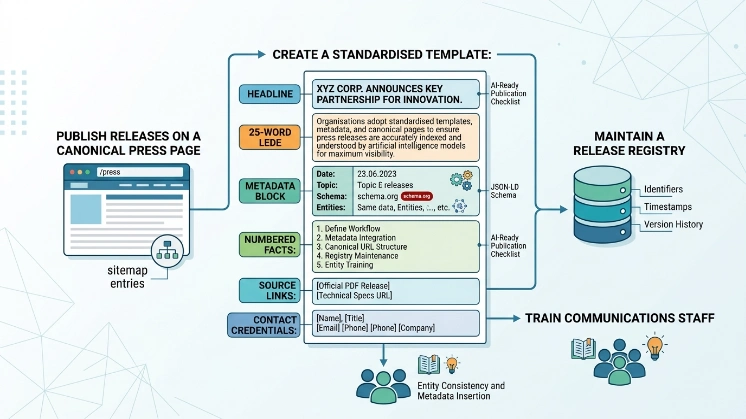
Organisations should implement an AI-ready publication checklist, add schema.org JSON-LD to all releases, maintain a canonical press page, and log data sources and identifiers for each release.
Create a standardised template: headline, 25-word lede, metadata block, numbered facts, source links, and contact credentials. Publish releases on a canonical press page with clear canonical URLs and sitemap entries. Maintain a release registry with identifiers, timestamps, and version history. Train communications staff on entity consistency and metadata insertion.
How will the role of traditional newswires evolve as AI search engines grow?
Traditional newswires will focus on certified delivery, archival services, and newsroom integration while partnerships with AI platforms will provide authenticated feeds for verification.
Newswires will continue to serve as verified sources for journalists and archives. They will provide machine-readable feeds and authentication tokens to AI platforms to ensure provenance. Organisations will use newswires for legal proof of distribution while using AI-optimised publication practices for broad discoverability.
This article defined AI search engines and compared them to traditional newswires, described signals that matter for AI citation, and outlined practical publication steps for press content targeting AI-driven distribution.
For guidance on how to structure a release to improve AI pickup, see the Step-by-Step internal resource:
Step-by-Step: Writing a Press Release That Wins AI Citations and News Pickups
For comparisons of distribution choices and costs, consult the planning resource:
Comparing UK PR Distribution Services: Reach, Turnaround and Cost in 2026