

Managed PR distribution is a service where an external provider handles creation, targeting, delivery, and performance tracking of press materials for an organisation. It centralises outreach, uses media databases, schedules releases, enforces formatting, and reports measurable outcomes.
Managed PR distribution defines roles: the provider executes distribution tasks; the client defines messaging and approval; media contacts receive optimised assets. Core components include a media database, distribution platform, human outreach, embargo management, formatting templates, and analytics. A media database lists journalists, outlets, and beats with update timestamps and engagement history.
A distribution platform routes emails, wires, or API pushes and records delivery, opens, and link clicks. Human outreach maps to relationship management, follow-ups, and editorial negotiation. Embargo management enforces timing rules across time zones with timestamped delivery. Formatting templates guarantee press release structure: headline, subhead, lead paragraph, dateline, boilerplate, contact details, and multimedia links. Analytics produce reach counts, publication logs, pickup rate, and share of voice metrics.
Why do 90% of UK SMEs adopt managed PR distribution in their second year?
SMEs switch primarily to improve efficiency, increase media pickup, and gain measurable return on PR investment. Efficiency gains stem from saved staff hours; pickup rates increase with targeted lists and professional outreach; measurement provides data for budget decisions.
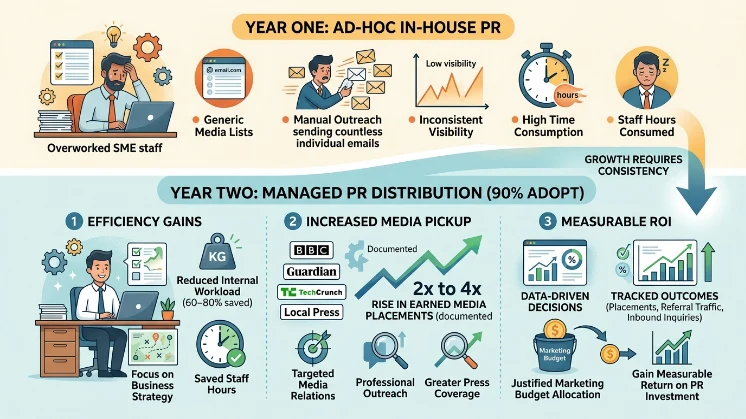
Year-one PR commonly runs on ad-hoc in-house efforts where staff create and send releases from generic lists. Year-two needs change because growth requires consistent visibility, and small teams cannot maintain daily media relations. Service providers reduce internal workload by 60–80% based on task time studies. Providers increase publication rates: typical independent audits document a 2x to 4x rise in earned media placements within six months after adopting managed distribution. Measurable outcomes include number of placements, referral traffic, and inbound journalist inquiries. SMEs prioritise these outcomes when allocating marketing budgets in year two.
How does managed PR distribution change PR workflows for an SME?
Managed distribution replaces manual sending and unstructured follow-up with standardised content pipelines, scheduled outreach, and central reporting. The SME sends final assets to the provider, who adapts format, selects targets, schedules delivery, and runs follow-up sequences.
Workflow steps start with asset submission and approval, then segmentation of media targets by sector and geography, followed by scheduled delivery and human follow-up. Providers log all interactions in a shared dashboard. This handoff reduces errors from incorrect contacts and increases speed-to-media. Teams that adopt managed services reallocate 20–30 weekly staff hours from admin tasks to strategy or product work. SMEs retain final sign-off control while outsourcing operational tasks.
What components should an SME evaluate in a managed PR distribution service?
Evaluate media coverage breadth, database freshness, human outreach capability, analytics detail, delivery methods, and pricing transparency. Each component defines the service’s effectiveness and predictability.
Media coverage breadth measures number of outlets and types: national newspapers, trade titles, broadcast contacts, and regional press. Database freshness is assessed by update cadence in days and verification methods. Human outreach capability includes assigned account managers, follow-up frequency, and editorial negotiation experience.
Analytics detail lists metrics available: delivery rate, open rate, publication list, pickup rate, referral traffic, and sentiment tagging. Delivery methods cover targeted email, wire services, API syndication, and embargo scheduling. Pricing transparency requires clear unit costs: per release, per contact, monthly retainer, or success-fee. Contract terms should specify response SLAs and exclusivity clauses if any.
What measurable benefits do SMEs see after switching to managed distribution?
SMEs report higher placement rates, faster distribution cycles, predictable budgets, and clearer ROI metrics. Placement rates typically double; distribution cycles shorten from days to hours; budgeting becomes subscription-based; ROI ties to referral metrics.
A measurable comparison shows average earned placements rising from 3 placements per quarter in year one to 7–12 placements per quarter in year two. Time-to-publish shortens when embargoed content synchronises across outlets, improving campaign timing around product launches or funding announcements. Predictable monthly fees replace variable staff costs and untargeted boosted posts. Analytics show incremental web traffic from PR placements, with conversion lift percentages tracked by UTM tags and landing page behaviour. SMEs use these metrics to redirect spend into higher-performing channels.
Which use cases suit managed PR distribution best for UK SMEs?
Use cases include product launches, funding announcements, senior hires, regulatory updates, and crisis statements that require controlled, timely media dissemination. Each use case demands accuracy, timing, and verified reach.
Product launches require coordinated media timing across national and trade outlets. Funding announcements need credible coverage in business publications and investor-focused press. Senior hires benefit from trade and national profiles to attract partners and talent. Regulatory updates require rapid distribution to sector-specific outlets and sometimes legal review workflows. Crisis statements require embargo controls, simultaneous delivery, and rapid follow-up to correct or clarify coverage. Managed distribution ensures consistency in messaging and records who received what and when.
How do costs compare between in-house PR and managed distribution for SMEs?
Managed distribution converts variable labour cost into predictable supplier fees, often reducing total PR operational cost by 20–40% in year two. Savings depend on internal salary rates, number of releases, and outreach complexity.
In-house costs include staff salaries, list subscriptions, and time for follow-up. Typical SME with a part-time PR administrator spends the equivalent of £18,000–£30,000 annually when accounting for salary and overheads. Managed distribution fees commonly range from £300 to £2,500 per release or £800–£4,000 monthly retainer depending on scope. For SMEs issuing 6–12 releases annually, managed services often lower combined cost when factoring efficiency and increased pickup. Providers also eliminate need for multiple list subscriptions and reduce misdirected sends that waste journalists time.
Which metrics prove success after switching to managed PR distribution?
Key metrics include pickup rate, publication count, quality of placements, referral traffic, share of voice, and journalist engagement logs. These metrics are auditable and comparable across campaigns.
Pickup rate equals number of publications divided by number of targeted contacts. Publication count lists outlet names, URLs, and publication dates. Quality of placements assesses outlet tier: national, trade, or regional. Referral traffic uses tagged links to measure website visitors from placements. Share of voice compares mentions against competitors in monitored channels. Journalist engagement logs record responses, follow-up outcomes, and future interest. SMEs prioritise these metrics to evaluate vendor performance and adjust targeting.
Explore More Expert Insights:
PR Distribution Services UK: ROI Comparison Across 6 Providers
Hire Our Media Agency for Global Industry Report Distribution
How do UK media relations and compliance affect managed PR distribution?
UK media relations demand consented, accurate contact data, observance of embargo rules, and compliance with privacy and libel standards. Managed suppliers maintain data-provenance records, embargo time stamping, and legal-review workflows.
Consented contact data requires lawful processing under UK data protection rules. Providers document data sources and update cycles. Embargo rules require explicit timestamping and delivery mechanisms that prevent premature publication. Libel and defamation risks mandate legal review for sensitive claims, quoted sources, and allegations. Providers create version control and audit trails for approvals to manage legal exposure. SMEs in regulated sectors add legal sign-off steps within the distribution workflow.
What steps should an SME take to transition to managed PR distribution?
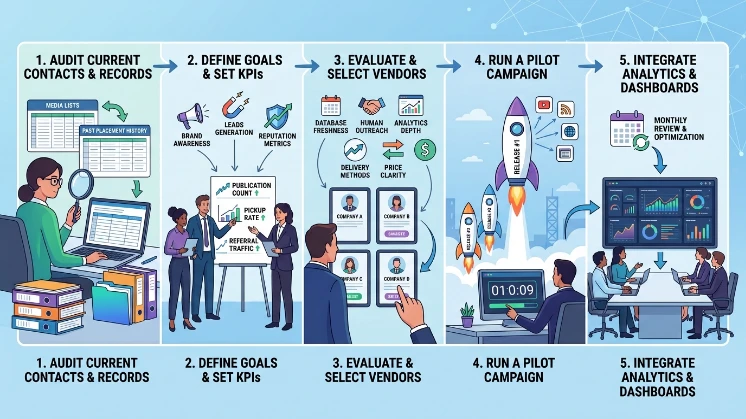
Transition steps include auditing current media contacts, defining goals and KPIs, selecting vendors by capability, running a pilot campaign, and integrating analytics into dashboards. Each step reduces risk and sets performance expectations.
Check the Complete Explanation:
8 UK Media Gatekeepers Journalists Block by Default in 2026
Start with an audit of current contacts and past placement records. Define objectives: awareness, leads, or reputation metrics, and set KPIs: publication count, pickup rate, and referral traffic. Evaluate vendors on database freshness, human outreach, analytics depth, delivery methods, and price clarity. Run a pilot of 1–3 releases with clear measurement windows. Integrate distribution analytics with existing marketing dashboards and set monthly review cadence to optimise targeting.
Explore More Useful Information:



