

An industry report is a structured research document that defines a market, quantifies opportunity, and identifies buyer behaviour; UK organisations commission reports to generate credible leads, inform strategy, and influence procurement.
An industry report defines a sector’s size, growth rate, segmentation, and key trends. It lists stakeholders, regulatory drivers, and buyer personas. UK organisations commission reports to build trust with procurement teams, attract senior decision-makers, and create content that exchanges data for contact details. The document serves three functions: evidence for marketing, briefings for sales, and input for product teams. Entities commissioning reports include trade associations, consultancies, vendor marketing teams, and public-sector bodies. Define the intended audience clearly: procurement managers, finance directors, IT heads, or clinical leads. State the geographic scope precisely: UK-wide, regional (England, Scotland, Wales, Northern Ireland), or metro-level.
What steps form the commissioning process?
Commissioning follows five clear steps: define objectives, set methodology, appoint researchers, manage production, and plan distribution; each step requires measurable deliverables and deadlines.
Define objectives with specific metrics. Example objectives: generate 1,000 marketing leads, secure 25 executive briefings, or achieve 5 industry mentions in national press. Set a deadline date and a budget in pounds. Next, set the methodology primary research (surveys, interviews), secondary research (public datasets, industry sources), or mixed methods. Specify sample sizes and respondent profiles. Example: 500 qualified UK B2B buyers across sectors with 30% C-suite representation.
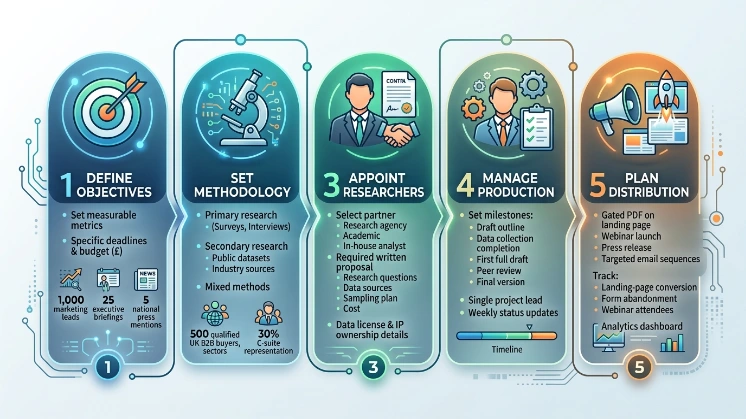
Appoint researchers by selecting a research agency, independent academic, or in-house analyst. Require a written proposal with research questions, data sources, sampling plan, and cost breakdown. Include a data license clause and IP ownership details. Manage production by setting milestones: draft outline, data collection completion, first full draft, peer review, and final version. Assign a single project lead with weekly status updates. Plan distribution: gated PDF on a landing page, webinar launch, press release, and targeted email sequences. Determine tracking: landing-page conversion rate, form abandonment rate, and webinar attendees.
What components should the report include?
A high-conversion report contains an executive summary, methodology, market sizing, segmentation, buyer insights, competitive landscape, and actionable recommendations with appendices.
Executive summary offers key findings in 200–400 words and three core statistics. Methodology lists data sources, sample sizes, fieldwork dates, and margin of error. Market sizing uses clear units: annual revenue in GBP, addressable market in number of organisations, or potential users. Segmentation defines buyer segments by industry, company size, and procurement behaviour. Buyer insights present direct metrics: 5 top purchase drivers, average decision time in months, and preferred information channels.
Competitive landscape names market leaders and their share estimates, with data sources cited. Actionable recommendations provide at least three tactical steps for marketing and sales teams tied to report findings. Appendices include raw survey tables, interview transcripts redacted for anonymity, and calculation sheets. Include clear definitions for all entities and acronyms used. Use UK-specific sources such as ONS statistics, Companies House filings, and UK government consultations when relevant.
How do you design research to produce lead-quality data?
Design research to record contactable, decision-making attributes by using closed survey fields, buyer-intent questions, and interview consent for follow-up; collect verified business email addresses and firmographic variables.
Include mandatory closed fields to capture role, company size (employee bands), industry SIC code, annual revenue bands, and procurement budget band. Ask buyer-intent questions with binary or scaled responses: purchase within 6 months (yes/no), influence level (0–10), and current vendor status (incumbent/considering supplier). Require business email verification through domain checks and use double opt-in for consent to follow-up. For interviews, secure written consent to record and to pass qualified contacts to the commissioning organisation. Use quota controls to ensure representation across sectors and seniority tiers. Track response rates and compute response-weighting where samples deviate from target quotas.
What formats and distribution channels increase lead conversion?
Gated reports, summary one-pagers, webinar launches, targeted email outreach, and social professional posts convert best when paired with segmentation-based landing pages and tracking pixels.
Offer a downloadable gated PDF requiring business email, job title, and company name. Add progressive profiling fields over multiple touchpoints to reduce form friction. Use a one-page executive summary as an open asset to drive downloads to the gated full report. Host a webinar or panel with authors and sector experts to capture live questions and qualified leads. Use targeted email sequences tailored by industry and role; include data points from the report to personalise subject lines and preview text. Post on professional networks with short excerpts and track click-throughs. Implement tracking pixels and UTMs to trace source-to-conversion. Set up CRM automation to route high-intent leads to sales for outreach within 48 hours.
What metrics define success for a lead-magnet report?
Define success by conversion rate, lead quality, engagement depth, media pickup, and downstream pipeline value with predefined numeric targets and time windows.
Set conversion targets: landing-page conversion rate of 15% and cost-per-lead (CPL) in GBP aligned with budget. Define lead quality thresholds: at least 30% of leads qualify as decision-makers (seniority score ≥7) and 20% express purchase intent within 12 months. Measure engagement: average time on page >2 minutes for the report summary and full report download-to-webinar-attendance ratio. Track media pickup: number of press mentions in national outlets and trade press within 60 days. Measure pipeline value: number of qualified opportunities created within 90 days and total pipeline value in GBP attributable to report-driven leads. Use CRM attribution to link opportunities to original download source.
Explore More Expert Insights:
Thought Leadership Reports: 8 Formats That Win UK Media Coverage
How Companies Leverage Market Studies
What legal and ethical requirements apply in the UK?
Comply with UK data protection law by securing lawful basis for data processing, issuing transparent privacy notices, and enabling data subject rights; ensure accuracy and avoid misleading claims.
Obtain consent for marketing and follow-up communications where consent is the lawful basis. Alternatively, use legitimate interests but document a balancing test. Provide a clear privacy notice on the landing page specifying data controller, retention period, and contact details. Allow data subjects to request access, correction, or deletion. For survey incentives, disclose terms and administer equally. For statistical claims, cite sources and fieldwork dates. Avoid presenting projections as guaranteed outcomes. For sector-specific research involving regulated industries, disclose any relevant conflicts of interest and funding sources.
Read the Detailed Explanation:
Why UK B2B Buyers Read 5 Reports Before Speaking to Any Vendor
What are proven use cases for industry-report lead magnets in the UK?
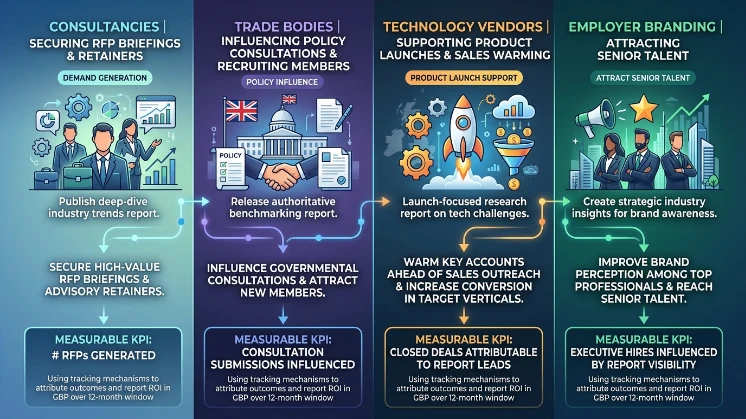
Use cases include demand generation for consultancies, policy influence for trade bodies, product launch support for technology vendors, and employer branding for sector leaders; each use case ties to measurable pipeline or engagement outcomes.
Consultancies use reports to secure RFP briefings and advisory retainers. Trade bodies use reports to influence policy consultations and recruit members. Technology vendors use reports to warm accounts ahead of sales outreach and increase conversion in target verticals. Employer branding teams use industry insights to attract senior talent. For each case, define a clear KPI: number of RFPs generated, consultation submissions influenced, closed deals attributable to report leads, or executive hires influenced by report visibility. Use tracking mechanisms to attribute outcomes and report ROI in GBP over a 12-month window.
Commission a UK industry report by defining precise objectives, designing rigorous methodology, collecting contactable buyer data, producing a structured deliverable, and executing a targeted distribution plan. Measure success with clear numeric KPIs for conversion, lead quality, engagement, media pickup, and pipeline value. Ensure legal compliance under UK data protection rules and cite authoritative UK sources.
Discover the Full Information:
Media-Published Research Reports: 4 UK Case Studies With Real Pipeline Numbers



