

UK B2B buyers consult approximately five independent reports to validate vendor claims, benchmark pricing, and reduce procurement risk before making contact. This behavior reflects a structured information-gathering process used by procurement teams, heads of department, and technical stakeholders. Buyers collect vendor-authored materials, market-analyst reports, peer case studies, regulatory guidance, and comparative white papers.
They use these sources to confirm product fit, check total cost of ownership, and identify implementation challenges. Studies of buying committees show 5–7 decision-influencers per deal and multiple written sources before outreach. The five reports often include one vendor brief, one analyst ranking, one sector-specific case study, one technical benchmark, and one compliance or regulatory review.
Why do UK B2B buyers rely on multiple reports?
Buyers rely on multiple reports to create an evidence base, reduce uncertainty, and speed internal approval. Procurement teams operate under audit requirements and budget controls. Multiple reports provide triangulation corroboration of claims, quantification of ROI, and documented risk assessments. Buyers use report comparisons to produce internal briefing packs.
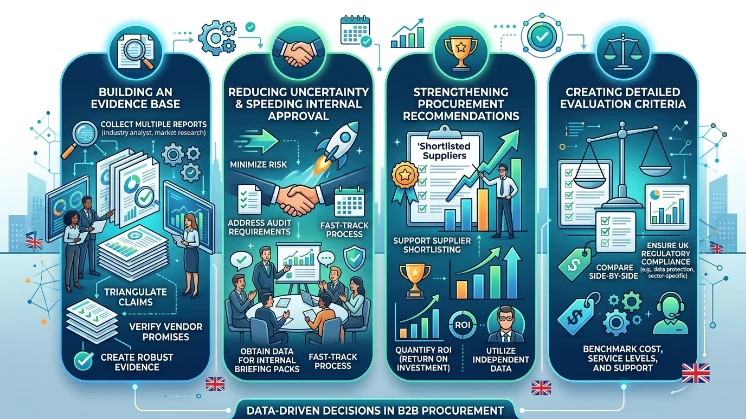
The presence of independent analyst data strengthens procurement recommendations during supplier shortlisting. Regulatory contexts in the UK, including data protection and sector-specific compliance, require documentary evidence before vendor engagement. Comparing reports also helps buyers create detailed evaluation criteria such as cost, service levels, and support commitments.
Who reads these reports within UK buying organisations?
Primary readers include procurement leads, technical managers, finance controllers, and business-unit heads; each uses reports for distinct approval tasks. Procurement leads focus on contract terms and supplier risk. Technical managers examine product architecture, integration, and benchmarks. Finance controllers verify total cost and ROI calculations. Business-unit heads assess operational fit and strategic alignment. Secondary readers include legal teams and compliance officers who check regulatory and contractual language.
Each stakeholder extracts different metrics: SLAs, mean time between failures (MTBF), payback period in months, and case-study performance numbers. Organisations with formal procurement policies normally require written justification from at least two domains (technical and financial) before vendor contact.
What types of reports do buyers prioritise?
Buyers prioritise vendor data sheets, independent analyst reports, sector case studies, technical benchmarks, and regulatory guidance. Vendor data sheets give feature lists, pricing models, and deployment options. Independent analyst reports provide market ranking and comparative scoring across vendors. Sector case studies show real-world deployments and performance metrics such as user adoption rates and time-to-value. Technical benchmarks report quantitative performance metrics like throughput, latency, and resource consumption.
Regulatory guidance explains compliance obligations and audit trails. Buyers often expect at least one independent analyst or third-party benchmark among their five sources to validate vendor-supplied claims.
How do buyers assess report credibility?
Buyers evaluate credibility by source reputation, methodological transparency, sample size, conflict-of-interest statements, and datedness. Reputable sources list methodology, sample sizes, and statistical measures. Method sections that specify sample size (for example, 200 surveyed buyers) and data collection dates increase trust. Conflict-of-interest statements identify paid sponsorship or vendor influence. Buyers check whether benchmarks use industry-standard tools and whether case studies include measurable KPIs such as 30% reduction in downtime. Reports older than 24 months receive lower weight in fast-moving markets. Clear, reproducible methods improve a report’s weight in procurement decisions.
When do buyers stop researching and contact a vendor?
Buyers contact a vendor when five corroborating reports match internal criteria for cost, risk, and technical fit and a short shortlist forms. Shortlisting begins when reports align on core metrics: acceptable total cost of ownership, demonstrable compliance, and confirmed integration paths.
Procurement timelines also influence contact timing; typical enterprise procurement cycles run 3–6 months from first research to vendor engagement for mid-market deals. Urgent projects may compress timelines to 4–6 weeks but still require the same evidence base. Contact occurs when internal stakeholders sign a go-ahead based on report evidence and predefined procurement thresholds.
How do buyers use report findings during vendor conversations?
Buyers use report findings to verify vendor claims, negotiate contract terms, and set technical acceptance criteria. Report data becomes the baseline in vendor meetings. Buyers ask vendors to explain discrepancies between their claims and independent reports.
They request contractual SLAs tied to metrics documented in benchmarks. Finance teams use ROI numbers from reports to justify budget lines. Technical teams require proof-of-concept demonstrations that reproduce reported benchmarks. Vendors who cannot align their proposals with the documented data risk failing shortlisting.
What are the benefits to buyers of this five-report approach?
The approach reduces procurement risk, shortens approval cycles, improves negotiating leverage, and increases the likelihood of successful deployments. Documented evidence supports stronger business cases, enabling faster sign-off from finance and executive stakeholders.
Multiple sources improve negotiation outcomes by providing objective cost and performance anchors. Risk mitigation improves because independent reports reveal common failure modes and integration pitfalls. Deployments show higher success rates when vendor promises match independent benchmarks used during procurement.
What limitations exist with relying on multiple reports?
Limitations include information overload, potential bias in sponsored reports, and outdated data in fast-moving technology areas. Large numbers of reports create synthesis work for procurement teams. Sponsored reports can present favourable outcomes for paying vendors. Buyers discount materially biased sources by checking methodological transparency. Rapid innovation in categories like cloud services or AI can render 12-month-old reports obsolete. Procurement teams maintain freshness by prioritising reports published within the last 12–24 months and by requiring reproducible methods.
Explore More Expert Insights:
Original Research Gets 5× More AI Citations Than Opinion Pieces
Why Are Consumer Insights Important for Your Business?
How should report authors format reports to meet buyer needs?
Authors should provide clear executive summaries, methodology sections, quantified KPIs, dated data, and conflict-of-interest disclosures. Buyers require concise executive summaries with key metrics and findings presented in numeric terms.
Methodology sections must state sample sizes, test environments, and tools used. Quantified KPIs should include percentages, timeframes, and cost figures (for example, 18% reduction in support calls, 9-month payback). Date all data and include conflict-of-interest statements. Clear appendices with raw data increase reproducibility and buyer trust.
What use cases show the five-report pattern in UK sectors
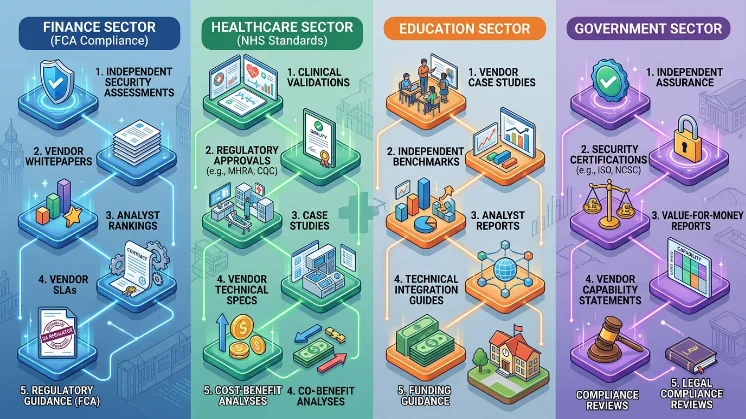
Procurement in finance, healthcare, education, and government commonly uses five reports to satisfy audit, compliance, and ROI requirements. In finance, buyers demand independent security assessments, vendor whitepapers, analyst rankings, vendor SLAs, and regulatory guidance to meet FCA requirements. Healthcare procurement requires clinical validations, regulatory approvals, case studies, vendor technical specs, and cost-benefit analyses to meet NHS procurement standards.
Education buyers use vendor case studies, independent benchmarks, analyst reports, technical integration guides, and funding guidance. Government procurement often mandates independent assurance, security certifications, value-for-money reports, vendor capability statements, and legal compliance reviews.
Related Article You Should Read:
How to Commission a UK Industry Report That Becomes a Lead Magnet
UK B2B buyers read five reports before contacting a vendor to create a documented evidence base that supports procurement decisions. The five-report pattern produces validated cost estimates, technical benchmarks, compliance proofs, and case-study evidence. Buyers use this evidence to shorten approval cycles, negotiate stronger contracts, and reduce deployment risk. Report authors who present dated, transparent, quantitative findings increase their work’s influence in UK procurement decisions.
Explore More Expert Insights:
Media-Published Research Reports: 4 UK Case Studies With Real Pipeline Numbers



