

Sponsored editorial is paid content produced with editorial standards, published on a media platform, and labelled as sponsored to inform business audiences. Sponsored editorial defines content formats where brands pay for placement but editorial teams manage tone, accuracy, and audience fit. Entities include publishers, brand marketers, editorial agencies, and procurement teams.
Key formats: longform explainers, case-study features, expert interviews, and sector analysis. A telecom analyst interview published on a technology publisher and a finance sector longform on a business news site.
How did sponsored editorial grow in UK B2B awareness by 2026?
Growth followed measurable performance, publisher investment in editorial quality, and clear disclosure rules that increased trust among business readers. From 2020 to 2026, UK publishers shifted budget toward content that combined advertising reach with editorial credibility. Publishers added in-house editorial teams, audience analytics, and A/B testing for headlines and formats.
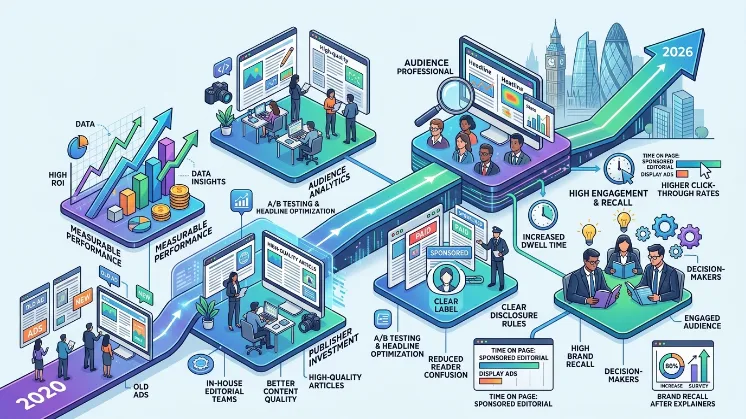
Regulatory clarity from advertising authorities on labelling paid content reduced reader confusion and improved click-through and dwell time metrics. Programmatic native advertising remained for reach, while sponsored editorial captured higher engagement and recall for decision-makers. Real examples include industry reports showing increased average time on page for sponsored editorial versus display ads, and surveys finding higher brand recall after reading sponsored explainers.
Why do UK B2B buyers trust sponsored editorial more than display ads?
Business readers trust sponsored editorial because it provides industry context, sources, and editorial structure rather than overt advertising claims. Sponsored editorial uses bylines, expert quotes, and sourced data that match standard editorial practices. This structure signals credibility.
Business audiences evaluate content based on relevance, depth, and evidence. Sponsored editorial that cites datasets, includes expert commentary, and frames problems and solutions in sector terms meets those criteria. Publishers enforcing strict disclosure clear labelling and transparent editorial involvement—reduced perceived bias. Example: procurement and IT decision-makers report preferring content with cited benchmarks and vendor-neutral analysis.
What production processes deliver effective sponsored editorial?
Effective production follows editorial briefing, research, drafting, editorial review, legal review, and clear labelling before publication.
Begin with a detailed brief that defines target audience, key messages, and permitted claims. Conduct primary and secondary research that includes data points, interviews, and sources. Drafts go through editorial review to ensure clarity and adherence to style. Legal review checks factual claims and compliance. Final steps include labelling as sponsored, applying metadata for SEO, and scheduling distribution. Publishers often set timelines: briefing (day 0), research and interviews (days 1–7), draft (days 8–12), review and revisions (days 13–18), legal clearance (days 19–21), and publication (day 22). Example timelines from publisher workflows show 3–4 week cycles for longform sponsored pieces.
Which components make sponsored editorial persuasive for B2B audiences?
Persuasion requires factual evidence, sector-specific language, cited sources, expert voices, and editorial structure. Factual evidence includes statistics, benchmarks, and case metrics. Sector-specific language aligns with the reader’s function, such as procurement, IT, or HR.
Cited sources include market reports, academic studies, and interview quotes. Expert voices come from named industry figures or internal specialists with credentials. Editorial structure uses headlines, subheads, and logical flow that lead readers from problem to insight. Example components in a strong piece: a statistic from an industry report, a named expert quote, and a short case study with measurable outcomes.
How are performance and measurement defined for sponsored editorial campaigns?
Performance uses audience reach, engagement metrics, lead signals, and brand-lift measures tied to campaign goals. Reach includes unique visitors and targeted impressions. Engagement metrics include time on page, scroll depth, and social shares. Lead signals include content downloads, form fills, and event RSVPs. Brand-lift uses pre/post surveys measuring awareness, consideration, and message recall.
Conversion tracking ties content interaction to downstream actions, such as webinar attendance or contact requests. Publishers and marketers use control groups and incrementality tests to isolate content impact. Example metrics: average time on page of 4+ minutes, scroll depth of 70%+, and lift in unaided brand awareness of 12 percentage points in controlled surveys.
Where does sponsored editorial sit in the B2B marketing funnel?
Sponsored editorial functions primarily at awareness and consideration stages by educating and framing vendor capabilities without hard selling. At the top of the funnel, sponsored editorial introduces industry challenges, trends, and comparative context. At consideration, it provides deeper analysis, benchmark data, and use-case narratives that help buyers evaluate options.
Content that answers common evaluation criteria and cites evidence supports movement to later stages. Publishers optimise distribution by aligning audience segments to funnel stages and tagging content accordingly. Example placement: an awareness longform on regulatory trends published on a sector news site, followed by a more technical sponsored explainer targeted to product evaluators.
What editorial standards and disclosure rules apply in the UK?
UK advertising rules require clear labelling of paid content, truthful claims, and avoidance of misleading statements; editorial standards demand source attribution and fact-checking. Advertising regulators require that sponsored content is identifiable as paid-for material. Labelling uses phrases such as “Sponsored”, “Paid partner”, or “Commercial feature.” Claims must be substantiated with evidence.
Editorial standards mandate named authors or editors, clear sourcing, and correction policies. Publishers maintain internal style guides that state required disclosure language, fact-check procedures, and permissible promotional copy. Example compliance steps: add a visible sponsorship label, include source links, and retain an audit trail of approvals.
Which use cases show the highest effectiveness for sponsored editorial in UK B2B?
Top use cases include thought leadership on regulation, product category education, event promotion, and sector benchmarking content. Thought leadership on regulation informs legal, compliance, and finance teams. Product category education helps technical buyers understand differences between solution types.
Event promotion builds qualified attendance when editorial previews topics and speakers. Sector benchmarking content gives procurement and strategy teams data to justify decisions. Each use case requires tailored evidence and audience targeting to perform. A benchmarking report published as a sponsored feature drove qualified contacts for a trade association event.
Explore More Expert Insights:
The UK Branded Content Boom: What the £17.9bn Advertising Export Market Is Telling Us
Context Is Everything: How UK Readers Respond Differently to News-Adjacent Content
How do publishers price and package sponsored editorial?
Publishers price packages by audience reach, content length, research requirements, and distribution add-ons such as newsletters and social promotion. Pricing models include flat fees per placement, bundled campaigns with multiple pieces, and performance-based pricing tied to lead generation. Packages often include editorial services, design, metadata optimisation, and targeted newsletter placements.
Add-ons include syndication, promoted social posts, and gated downloads with lead capture. Publishers provide audience data and historical performance as part of pricing justification. Example packages: single longform feature with two newsletter slots and social amplification; series package with three articles plus webinar preview.
What future trends will shape sponsored editorial in UK B2B?
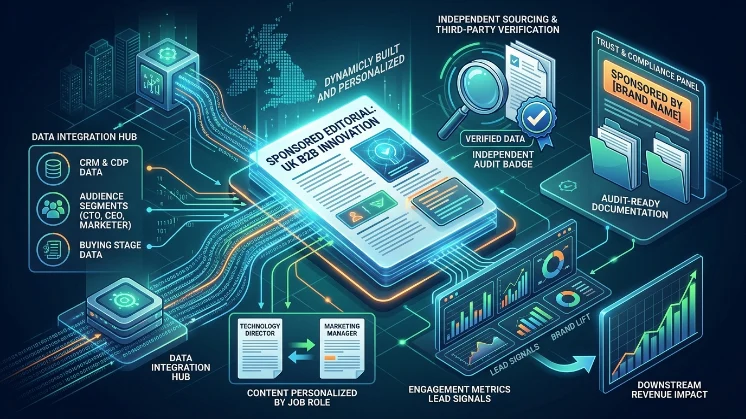
Future trends include deeper data integration, increased use of independent sourcing, and stricter disclosure enforcement to sustain trust. Data-driven personalisation will tailor sponsored editorial to job functions and buying stage. Independent sourcing and third-party verification will strengthen credibility. Regulatory scrutiny will push clearer labels and audit-ready documentation. Publishers will invest in analytics to measure downstream revenue impact more precisely. Example innovations: content personalised by role via dynamic content blocks, and third-party audit badges for verified data.
Explore the Advanced Guide:
Working With a UK Editorial Team on Sponsored Articles: Dos, Don’ts and Deadlines
Sponsored editorial reached top-three status in UK B2B awareness by combining editorial rigor, clear disclosure, measurable performance, and publisher investment in quality workflows. Publishers and marketers align briefs, research, and legal review to create factual, sourced content that performs across awareness and consideration stages. Metrics focus on engagement, lead signals, and brand lift, while evolving practices emphasise data integration and independent verification.
Read More for Better Understanding:
Sponsored Content Renewal Rates: Why 71% of UK Brands Extend After Month 3



