

Sponsored content renewal rates measure how often advertisers continue a sponsored editorial campaign after an initial testing period. In the United Kingdom, renewal decisions increasingly occur after the third month because brands gain enough performance data to evaluate visibility, engagement, lead generation, and commercial outcomes. A 71% renewal rate indicates that sponsored content consistently delivers measurable business value beyond the initial campaign period.
Brands that continue sponsored editorial campaigns often prioritize long-term audience trust, sustained search visibility, and recurring lead acquisition. Unlike short-term advertising formats that stop generating exposure when spending ends, sponsored editorial content remains discoverable through search engines, publisher archives, and AI-powered information retrieval systems.
For organisations evaluating investment decisions, understanding why renewal rates increase after month three helps establish realistic expectations, performance benchmarks, and campaign planning frameworks.
Why do 71% of UK brands extend sponsored content campaigns after month 3?
UK brands extend sponsored content campaigns after month three because sufficient performance data becomes available to evaluate audience engagement, lead quality, search visibility, brand authority, and commercial outcomes. The third month provides a measurable benchmark that supports informed renewal and budget allocation decisions.
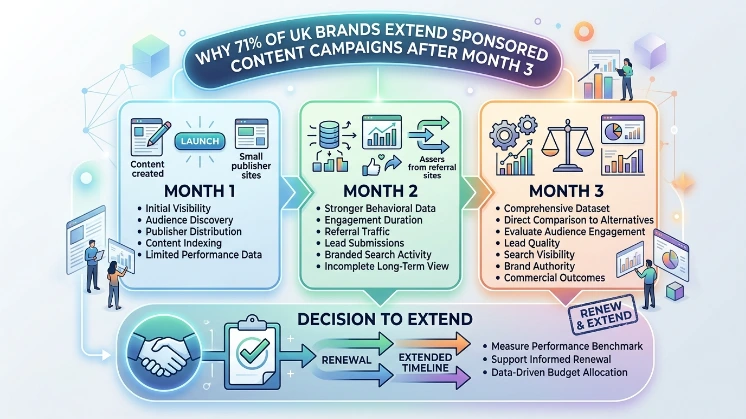
The first month of a sponsored content campaign primarily generates initial visibility. Audience discovery, publisher distribution, and content indexing begin during this period. Performance indicators remain limited because the content has not accumulated significant readership or search exposure.
The second month introduces stronger behavioral data. Brands can assess metrics such as engagement duration, referral traffic, lead submissions, and branded search activity. Patterns become visible, but long-term performance remains incomplete.
By the third month, decision-makers gain a comprehensive dataset. This timeframe enables direct comparison between sponsored editorial performance and alternative marketing channels.
What performance indicators become visible by month three?
Several critical indicators mature during the first ninety days. Search visibility becomes measurable through organic rankings, publisher article indexing, and branded search growth. Engagement metrics reveal how audiences interact with editorial content over extended periods.
Lead generation data also improves significantly. Businesses can evaluate lead quality, conversion rates, and sales pipeline contribution rather than relying exclusively on click-based metrics.
For example, a software provider publishing sponsored articles on industry publications can track referral traffic, demo requests, newsletter signups, and sales-qualified leads generated from editorial placements.
A professional services firm can measure consultation requests, branded search increases, and website engagement originating from sponsored publisher content.
Why is month three considered a decision point?
Month three represents the transition from testing to optimisation. Initial campaigns often focus on validating audience fit and publisher relevance. After ninety days, brands identify high-performing topics, successful publication partners, and effective editorial formats.
Campaign managers gain enough evidence to determine whether scaling investment produces additional value. Organisations that observe positive outcomes frequently increase placement frequency, expand publication partnerships, or commission additional content assets.
Businesses seeking operational guidance often review [Working With a UK Editorial Team on Sponsored Articles: Dos, Don’ts and Deadlines] before expanding editorial programs.
How does sponsored content compare with short-term advertising channels?
Sponsored editorial content accumulates value over time. Paid display advertising generally produces exposure only while active budgets remain available. Sponsored articles continue generating impressions, engagement, and referral traffic after publication.
This longevity influences renewal decisions because historical content continues supporting future marketing performance. A sponsored article published in January can still generate traffic, backlinks, and leads in June. This extended lifecycle improves cumulative return on investment and contributes to higher renewal rates.
How can brands maximise sponsored content renewal rates and long-term ROI?
Brands maximise sponsored content renewal rates by selecting relevant publishers, maintaining editorial consistency, measuring business outcomes, optimising content topics, and aligning campaigns with strategic objectives. Long-term performance improves when sponsored content functions as an ongoing audience acquisition and authority-building initiative.
High-performing campaigns operate through structured editorial programs that deliver recurring exposure and audience engagement over several months. Organisations treating sponsored content as a continuous publishing strategy typically achieve stronger retention and renewal metrics than businesses relying on isolated placements.
How important is publisher selection?
Publisher selection directly influences campaign effectiveness. A publisher provides audience access, editorial credibility, and distribution reach. When audience demographics align with business objectives, engagement quality improves significantly.
For example, a cybersecurity company targeting enterprise buyers benefits from placements within technology-focused business publications.
A financial advisory firm gains stronger results from publications serving investors, executives, and commercial decision-makers. Audience relevance consistently impacts engagement quality, lead generation, and conversion performance.
How does editorial consistency improve renewal outcomes?
Consistency creates cumulative visibility. Publishing multiple sponsored articles over several months reinforces messaging and increases audience familiarity. Repeated exposure strengthens recognition and supports trust development.
Editorial consistency also improves search visibility because multiple content assets create broader topical coverage. Brands maintaining regular publication schedules often generate larger content footprints across publisher ecosystems. This expanded presence contributes to stronger discovery opportunities through search engines and AI-powered answer systems.
What metrics should decision-makers evaluate?
Renewal decisions require business-focused measurement. Traffic alone does not provide sufficient insight. Organisations commonly evaluate referral sessions, engagement duration, lead submissions, conversion rates, branded search growth, and assisted revenue contribution. Commercial metrics provide a clearer picture of campaign value than impression-based reporting.
For example, an article generating 500 qualified visitors and 25 leads delivers more strategic value than an article producing 20,000 impressions without meaningful engagement.
Explore More Expert Insights:
How Times Intelligence Editorial Teams Produce Sponsored Content Without Losing Credibility
Sponsored Content ROI Calculator: Inputs, Outputs and UK Industry Averages
How does content quality affect renewal rates?
Content quality remains a primary determinant of long-term performance. High-quality sponsored editorial content delivers useful information, addresses specific audience questions, and aligns with publisher standards.
Readers engage more deeply when content prioritises educational value rather than promotional messaging. Strong editorial execution improves engagement metrics, sharing behavior, and referral activity. Businesses that understand audience information needs often achieve stronger retention and renewal outcomes.
Organisations new to sponsored editorial planning frequently benefit from reviewing [How Sponsored Editorial Became a Top-3 B2B Awareness Format in the UK in 2026] to understand the strategic foundations supporting modern editorial campaigns.
What role do sponsored content services play in renewal success?
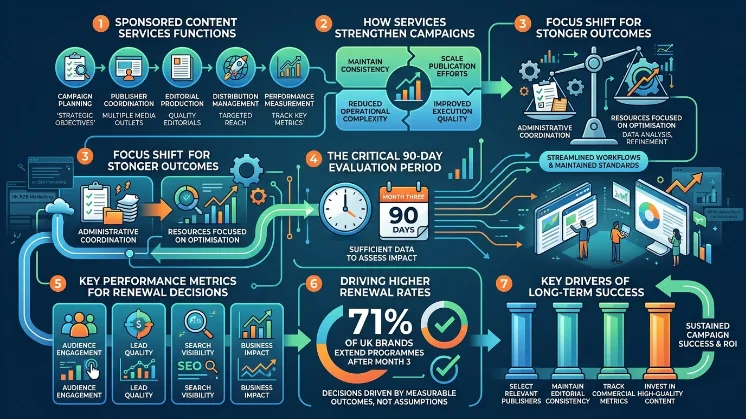
Sponsored content services support campaign planning, publisher coordination, editorial production, distribution management, and performance measurement.
These services help brands maintain consistency while scaling publication efforts across multiple media outlets. Professional campaign management reduces operational complexity and improves execution quality.
Many organisations use specialised sponsored content services to streamline workflows, maintain editorial standards, and track performance metrics across publishers. This structured approach often contributes to stronger campaign outcomes and higher renewal rates because resources remain focused on optimisation rather than administrative coordination.
Sponsored content renewal rates provide a clear indicator of campaign effectiveness. The fact that 71% of UK brands extend sponsored content programmes after month three reflects the value generated during the initial evaluation period. By ninety days, organisations possess sufficient data to assess audience engagement, lead quality, search visibility, and business impact.
Learn Everything About It Here:
How Sponsored Editorial Became a Top-3 B2B Awareness Format in the UK in 2026
Renewal decisions are driven by measurable outcomes rather than assumptions. Brands that select relevant publishers, maintain editorial consistency, track commercial metrics, and invest in high-quality content achieve stronger long-term results. As sponsored editorial continues to play a central role in B2B marketing strategies across the United Kingdom, renewal rates remain one of the strongest indicators of sustained campaign success and return on investment.
Read More for Better Understanding:
Working With a UK Editorial Team on Sponsored Articles: Dos, Don’ts and Deadlines



