

The UK branded content market is the creation and distribution of content paid for by advertisers to promote products, services, or narratives; its advertising export value reached £17.9 billion. Branded content combines editorial-style storytelling with commercial objectives. It includes sponsored articles, native advertising, video series, podcasts, and social media content.
Measured as part of the advertising export market, the £17.9 billion figure covers media sold by UK-based publishers, production houses, and creative agencies to international clients. This value captures fees for content production, placement, distribution, and associated creative services. Major revenue streams include video content, long-form editorial projects, programmatic native placements, and cross-platform campaigns delivered for non-UK advertisers.
How is branded content defined and which entities produce it?
Branded content is content created or commissioned by a paying client and produced by publishers, agencies, or in-house teams to reach audience segments without using standard display ads. Commissioning client with a commercial interest, a producer that handles creative and editorial execution, and a distribution channel that places the content in front of an audience.
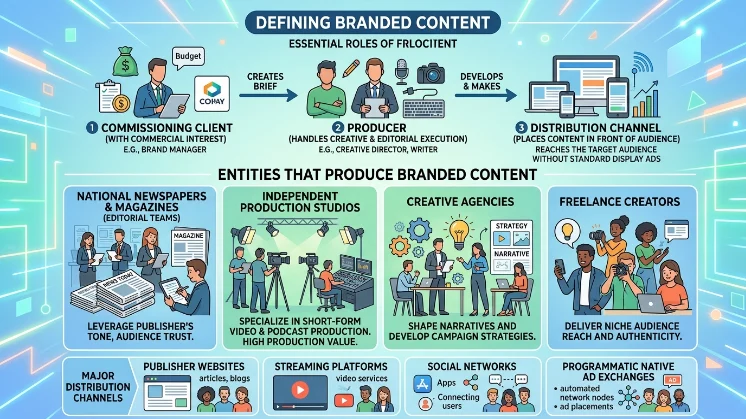
Producers include editorial teams inside national newspapers and magazines, independent production studios that make short-form video and podcasts, creative agencies that shape narratives and strategy, and freelance creators who deliver niche audience reach. Distribution channels include publisher websites, streaming platforms, social networks, and programmatic native ad exchanges.
Which metrics measure branded content performance?
Performance metrics for branded content include viewability rates, engagement time, completion rates, brand lift scores, conversion rates, social shares, and earned media value. Viewability measures whether content appeared in a user’s viewport.
Engagement time records how long users interact with content. Completion rates apply to video and indicate the percentage of viewers who watched to the end. Brand lift uses survey-based tests to quantify changes in awareness, preference, or message recall after exposure. Conversion rates track defined actions such as sign-ups or purchases linked to content. Social shares and comments measure organic amplification. Earned media value estimates the equivalent advertising cost if the same reach came from paid media. Each metric serves different campaign goals: awareness campaigns prioritise brand lift and reach; consideration campaigns value engagement time and completion rates; direct-response campaigns focus on conversions and cost per acquisition.
How do production processes for branded content operate in the UK?
Production follows a sequence: brief and objectives, audience research, creative concept, production planning, execution, distribution plan, and measurement. The client or advertiser issues a brief specifying objectives, target audiences, and KPIs. Producers conduct audience research using first-party data, publisher analytics, and demographic studies.
Creative teams draft concepts aligned with editorial style and platform formats. Production planning sets budgets, timelines, legal clearances, and talent agreements. Execution includes scripting, filming, editing, and quality control. A distribution plan defines placement across publisher channels, social platforms, programmatic native buys, and partner sites. Measurement frameworks are established before launch with agreed metrics and tracking methods. Post-campaign reporting compares outcomes to KPIs and documents learnings for future iterations.
What legal and editorial standards govern branded content?
Branded content in the UK must follow advertising standards, transparency rules, and editorial independence guidelines set by regulators and platform policies. Key legal frameworks include rules from the Advertising Standards Authority (ASA) and the Committee of Advertising Practice (CAP) Codes, which require clear labelling when content contains advertising.
Editorial independence protocols separate sponsored content creation from core news reporting to avoid conflicts of interest. Disclosure practices must be prominent and unambiguous, using labels such as “Sponsored” or “Paid for by” near the content title. Contractual clauses govern ownership, rights, and usage of produced assets. Publishers often implement internal sign-off processes involving legal and editorial teams to ensure compliance with regulatory and reputational standards.
What components make a branded content campaign effective?
Effective campaigns combine a clear brief, audience-first creative, platform-specific formats, strong measurement, and transparent disclosure. A clear brief aligns stakeholders on objectives and KPIs. Audience-first creative uses data to shape tone, format, and distribution strategy. Platform-specific formats respect viewing behaviour: short-form video for social feeds, long-form articles for publisher sites, episodic series for streaming and podcasts.
Measurement frameworks tie creative outcomes to business metrics such as awareness lift or conversions. Transparent disclosure preserves trust and reduces regulatory risk. Budget allocation across production and distribution ensures adequate reach and performance testing. Iterative testing during campaign runtime improves targeting and creative variants.
What benefits does the branded content export market bring to the UK economy?
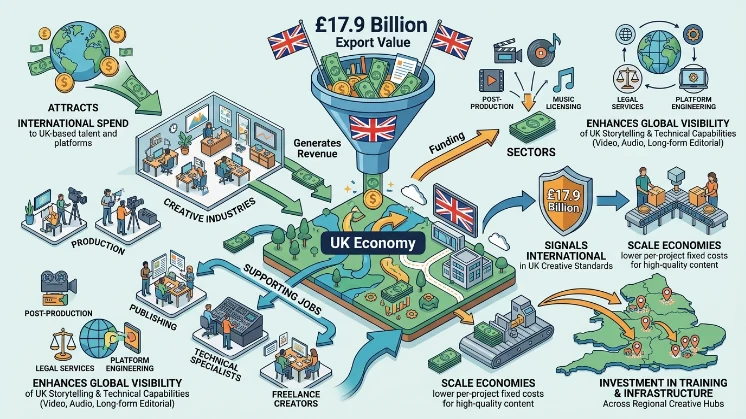
The £17.9 billion export value generates revenue for creative industries, supports jobs in production and publishing, and attracts international advertising spend to UK-based talent and platforms. Revenue from exports funds production companies, editorial teams, technical specialists, and freelance creators. Exports enhance the global visibility of UK storytelling skills and technical capabilities in video, audio, and long-form editorial.
This income supports related sectors such as post-production facilities, music licensing, legal services, and platform engineering. High export values signal international trust in UK creative standards and provide scale economies that lower per-project fixed costs for high-quality production. Export-led demand also encourages investment in training and infrastructure across regional creative hubs.
Explore More Expert Insights:
Context Is Everything: How UK Readers Respond Differently to News-Adjacent Content
Why Brands That Publish on News Sites Build Trust Faster Than Those on Social Only
What use cases demonstrate the range of branded content formats?
Use cases include awareness films for global launches, documentary-style editorial packages, episodic branded podcasts, integrated social series, and native articles placed within publisher ecosystems. Awareness films run across streaming platforms and publisher homepages to reach large audiences.
Documentary-style editorial packages explore complex subjects over multiple assets and sustain attention across weeks. Episodic podcasts establish recurring listener relationships and enable longer-form storytelling. Integrated social series use platform-native formats such as vertical video and short reels to drive engagement and shareability. Native articles embed sponsored narratives within a publisher’s editorial feed, combining long-form context with targeted distribution. Each format aligns with specific objectives: awareness, consideration, or conversion.
How should stakeholders interpret the £17.9bn figure when planning campaigns?
Treat the £17.9 billion as an indicator of market scale, international demand, and available supply of creative services, and use it to benchmark investment potential and talent sourcing decisions. The figure shows that international clients allocate substantial budgets to UK-based creative work. Agencies and in-house teams should use this benchmark to evaluate pricing strategies, resource planning, and potential partnerships.
Talent recruitment efforts can focus on skills demonstrated in export projects: long-form storytelling, multilingual production, and cross-platform optimisation. Media planners can compare their client budgets to sector averages to determine appropriate production value and distribution spends. Procurement teams should factor in rights and distribution costs when negotiating contracts, as export projects often require broader licensing.
For More Details, Explore::
Measuring Sponsored Content Performance: 8 UK Benchmarks You Should Know
Discover More Insights:
How Times Intelligence Editorial Teams Produce Sponsored Content Without Losing Credibility
This article defined branded content, described production processes, listed performance metrics, and explained legal, operational, and economic implications of a £17.9 billion advertising export market. The figure reflects large-scale international demand for UK creative services and signals opportunity for publishers, producers, and advertisers focusing on high-quality, measurable, and transparent branded content.



