

A sponsored article is paid editorial content produced with a publisher or editorial team, labeled for transparency and aligning with editorial standards; it differs from native advertising by stronger editorial influence and clearer disclosure.
A sponsored article is paid content created to inform a target audience while maintaining an editorial tone. Publishers require clear labeling such as “Sponsored” or “Paid content” to meet UK ASA advertising rules and CAP Code requirements. Native advertising is a broader category that disguises marketing as editorial; sponsored articles must avoid misleading presentation and must not omit the paid nature.
An editorial team adds journalistic structure, fact-checking, and style consistency. Entities involved include the sponsoring brand, the publisher, the editorial lead, and a legal or compliance reviewer. Each entity has defined responsibilities: the brand supplies objectives and assets, the editorial team drafts and edits content, and compliance confirms labeling and claims.
How does the UK regulatory environment affect sponsored editorial?
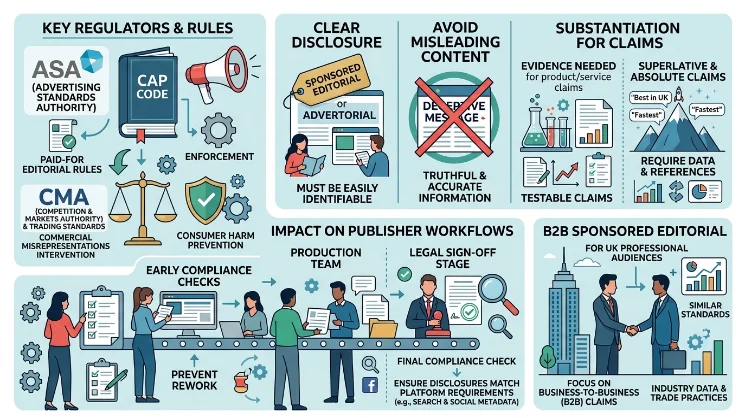
UK advertising regulation requires clear disclosure, substantiation for claims, and avoidance of misleading content; the ASA enforces these rules and publishers enforce them in production workflows.
The Advertising Standards Authority (ASA) enforces the CAP Code that applies to paid-for editorial. Claims about products or services need evidence and must be testable. Superlative or absolute claims require substantiation with data or references. Editorial teams add compliance checks early in the workflow to prevent rework. The Competition and Markets Authority (CMA) and Trading Standards intervene on commercial misrepresentations, particularly where consumer harm exists.
Publishers often keep a legal sign-off stage in the process to check compliance and to ensure disclosures match platform requirements, such as search or social metadata. For B2B content aimed at UK professional audiences, standards are similar but focus on business-to-business claims, industry data, and trade practices.
What are the typical roles and responsibilities in a UK editorial workflow?
Roles include brand strategist, account manager, editorial lead, copywriter, fact-checker, legal reviewer, designer, and publishing coordinator; each role has specific deliverables and deadlines.
The brand strategist defines campaign goals and target metrics. The account manager centralizes communication and tracks deadlines. The editorial lead assigns writers and sets editorial tone and structure. Copywriters draft headlines, ledes, and body copy following the publisher’s style guide. Fact-checkers validate data, quotes, and sources. Legal reviewers confirm claims and disclosures. Designers create visuals and format layouts. The publishing coordinator schedules CMS upload, metadata, and live date controls. Example: a B2B sponsored article for a trade publisher often requires a 10–14 day cycle with a 72-hour legal review window and a 48-hour design finalisation slot. Define exact timelines before project start to avoid scope creep.
How should brands prepare content assets for an editorial team?
Brands must provide a concise brief, verified data, clear messaging hierarchy, logos, imagery licensed for publication, and a list of spokespeople with bios; all assets must include source citations and usage rights.
A concise brief includes campaign objective, target audience, key messages, and measurable KPIs. Verified data means citations for statistics and permission for proprietary figures. Messaging hierarchy lists primary and secondary points and any forbidden claims. Imagery requires high-resolution files and explicit usage rights for publication and social amplification. Spokespeople require full names, titles, short bios, and verified quotes where appropriate. Provide a fact sheet and a link to studies or white papers. Include brand tone and preferred do-not-say list. Editorial teams use these assets to draft content that fits the publisher’s voice while preserving contractual deliverables.
What are best-practice dos when commissioning sponsored editorial?
Do provide a single, clear project brief, agree deadlines in writing, share verifiable data, accept editorial adjustments, and plan for legal and design review windows.
Start by agreeing scope: word count, format (Q&A, long-form, list), and distribution channels. Share a one-page brief summarizing objectives and must-have messages. Provide data with sources and any required third-party permissions. Expect the editorial team to edit for readability, accuracy, and audience fit; accept changes that preserve facts. Build in legal review (48–72 hours) and design lead time (48 hours) as contractual milestones. Confirm labeling language to meet ASA rules. Maintain a single point of contact on both sides to expedite approvals.
What are clear don’ts when working with UK editors?
Do not attempt to dictate headlines or final wording that conflicts with editorial standards, do not request removal of paid-disclosure labels, do not submit unverified claims or unlicensed images, and do not compress review timelines below agreed minimums.
Editors retain final say on headlines and framing to protect editorial integrity. Removing paid-disclosure labels breaches CAP rules and risks sanctions. Unverified statistical claims provoke rewrites or rejection. Using images without rights creates copyright liability and delays. Last-minute rushes cause errors and reduce quality; avoid compressing timelines unless contractually accepted and compensated. Do not insert hidden calls-to-action that bypass editorial guidelines.
What deadlines should teams set for each production stage?
Set deadlines as: briefing and asset delivery (Day 0), first draft (Day 5–7), internal brand review (48 hours), legal review (48–72 hours), design/layout (48 hours), final sign-off (24–48 hours), and scheduled publish date.
A typical mid-funnel campaign follows a 10–14 day schedule for a 800–1,200-word article. Day 0 is asset handover. Allow 5–7 days for research and the first draft for detailed B2B topics. Brand reviews should be limited to a single round of comments within 48 hours. Legal review needs 48–72 hours depending on complexity. Design and layout take 48 hours once copy is locked. Final sign-off requires 24–48 hours to ensure metadata, disclosures, and SEO fields are correct. For multi-asset campaigns, add buffer days for iteration and scheduling conflicts. Frozen deadlines should be contractually defined to apply late-review penalties or alternate plans.
Explore More Expert Insights:
Measuring Sponsored Content Performance: 8 UK Benchmarks You Should Know
How to Use Sponsored Content to Nurture UK Leads Who Are Not Ready to Buy Yet
What quality controls ensure accuracy and compliance?
Quality controls include editorial style checks, fact-checking against primary sources, legal compliance review, image licensing verification, and final prepublish checklist for disclosures and metadata.
Publishers apply a style guide to maintain consistency. Fact-checkers verify statistics and quotes against original papers, reports, or transcripts. Legal reviewers confirm claims and required disclaimers. Image teams validate licenses and model releases. A prepublish checklist confirms labeling, metadata, canonical tags, alt text, and targeted keywords. Track changes and version control reduce version conflicts. For B2B sectors like healthcare or finance, an additional subject-matter expert review is common.
What outcomes and benefits can brands expect from working with UK editorial teams?
Brands gain editorial credibility, access to publisher audiences, improved content discoverability, and measurable engagement metrics when campaigns follow compliance and quality standards.
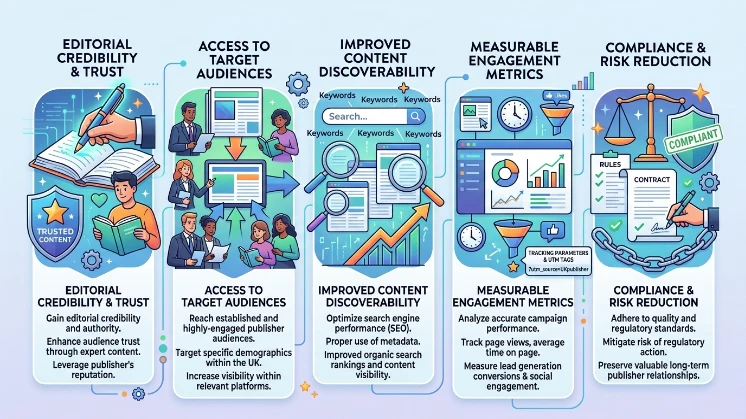
Sponsored editorial delivers visibility within a trusted publication environment. Editorial framing increases time-on-page and audience trust. Proper SEO and metadata improve search performance. Compliance reduces risk of regulatory action and preserves long-term publisher relationships. Measurable outcomes include page views, average time on page, lead-generation conversions, and social engagement. Provide tracking parameters and UTM tags to measure performance accurately.
Click Here to Explore More:
How Sponsored Editorial Became a Top-3 B2B Awareness Format in the UK in 2026
Working with UK editorial teams requires clear roles, compliant processes, and agreed deadlines. Provide verified assets, accept editorial adjustments, and respect disclosure rules. Use a defined timeline with built-in legal and design review windows. Follow SEO and quality controls to maximise reach and reduce regulatory risk.
For guidance on later stages of the content funnel, consult internal resources such as:
Sponsored Content Renewal Rates: Why 71% of UK Brands Extend After Month 3



