

Sponsored content is editorial material paid for by a brand, labeled as sponsored, and written with editorial standards; it differs from native advertising by clearer editorial involvement and disclosure.
Sponsored content is content created to inform or engage readers while reflecting a sponsor’s message. Native advertising replicates the format of surrounding content and often prioritises promotional goals. Sponsored content keeps editorial oversight and places clear disclosure statements at the top or alongside the content. Key entities: sponsor (company paying for content), editorial team (journalists and editors who shape the piece), legal/compliance reviewers (verify disclosures), and audience (readers in the UK market). Examples include long-form explainers, interviews with experts, and data-driven reports.
How do editorial teams keep editorial independence during sponsorship?
Teams set strict editorial guidelines, separate commercial and editorial decision-making, and enforce final editorial approval on all sponsored pieces.
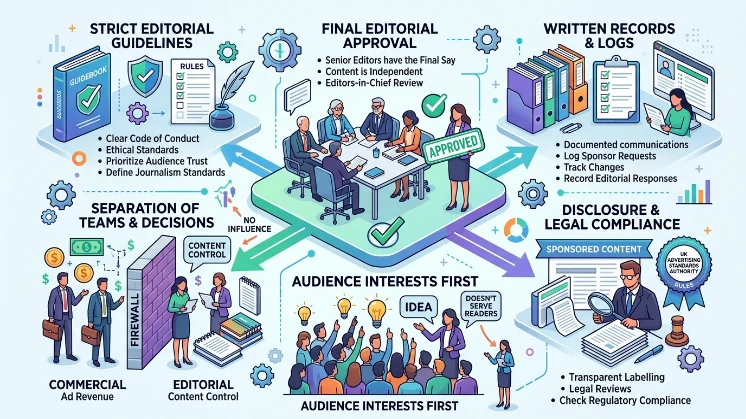
Editorial independence begins with documented policies that prevent commercial teams from dictating story angles. Policies assign final content approval to senior editors or an independent editor-in-chief role. Teams log communications with commercial partners and maintain written records of requested changes and editorial responses. Editors reject sponsor requests that conflict with audience interests or journalistic standards. Legal and compliance teams verify disclosure language and check for regulatory compliance under UK Advertising Standards Authority rules.
What processes ensure transparency to readers?
Processes include explicit labeling, disclosure statements at the top, and detailed sponsor attribution in metadata and social posts.
Clear labeling uses phrases like “Sponsored by [Sponsor]” or “Paid partnership.” Disclosure appears in the first 50–80 words and repeats in the article metadata. Social media posts include the same disclosure and relevant hashtags where required. Editorial teams publish sponsor lists or a sponsorship policy page that explains criteria for accepting paid content. Audits and reader feedback mechanisms monitor whether readers understand the relationship. Examples: in-article banner with “Sponsored” label, and a sidebar explaining the editorial review process.
Which editorial controls limit sponsor influence on content?
Controls include contractual boundaries, edit-only clauses, editorial kill-switches, and pre-approval limits for sponsor review.
Contracts specify that sponsors provide facts, data, or interviews but do not control final wording. Contracts include an editorial kill-switch granting editors the right to refuse publication. Sponsor review deadlines are limited to a defined window, typically 48–72 hours, to prevent prolonged negotiation. All sponsor requests for edits require written justification and editor sign-off. Editors retain the right to add independent reporting, expert quotes, and counterpoints. Examples of control measures: an editorial-only copy ownership clause and mandatory independent fact-checking for sponsor-supplied data.
How do teams handle sponsor-supplied data and claims?
Teams verify sponsor data through independent sources, attach methodological notes, and label unverified claims clearly.
Verification begins with source documentation: raw data, methodology, and sampling details. Editorial teams request original datasets or access to primary reports. Journalists cross-check claims against government data, academic studies, or industry reports. When verification is partial, teams include disclaimers and clearly label the claim as provided by the sponsor. Method sections describe data collection dates, sample sizes, and limitations. Examples include linking to Office for National Statistics tables or referencing peer-reviewed studies when available.
What editorial formats preserve credibility while serving sponsor goals?
Formats that preserve credibility include bylined features, expert Q&A, and independently reported explainers with sponsorship acknowledgement.
Bylined features list an editor or journalist as author and include standard newsroom elements: ledes, quotes, and attribution. Expert Q&A segments use named, credentialed experts and disclose any financial ties. Independently reported explainers combine sponsor-funded research with external perspective from academics or regulators. Visual formats use neutral design, avoiding overt promotional styling. Examples: an independent explainer citing university research, and a Q&A with an industry regulator.
How do editorial teams measure performance without compromising standards?
Teams measure performance with audience engagement metrics, qualitative feedback, and brand safety checks while preserving editorial criteria.
Performance metrics include time on page, scroll depth, and reader satisfaction surveys. Teams track conversion metrics only if they do not require content changes that undermine editorial standards. Separate analytics dashboards exist for commercial reports, but editors access the same metrics for quality assessment. Brand safety and reputational risk assessments run before publication. Examples: using anonymised engagement data to report reach to sponsors, and publishing aggregated audience feedback.
What role do legal and regulatory frameworks play in maintaining credibility?
Legal teams enforce Advertising Standards Authority rules, Competition and Markets Authority guidance, and data protection laws throughout the sponsored content lifecycle.
Legal review confirms disclosure language meets ASA transparency requirements and verifies that claims do not breach consumer protection laws. Data processing for sponsored content follows UK GDPR rules; consent documentation for interviews and data sharing is mandatory. Competition law reviews ensure claims do not mislead or disadvantage competitors. Legal also reviews commercial agreements to protect editorial rights and record retention policies for audits.
What staffing and governance structures support impartial sponsored content?
Structures include an independent editorial review board, dedicated sponsored content editors, and mandatory training on disclosure and ethics.
An editorial review board reviews contentious sponsorships and adjudicates disputes. Dedicated sponsored content editors manage workflows, ensure consistency, and act as a firewall between commercial teams and newsroom editors. All staff complete annual training on disclosure, ASA rules, and editorial ethics. Governance requires quarterly audits of sponsored pieces and a public report on sponsorship volume and categories. Examples: a quarterly transparency report listing sponsored campaigns and topics.
What benefits do trustworthy sponsored content programmes deliver?
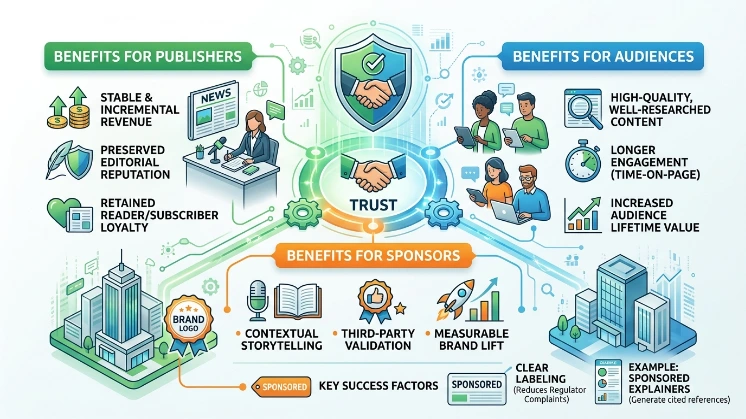
Reliable sponsored content programmes deliver stable revenue, preserved audience trust, and measurable brand lift without damaging editorial reputation.
When credibility remains intact, publishers secure incremental revenue from sponsors while retaining subscriber or reader loyalty. Audiences engage with well-researched content longer, increasing lifetime value. Sponsors gain contextual storytelling with third-party validation. Independent verification and clear labeling reduce complaint volumes to regulators. Sponsored explainers that sustain longer time-on-page and generate cited references in other media.
Explore More Expert Insights:
Sponsored Content ROI Calculator: Inputs, Outputs and UK Industry Averages
What Makes a Sponsored Content Partner Worth Paying For in the UK in 2026
When is sponsored content inappropriate for an editorial team?
Sponsored content is inappropriate when sponsor goals conflict with public interest, when claims remain unverifiable, or when the topic undermines editorial independence.
Teams reject sponsorships for topics that create conflicts of interest, such as health claims without robust evidence or political advocacy during election periods. If sponsors insist on ghostwriting without disclosure or demand narrative control, editorial teams decline. Editorial policies list banned sectors or scenarios and apply consistent refusal criteria. Examples: refusal of sponsorship for unverified medical product claims, or political campaigning content near election dates.
How should readers and sponsors evaluate sponsored content credibility?
Evaluation uses disclosure presence, author byline, source transparency, and independent verification as key signals.
Readers check whether the piece clearly states sponsor involvement and names the author. They examine source citations, methodological notes, and external expert input. Sponsors evaluate credibility by requesting editorial policies, proof of independent review, and post-campaign performance reports. Third-party audits or certifications increase trust. An article linking to regulatory data and including external expert quotes.
Dive Deeper Into This Topic:
The UK Branded Content Boom: What the £17.9bn Advertising Export Market Is Telling Us
This article defined sponsored content, described processes that protect editorial independence, and outlined specific controls, verification steps, governance structures, and evaluation criteria used by reputable editorial teams in the UK. These practices enable publishers to accept sponsor funding while maintaining transparency, legal compliance, and audience trust.
For implementation details and performance benchmarks, see:
Measuring Sponsored Content Performance: 8 UK Benchmarks You Should Know



