

A sponsored content partner is a publisher or platform that publishes paid editorial content on behalf of advertisers, providing audience access, editorial context, and tracking for campaign performance.
A sponsored content partner acts as an intermediary between a brand and an audience. Define the partner by three core functions: creation, distribution, and measurement. Creation involves writing articles, producing video, or designing infographics under an editorial framework. Distribution uses the partner’s owned channels: news sites, newsletters, video pages, and social feeds.
Measurement provides metrics such as unique visitors, time on page, view-through rate, and conversions. Important entities include publishers (news sites, specialist outlets), content studios (in-house or third-party creative teams), and ad-ops providers (tracking and attribution systems). In the UK in 2026, compliance and data handling also form part of the partner definition because publishers must follow local advertising and data-protection rules.
How do sponsored content partners reach and verify audience quality?
Partners verify audience quality through third-party measurement, consented first-party data, viewability standards, and platform-level analytics to prove reach and relevance.
Audience verification begins with audience identity. Publishers provide logged-in user counts, subscription figures, and newsletter open rates. Partners use independent measurement like comScore, Nielsen Digital Ad Ratings, or server-to-server analytics to validate reported reach.

Viewability follows MRC (Media Rating Council) or equivalent UK standards partners report viewable impressions and time-in-view. Consented first-party data helps partners show demographic and behavioural segments while complying with UK GDPR. Fraud prevention uses third-party verification services to filter non-human traffic. Partners also provide contextual signals topic taxonomy, section-level engagement, and keyword-level interest to show relevance for the brand’s target audience.
What elements of service determine the partner’s value?
Value depends on campaign planning, editorial integration, multi-format production, measurement transparency, and regulatory compliance.
Campaign planning includes audience research, KPI definition, and placement strategy. Editorial integration measures how well sponsored content aligns with the publisher’s voice and audience expectations. Multi-format production covers written features, video, audio, and visual assets. Measurement transparency requires access to raw metrics, third-party verification, and clear attribution windows. Regulatory compliance requires labels that meet the Advertising Standards Authority (ASA) rules and clear data-processing notices for consent. Each element must be documented in the contract with specific deliverables, timelines, and reporting cadence.
How does editorial integration affect performance?
Strong editorial integration increases time-on-page, reader trust signals, and social sharing by aligning tone, format, and placement with organic content.
Editorial integration assigns the sponsored piece to an appropriate site section and matches the publisher’s style guide. Integration affects content length, headline style, image selection, and metadata. Readers move faster to convert when sponsored content appears in a context they already trust. Publishers that embed sponsorship into native reading flows report higher engagement metrics: average session duration, scroll depth, and comment activity. Integration also affects SEO: on-site editorial placement and internal linking patterns help search engines index and rank sponsored content alongside organic articles.
What measurement and reporting standards should brands demand?
Brands should demand third-party verified reach, viewability, time-on-content, engagement events, and conversion attribution with a defined attribution window.
Measurement must include baseline metrics: unique users, sessions, viewable impressions, view-through rate, and average time on content. Engagement events include scroll depth, video completion rate, clicks on calls-to-action, and newsletter sign-ups. Conversion attribution ties content exposure to downstream actions, using deterministic tracking (UTM, server-side events) and probabilistic modelling where necessary. Reporting cadence should include an initial delivery report, a mid-campaign status update, and a final report with raw data export. Contracts should specify the attribution window (commonly 7, 14, or 30 days) and the method for deduplicating cross-channel exposures.
What pricing models and contract terms reflect fair value?
Fair pricing uses CPM or fixed-fee for production plus performance-linked payments for measured outcomes, with clear deliverable timelines and data access clauses.
Pricing models include fixed-fee for content production and placement, CPM for impressions, and CPC or CPL for performance-linked outcomes. Contracts must spell out the editorial review process, approval windows, and revision counts. Data access clauses must include delivery of raw analytics and permission to run post-campaign audits. Payment terms often use a 50/50 split: 50% on contract, 50% on delivery or reporting. Cancellation terms and makegood clauses must specify remedies for under-delivery, such as additional placements or pro-rata refunds.
How do regulatory and transparency requirements shape partner selection?
Regulatory compliance requires ASA-compliant labelling, GDPR-aligned data handling, and transparent disclosure of commercial relationships.
The ASA demands clear disclosure when content is sponsored. Labels must appear at the top of the content and in metadata where applicable. GDPR requires lawful basis for processing user data and clear consent mechanisms for personalised targeting. Partners must provide a data-processing addendum detailing data controllers and processors. Transparency also covers native tagging: publishers must make sponsorship relationships discoverable in feed labels, canonical tags, and RSS metadata. Failure to meet these standards exposes brands to regulatory complaints and reputational cost.
What technical capabilities improve campaign outcomes?
Technical capabilities include server-side tracking, content delivery optimisation, mobile-first video players, and CMS integration for metadata and schema.
Server-side tracking reduces discrepancy from client-side blockers and provides reliable conversion data. Content delivery optimisation uses CDNs and lazy-loading to maximise page speed, which correlates with lower bounce rates and higher viewability. Mobile-first players support adaptive bitrate streaming and interactive features to increase video completion. CMS integration ensures sponsored content includes correct canonical tags, structured data (schema.org Article with sponsor metadata), and open graph tags for social sharing. Technical maturity also includes API access for automated reporting and placement scheduling.
What media formats and combinations deliver the best ROI?
Multi-format campaigns that combine long-form articles, short video, and data visualisation deliver higher engagement and measurable conversion lifts.
Long-form articles provide search value and SEO longevity. Short-form video increases attention and social reach; 15- to 30-second clips work well for publisher social feeds. Data visualisations and infographics support quick comprehension and shareability. Combining formats allows sequential exposure: an article creates context, video drives attention, and an infographic amplifies social sharing. Real examples include article-led series that feed into a branded video and a downloadable infographic to capture leads. Measurement must capture cross-format exposure to report cumulative impact.
Explore More Expert Insights:
Sponsored Content for UK Financial, Tech and Healthcare Brands: Vertical Benchmarks
Single Site vs Multi-Property Sponsored Content: UK Reach and CPL Compared
What use cases benefit most from paying for sponsored content partners?
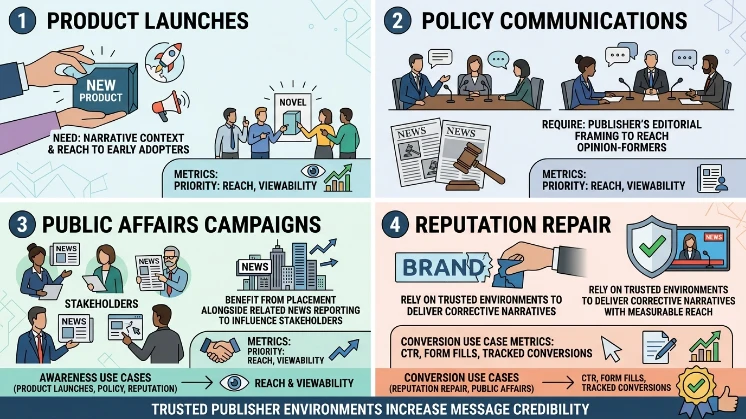
Use cases include product launches, policy communications, public affairs, and reputation repair where trusted publisher environments increase message credibility.
Product launches need narrative context and reach to early adopter audiences. Policy communications require a publisher’s editorial framing to reach opinion-formers. Public affairs campaigns benefit from placement alongside related news reporting to influence stakeholders. Reputation repair relies on trusted environments to deliver corrective narratives with measurable reach. Each use case requires different metrics awareness use cases prioritise reach and viewability conversion use cases prioritise CTR, form fills, and tracked conversions.
How should brands evaluate partner performance after a campaign?
Evaluate performance by comparing delivered metrics to contracted KPIs, auditing raw data, and measuring downstream business outcomes with agreed attribution windows.
Start with contractual KPIs: impressions, viewability, time on content, and engagement events. Audit raw data exports for discrepancies and confirm third-party verification reports. Measure downstream outcomes: organic search gains, direct traffic lift, form submissions, and sales attributable within the attribution window. Conduct a qualitative review: editorial alignment, user comments, and social sentiment. Use findings to refine future briefs, pricing negotiations, and targeting.
Find Out More:
Why Brands That Publish on News Sites Build Trust Faster Than Those on Social Only
A sponsored content partner is worth paying for when they combine verified audience access, strong editorial integration, multi-format production, transparent measurement, technical maturity, and regulatory compliance. For UK campaigns in 2026, demand third-party verification, clear ASA-compliant disclosure, server-side tracking, and contracts that tie fees to measurable deliverables. Use multi-format approaches for higher engagement and set explicit attribution windows to evaluate ROI.
Read the Full Blog Here:
Multi-Format Sponsored Campaigns: Combining Articles, Video and Infographics on UK Sites



