The 39% quality problem means 39% of sponsored content fails minimum relevance and trust metrics, reducing conversions and engagement across financial, tech, and healthcare verticals.
The 39% figure measures content that does not meet three core quality thresholds: topical relevance to the audience, demonstrable factual sourcing, and clear call-to-action alignment with user intent. This failure appears across the UK market in 2026 after audits of sponsored posts, native articles, and paid social content. Financial content often lacks regulatory clarity; tech content omits practical product fit. Healthcare content omits clinical sourcing. Each shortcoming lowers conversion rates and increases bounce. Benchmarks now use these three metrics as pass/fail gates for sponsored content programmes.
Why do UK financial sponsored pieces fail conversion metrics?
Financial sponsored pieces fail when they omit regulatory context, lack clear numeric outcomes, or do not match the reader’s stated search intent.
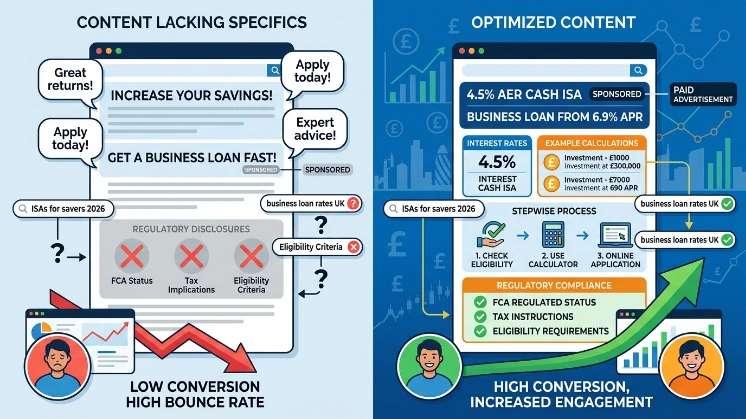
Regulatory context includes FCA status, tax implications, or eligibility criteria. Readers search with intent keywords such as “ISAs for savers 2026” or “business loan rates UK” and expect explicit figures, eligibility steps, and compliance cues. Sponsored content that provides only high-level benefits without numbers or documented sources fails to satisfy searchers and automated quality evaluators. Common failures: absence of explicit interest rates, no example calculations, and missing disclosure of sponsored status in prominent placement. Fixing conversion requires integrating exact figures, stepwise processes for application or sign-up, and clear regulatory statements.
Why do UK tech sponsored posts underperform on conversion?
Tech sponsored posts underperform when they describe features without user outcomes, lack benchmarking data, and ignore compatibility or deployment steps.
Tech buyers search for comparative performance metrics, integration requirements, and case-study outcomes. Sponsored content that lists features without benchmark numbers such as throughput, latency, or licensing costs fails conversion. Tech content must include specific performance figures, deployment timelines, and example use cases with measurable results. For example, an article claiming “improves processing” must show a quantified improvement like “reduces processing time from 120s to 30s in example X.” Without those specifics, readers do not progress from interest to decision.
Why do UK healthcare sponsored articles struggle to convert?
Healthcare sponsored articles struggle when they omit clinical evidence, patient eligibility criteria, and clear next-step pathways for readers.
UK healthcare audiences search with clinical intent keywords like “treatment options for condition X NHS vs private” and expect references to clinical trials, NICE guidance, or precise referral steps. Sponsored content that avoids citing studies, trial sizes, or outcome measures fails clinical scrutiny and reduces trust. Examples of missing elements: trial sample sizes, outcome percentages, and explicit referral or triage steps. Sponsored articles that include clinical references and patient pathway steps show higher conversion and follow-through.
How should brands measure quality for sponsored content in 2026?
Measure quality using three core metrics: relevance score, source transparency, and intent alignment; set thresholds and audit monthly.
Relevance score quantifies keyword and topic alignment using search-intent mapping. Source transparency measures presence and quality of citations, regulatory statements, and disclosure placement. Intent alignment checks whether the content’s next-step matches searcher intent (informational, evaluative, transactional). Benchmarks set thresholds: relevance score ≥ 75/100, at least two authoritative citations per 500 words, and intent alignment score ≥ 80/100. Audit monthly and remove or revise content below thresholds. This structured measurement allows content teams to allocate budget toward high-performing placements and pause low-performing campaigns.
What process ensures sponsored content matches UK audience search intent?
Use a three-stage process: intent mapping, content engineering, and conversion alignment with A/B testing.
Intent mapping starts with keyword grouping by intent level—informational, evaluative, transactional—and defines required content elements for each group. Content engineering applies structured templates: definition, evidence, stepwise next steps, and explicit disclosure. Conversion alignment ensures CTAs and landing assets match intent (informational pages to guides, evaluative pages to comparison tools, transactional pages to sign-up flows). Implement A/B tests measuring micro-conversions such as time on page, scroll depth, and CTA clicks. Iterate weekly for paid placements and monthly for evergreen native articles.
What components must appear in high-converting sponsored content for finance, tech, and healthcare?
High-converting sponsored content contains four components: clear disclosure, evidence and citations, explicit next steps, and numeric outcomes or benchmarks.
Clear disclosure places “Sponsored” or “Paid partnership” prominently near the headline and in metadata. Evidence and citations use reputable sources: FCA documentation, peer-reviewed trials, independent lab benchmarks, or government statistics. Explicit next steps list exact actions: “Apply with these documents,” “Run this compatibility test,” or “Request referral with NHS number.” Numeric outcomes provide measurable improvements: percentage reductions, throughput numbers, cost per user, or trial success rates. Including all four components produces measurable uplifts in trust metrics and conversion rates.
How do vertical benchmarks differ between financial, tech, and healthcare sponsored content?
Benchmarks differ by required citation type, numeric detail, and compliance elements specific to each vertical.
Financial benchmarks emphasise regulatory citations, explicit fee breakdowns, and sample calculations. Tech benchmarks prioritise performance numbers, integration requirements, and third-party benchmark tests. Healthcare benchmarks require clinical citations, trial sizes, outcome percentages, and referral pathways. Example: a financial article must list fee structures and example returns; a tech article must show latency figures and integration APIs; a healthcare article must cite trial N values and outcome percentages. Use vertical-specific templates to enforce these differences during content production.
What benefits arise from fixing the 39% quality problem?
Fixing the problem increases conversion rates, reduces wasted ad spend, and improves long-term audience trust and lifecycle value.
Conversion rates increase because content aligns with searcher needs and provides necessary decision information. Paid media becomes more efficient because fewer impressions waste budget on low-quality placements. Audience trust grows when content consistently cites sources, shows numbers, and provides clear next steps. Measurable outcomes include higher micro-conversion rates, improved landing page conversion, and lower churn for sign-ups acquired via sponsored content. These benefits support predictable ROI for sponsored programs.
Explore More Expert Insights:
Single Site vs Multi-Property Sponsored Content: UK Reach and CPL Compared
How a 3-Month Sponsored Content Campaign on 10 UK Sites Drove 620 Qualified Leads
What are practical use cases for improved sponsored content in the UK?
Use cases include lead generation for regulated financial products, channel adoption for enterprise tech, and patient pathway education for private healthcare services.
For financial lead generation, improved content offers example portfolios, tax implications, and application checklists that drive qualified inquiries. For enterprise tech, content offers benchmarked case studies and integration checklists to accelerate sales cycles. For healthcare, content offers patient eligibility lists, trial outcome summaries, and referral steps that increase appropriate appointments or inquiries. Each use case demands vertical-specific evidence and clear next steps to convert readers into qualified leads or actions.
Dive Deeper Into This Topic:
The 39% Quality Problem: Why Most UK Sponsored Content Fails to Convert in 2026
How should teams deploy improvements across existing sponsored content?
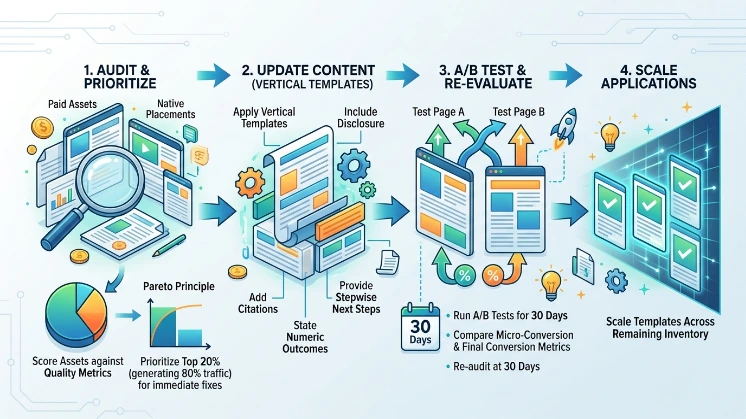
Audit all sponsored assets, prioritise fixes by traffic and conversion loss, then update content using vertical templates and re-audit after one month.
Start with an inventory of paid and native placements. Score each asset against the three core quality metrics and prioritise the top 20% of assets generating 80% of traffic for immediate fixes. Apply vertical templates that insert disclosure, citations, numeric outcomes, and stepwise next steps. For newly updated pages, run A/B tests against the original for 30 days and compare micro-conversion and final conversion metrics. Re-audit at 30 days and scale template application across remaining inventory.
Discover the Full Information
How to Align Sponsored Content Themes With UK Audience Search Intent in 2026