

Single-site sponsored content appears on one publisher’s website; multi-property content runs across two or more distinct publisher sites. Single-site placements target one audience and one editorial environment. Multi-property placements aggregate audiences across multiple editorial brands and formats.
Single-site means one domain and one audience profile managed by a single editorial team. Multi property means multiple domains under a publisher group or across different publishers, coordinated to run related sponsored articles, native placements, or content tiles simultaneously. Examples: a single-site campaign runs only on The Times; a multi-property campaign runs on The Times plus a regional news network and a lifestyle publisher.
Single-site campaigns involve a brief between advertiser and one publisher, creative approval, and placement scheduling. Multi-property campaigns require coordination across ad operations, unified targeting parameters, and harmonised creative versions. Measurement differs: single-site reports site-level metrics; multi-property reports aggregated reach, frequency, and blended cost-per-lead (CPL).
Inventory type, audience segmentation, editorial integration level, and reporting cadence. Inventory type includes homepage takeovers, article placements, and newsletter features. Audience segmentation includes demographics and interest cohorts. Editorial integration level indicates whether content is bespoke or templated across properties. Reporting cadence defines daily or campaign-end delivery of metrics.
Single-site yields deep contextual relevance and editorial alignment; multi-property yields wider net reach and better frequency control. Use cases: single-site suits campaigns needing tight brand-audience fit; multi-property suits lead-generation campaigns requiring broad reach and CPL optimisation.
How does reach differ between single-site and multi-property sponsored content in the UK?
Multi-property campaigns deliver broader unique reach than single-site campaigns because they combine distinct audience pools across properties. Multi-property reach increases unique users, reduces dependence on one editorial audience, and supports geographic coverage across the UK.
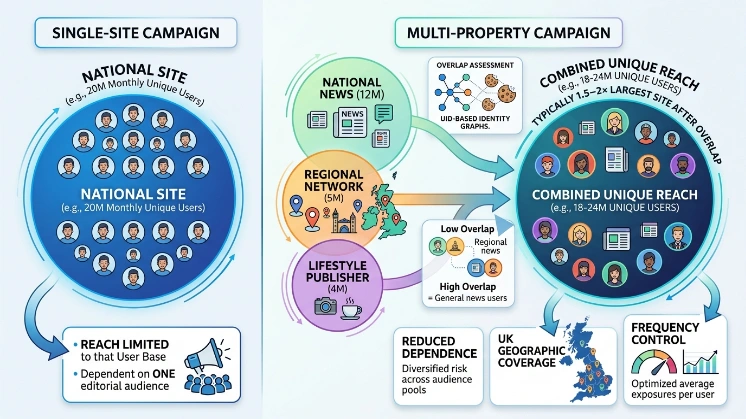
Publishers report unique monthly audience and session overlap. Single national site with 20 million monthly unique users provides reach limited to that user base. Example: a coordinated three-property set combining a national news site (12 million), a regional network (5 million), and a lifestyle publisher (4 million) yields combined reach not equal to the sum but typically 1.5–2× the largest site after accounting for overlap.
Overlap assessment uses cookie or UID-based identity graphs. Low overlap exists between niche lifestyle audiences and regional news readers. High overlap exists among general news consumers. Frequency control matters: multi-property buys can manage average exposures per user to avoid wasted impressions. Reporting must include guaranteed unique reach or target CPM to validate placement.
What drives cost-per-lead (CPL) differences between single-site and multi-property campaigns?
CPL varies primarily due to audience intent, placement context, and creative integration; single-site CPL often is higher when editorial alignment yields stronger conversions. Multi-property CPL often lowers because wider reach increases lead pool, but conversion rate may decline without strong contextual matches.
Audience intent signals (news vs lifestyle), placement prominence (above-the-fold vs in-article), editorial integration (native long-form vs feed tiles), and lead capture mechanism (form length, incentive). Example: a single-site in-article native sponsored piece with a 6-minute read and embedded form can generate CPL of £35. Example: a multi-property mix of feed cards leading to a landing page may average CPL of £18 when reach expands and creative is optimised.
Last-click models inflate CPL for channels that push users off-site. Cross-property attribution requires unified UTM tags and consistent CRM capture to measure blended CPL accurately. Advertisers should account for view-through conversions from editorial reads when comparing CPL across approaches.
How do content format and editorial integration affect dwell time and lead quality?
Long-form native content integrated with editorial context increases dwell time and improves lead quality; short-form placements increase impressions but lower average session duration. Dwell time correlates with content depth and alignment to audience interest.
Native articles of 800–1,200 words produce session durations of 3–6 minutes on news sites. Short cards or homepage tiles produce 10–45 seconds per view. Lead quality improves when content includes substantive value exchange, such as detailed guidance, data points, or tool access. Example: a single-site sponsored article offering a downloadable UK tax checklist yields qualified leads at higher conversion cost but higher lifetime value.
Operationally, embed forms, progressive capture, or gated downloads to convert engaged readers. Use event tracking and conversion pixels to link dwell time to lead events. Multi-property campaigns should standardise creative to maintain consistent messaging while adapting format for each property’s optimal article length and layout.
How should advertisers set targeting and frequency across single-site and multi-property buys?
Set specific demographic and contextual targets for each placement and cap frequency to 2–4 exposures per user during campaign flight. Targeting ensures relevance; frequency caps limit wasted impressions and reduce CPL inflation from overexposure.
Use publisher first-party data segments, contextual taxonomy tags, and geo-targeting for UK regions. Example segments: financial services interest (1.2 million users), regional politics readers in London (0.9 million), and lifestyle home-improvement readers (0.6 million). Frequency rules: cap impressions differently per channel—news article reads tolerate 1–2 exposures; homepage takeovers require 1 exposure maximum per user.
Monitor reach, frequency distribution, and incremental lift. Adjust bids or pacing when frequency skews high for low-converting segments. For multi-property buys, harmonise segments across properties to avoid duplication and wasted spend.
How to measure performance and attribute leads across single-site and multi-property campaigns?
Use unified tracking, standardised UTM parameters, and a centralised analytics dashboard to compare reach, conversion rate, and CPL across placements. Combine publisher reporting with first-party event data and CRM ingestion for full-funnel visibility.
Unique users reached, sessions, average session duration, scroll depth, click-through rate to lead capture page, conversion rate, and CPL. Example reporting cadence: daily impressions and clicks, weekly dwell and engagement trends, campaign-end CPL and conversion quality. Attribution models: time-decay or data-driven models better reflect editorial impact than last-click alone.
Ensure publishers provide impression-level data for matching, and export events to a CDP or analytics platform. Reconcile publisher-reported leads with CRM-validated leads to calculate true CPL and lead quality. Report on cost-per-engaged-user and cost-per-qualified-lead when lead qualification occurs post-capture.
What are typical performance ranges for reach and CPL in UK sponsored content campaigns?
Typical ranges: multi-property campaigns achieve 1.2–2.5× the unique reach of a single-site buy; CPL ranges vary from £15–£60 depending on format, audience, and lead qualification. Values depend on vertical and placement.
Consumer finance lead-gen CPL often sits between £20–£45 when using multi-property mixes; healthcare awareness CPL often sits between £15–£35 with strong editorial context; B2B recruitment CPLs range £40–£80 due to higher qualification requirements. Format impact: long-form native pieces yield higher dwell and higher CPL; feed-card networks yield lower CPL but lower lead quality.
Advertisers must define target CPL based on customer lifetime value. Use test-and-learn with controlled budgets to refine expected ranges before scaling.
When should an advertiser choose single-site over multi-property placement?
Choose single-site when deep editorial alignment, premium brand safety, and specific audience composition deliver higher lead quality that justifies higher CPL. Single-site suits campaigns where context and brand association drive trust and conversions.
High-value financial products requiring credibility, regulated public health campaigns needing authoritative environments, or brand partnerships that require bespoke editorial collaboration. Measurement requirements: expect smaller reach, denser engagement, and clearer editorial control. Prepare for higher CPMs and monthly or campaign-level guaranteed placements.
Explore More Expert Insights:
How a 3-Month Sponsored Content Campaign on 10 UK Sites Drove 620 Qualified Leads
Sponsored Content Packages on UK News Sites: What Each Tier Delivers
When is multi-property the better option for UK campaigns?
Choose multi-property when the goal is to scale reach, lower average CPL, and cover multiple audience segments or UK regions quickly. Multi-property suits performance-led campaigns needing volume and geographic coverage.
Consumer lead generation across UK regions, product launches targeting diverse demographics, and campaigns requiring frequency and repetition across different content ecosystems. Measurement requirements: plan for aggregation, overlap correction, and consistent creative templates. Optimise by shifting spend to high-conversion properties during flight.
How do publishers report and verify reach and CPL for sponsored content?
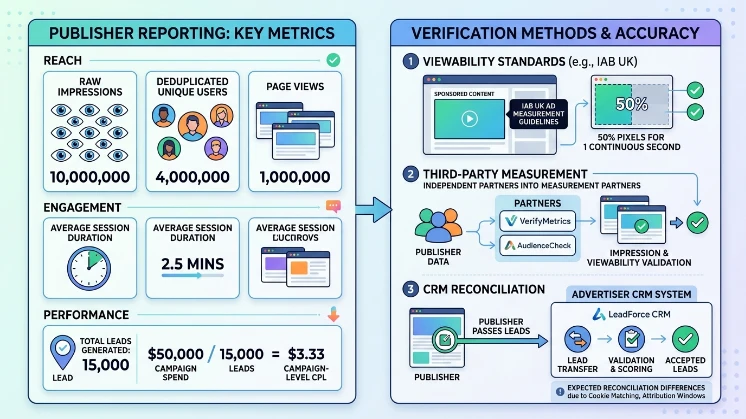
Publishers report impressions, unique users, page views, session duration, and leads; verification uses viewability standards, third-party measurement, and CRM reconciliation. Reporting includes raw and deduplicated reach numbers plus campaign-level CPL based on reported leads.
Follow IAB UK viewability and ad measurement guidelines. Third-party verification uses measurement partners to validate impressions and viewability. CRM reconciliation happens when publishers pass leads to advertiser systems for validation and scoring. Expect reconciliation differences due to cookie matching and attribution windows.
Click Here to Explore More:
How Native Content on News Sites Earns 3× Longer Dwell Time Than Social Posts
Dive Deeper Into This Topic:
Headlines for Sponsored Articles: 9 Formulas That Drive UK News Reader Clicks



