

The 39% quality problem describes research showing 39% of UK-sponsored content scores below quality thresholds and fails basic relevance, trust, or clarity tests. This problem measures content that misses minimum standards for search intent alignment, factual accuracy, or audience relevance. Researchers assess quality using criteria such as topical relevance, clear sourcing, explicit audience signals, readability, and technical SEO. In 2026 audits across news sites, publisher platforms, and brand partnerships, 39% of sponsored pieces failed two or more criteria. The result: low engagement, poor dwell time, and weak conversion signals.
Quality metrics used in assessments focuses on measurable attributes. Topical relevance refers to precise alignment with user queries and intent. Sourcing requires cited evidence, dates, and named authorities. Readability mandates short paragraphs, clear headings, and consistent terminology. Technical SEO demands correct metadata, schema, and mobile performance. When sponsored content lacks these elements, algorithmic systems and human readers both penalize it.
Examples include sponsored explainers that do not answer common user questions, financial partnership articles that omit regulatory context, and healthcare pieces that lack verifiable sources. Each example shows a failure to meet at least one core metric. The 39% figure aggregates these failures across evaluated UK campaigns in 2026.
Why does sponsored content fail to match UK audience search intent?
Content fails search intent when creators target generic themes instead of explicit UK user queries and context-specific needs. Search intent for UK audiences includes location-specific language, regulatory context, and culturally relevant use cases. Many sponsored pieces use broad messaging aimed at global readers. Those pieces omit UK-specific signals such as legal frameworks, local pricing, regional comparators, and national examples. Search engines and users penalise this mismatch through low rankings and quick exits.
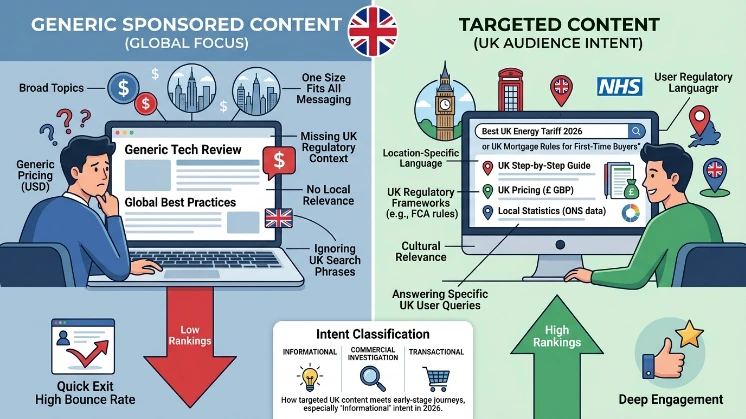
Intent classification splits into informational, commercial investigation, and transactional intent. In the UK in 2026, informational queries dominate early-stage journeys. Successful sponsored content should answer direct questions, provide statistics from UK sources, and present step-by-step clarity. Failure often occurs when content assumes readers already know the local landscape or when it ignores common UK search phrases and synonyms. Examples: articles about pensions that ignore UK auto-enrolment rules, tech reviews that exclude UK network compatibility, and healthcare explainers that omit NHS guidance.
How do measurement and governance gaps reduce sponsored content quality?
Gaps in measurement and governance exist when brands and publishers lack unified quality standards, audit processes, and accountability for sponsored content outcomes. Many partnerships do not require shared KPIs beyond impressions. Without agreed metrics for relevance, accuracy, and user satisfaction, teams prioritise volume over quality. Publishers sometimes accept sponsored briefs that do not mandate fact-checking or editorial review. Brands occasionally approve content without verifying source attribution or compliance with UK regulations such as ASA rules for advertising and CAP codes.
Governance failures show in missing editorial sign-off, lack of independent fact-checks, and absent technical SEO checks. Measurement flaws include reliance on surface metrics—clicks and pageviews—rather than dwell time, scroll depth, and task completion. As a result, content appears live but does not satisfy readers’ needs. Audits that applied standardised quality rubrics in 2026 found these gaps contribute directly to the 39% failure rate.
What process changes improve relevance and conversion for sponsored content?
A structured content process that integrates audience research, UK-specific QA, and SEO checks before publication improves relevance and conversion. Effective processes begin with explicit audience definition and search intent mapping. Teams must document the exact queries the content targets and list primary UK entities to reference. The next step is a content brief requiring named sources, required editorial reviews, and a technical checklist for metadata and mobile loading. Workflow should include independent fact-checking and a post-publication performance review.
Measurement during the process must include qualitative review milestones. Early drafts require an intent-alignment check does the opening answer the target query within the first 40 words? Mid-stage reviews verify sources and compliance with UK advertising rules. Final technical review confirms metadata, canonical tags, and schema markup. After publication, teams monitor dwell time, organic search refinements, and conversion micro-actions. Repeat iterations use these signals to update content and reduce future failures.
Which core components determine sponsored content quality?
Core components are intent alignment, factual sourcing, clarity of structure, technical SEO, and governance controls. Intent alignment means the headline, opening lines, and subheadings map directly to user queries. Factual sourcing requires named UK sources, publication dates, and links to primary data. Clarity of structure uses concise paragraphs, explicit answers, and clear H1/H2 hierarchy. Technical SEO covers metadata, schema, mobile performance, and secure hosting. Governance controls mandate editorial sign-off, legal review for claims, and transparent labeling of sponsored relationships.
Each component has measurable checks. Intent alignment uses keyword intent matrices. Sourcing uses a citation checklist (source name, date, link). Clarity uses readability scores and paragraph-length limits. Technical SEO metrics include page speed scores and schema validation. Governance uses a sign-off log and a compliance checklist. Missing any component increases the chance a piece belongs to the 39% failing group.
What benefits result from fixing the 39% quality problem?
Fixing quality issues raises organic visibility, increases user trust, and improves measurable engagement such as dwell time and form completions. When content aligns with UK search intent and includes verifiable sources, search engines rank it higher for relevant queries. Higher rankings deliver sustained organic traffic instead of one-off referral spikes. Users who find clear, source-backed answers spend more time on pages and engage with follow-up content or micro-conversions. Brands and publishers see improved view-through rates and more meaningful KPIs, such as returning visitors and assisted conversions.
Improved governance reduces regulatory risk. Clear labeling and accurate claims prevent complaints under ASA and CAP rules. Technical improvements lower bounce rates through faster load times. Together, these benefits convert more of the remaining 61% of effective content into measurable outcomes, while reducing wasted spend on underperforming campaigns.
Which use cases show the largest conversion gains after quality improvements?
High-impact use cases include financial education pieces, health explainers, and technology compatibility guides tailored for UK readers. Financial education content benefits from UK-specific tax rules, pension regulations, and example calculations. Healthcare explainers perform better when they reference NHS guidance, local clinical pathways, and verified studies. Technology guides increase conversions when they include UK device models, network compatibility, and retailer availability. These verticals show measurable uplift because UK users require jurisdiction-specific answers before taking action.
Pension explainers that include auto-enrolment thresholds and sample numerical projections show higher engagement. NHS-aligned health content that cites recent UK public health guidance increases trust signals and session duration. Tech articles that list UK-compatible bands and retailer SKUs reduce friction and improve assisted conversions. Each example demonstrates how removing one or more failures from the 39% group translates to measurable performance gains.
Explore More Expert Insights:
How Native Content on News Sites Earns 3× Longer Dwell Time Than Social Posts
Sponsored Content vs Display Advertising: Where UK Purchase Intent Actually Lives
How does content format affect conversion for UK sponsored pieces?
Formats designed to answer search queries directly Q&A, short explainers, and numbered steps—improve conversion compared with long-form general narratives. Readers in the UK use search to complete tasks quickly. Formats that present direct answers in the first 40 words, followed by concise sections, deliver higher task success. Q&A formats map to question queries. Short explainers map to informational intent. Step-by-step guides map to procedural queries. Formats that bury answers in long narratives reduce dwell time and increase bounce rates.
Effective formats combine a clear opening answer, supportive evidence, and a short summary of next steps. Metadata and headings must reflect the chosen format so search engines extract relevant snippets. When sponsored content uses these formats and adheres to the core components, conversion metrics improve consistently.
What immediate checks reduce the chance of joining the 39% failure group?
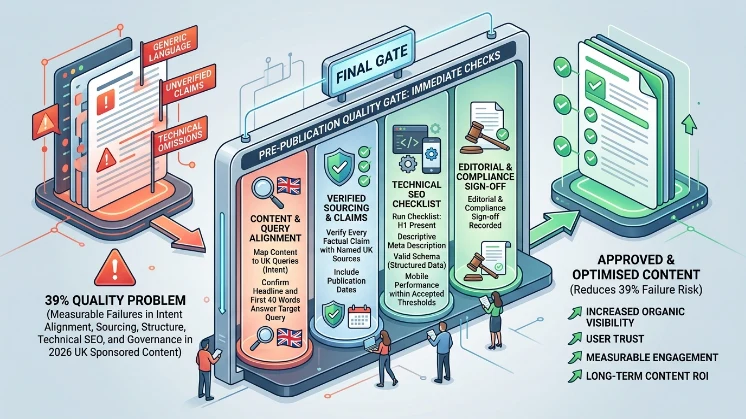
Immediate checks include confirming UK intent alignment, verifying all claims with named UK sources, and running a technical SEO checklist before publish. Before publishing, confirm the headline and first 40 words answer the target query. Verify every factual claim with a named UK source and include publication dates. Run a metadata check: H1 present, descriptive meta description, valid schema, and mobile performance within accepted thresholds. Ensure editorial and compliance sign-off is recorded.
These checks act as a final gate. They intercept common failures such as generic language, unverified claims, and technical omissions. Implementing these checks reduces the risk of inclusion in the 39% and improves long-term content ROI.
Read the Full Blog Here:
How to Align Sponsored Content Themes With UK Audience Search Intent in 2026
The 39% quality problem reflects measurable failures in intent alignment, sourcing, structure, technical SEO, and governance across UK sponsored content in 2026. Clear definitions, structured processes, and specific checks reduce failure risk. Priority improvements include mapping content to UK queries, verifying claims with named sources, enforcing editorial sign-off, and optimising technical SEO. Addressing these areas increases organic visibility, user trust, and measurable engagement without promotional messaging.
Discover More Insights:
Sponsored Content for UK Financial, Tech and Healthcare Brands: Vertical Benchmarks



