

Native content on news sites is editorial-style material paid for or produced to match the host site’s format, tone, and audience; it appears alongside journalistic content and integrates with site design.
Native content equals sponsored articles, advertorials, and paid features when they follow the publisher’s editorial format. Entities involved include advertisers (funders), publishers (site hosts), editorial teams (format and style), and readers (audience). Native content uses the publisher’s headline conventions, body structure, image sizes, metadata, and navigation placement.
How does native content differ technically from social posts?
Native content runs inside a publisher’s content management system with full article metadata, structured HTML, and persistent URLs; social posts live on platforms with ephemeral feeds and limited structured metadata.
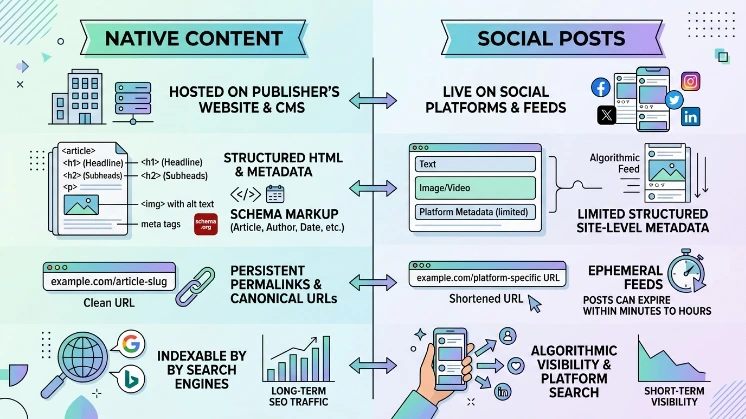
Native content uses structured schema markup (article, author, date), canonical URLs, and persistent permalinks. Publishers supply headings, subheads, image alt text, and tag taxonomies. Social posts use platform-specific formats (cards, short text, image/video) and rely on algorithms to surface content; they lack persistent site-level metadata and often expire from feeds within minutes to hours. Example: a native article with schema.org/article markup remains indexed and accessible on search engines; a tweet-sized post gets discoverability via platform search and archived threads only.
Why do readers spend three times longer on native articles than on social posts?
Readers spend more time because native articles present longer-form, structured content, load in site context, and offer related links that extend sessions.
Native articles average 800–1,500 words and include headings, multimedia, and in-article navigation. Readers arrive via search or navigation with intent to read, not to scroll a feed briefly. Publishers add related-article modules and recommended reads that increase session length. Loading within the publisher’s site removes the platform jump that ends dwell time measurements. Example: a 1,200-word feature with embedded video and a “related reads” strip yields session durations near 4–6 minutes, while a social post link often records 1–2 minutes.
What measurement methods show longer dwell time?
Measurement uses time-on-page analytics, session duration, scroll depth, and engagement metrics sourced from web analytics platforms and attention tracking tools.
Time-on-page calculates the interval between page load and last interaction. Session duration aggregates time across pages within a visit. Scroll depth measures how far readers scroll, often as a percentage of article length. Attention tools record active tab time and mouse movement. Publishers cross-reference these metrics with campaign reports to validate dwell times. Example: analytics show average time-on-page for native articles at 3:45 minutes versus 1:10 minutes for visits from social referral links.
Which content features increase dwell time on news sites?
Long-form narrative, clear headings, inline multimedia, author credibility, and related content modules increase dwell time on news sites.
Long-form narrative gives readers context and depth. Clear headings and subheads support skimming and focused reading. Inline multimedia such as photos, interactive charts, and short videos extend engagement. Author credentials and datelines add perceived authority. Related-content modules and internal links encourage sequential consumption. Example: a feature that combines a 1,000-word narrative, two photos, one data visual, and three internal links records higher scroll depth than a plain-text article.
How does placement on the site affect dwell time?
Placement within editorial channels, homepage features, or category pages increases visibility and leads to higher dwell time compared with placements inside ad slots or isolated landing pages.
Content placed within editorial streams appears to readers as a natural article selection. Homepage and category placements inherit editorial context and site navigation, producing stronger session continuity. Ad-slot placements open in different frames or lack surrounding context, reducing reader immersion. Example: native content featured in the technology section receives readers who browsed other tech articles, increasing the chance they read fully, while the same content in a banner ad yields lower session length.
What role do audience intent and referral source play?
Referral source defines intent: search and direct navigation indicate reading intent and create longer visits; social referrals indicate discovery intent and create shorter visits.
Search referrals bring users who actively seek information. Direct visitors include subscribers and returning readers with established habits. Social referrals originate from feeds and emphasise quick consumption and fast scrolling. Email referrals combine intent and curation and often deliver higher dwell times than social. Example: search-driven traffic to a native article shows 3.5 minutes average, direct traffic 4.1 minutes, social referrals 1.2 minutes.
How do content length and structure correlate with dwell time?
Longer content with clear structure correlates positively with dwell time when headings, short paragraphs, and visual breaks aid readability.
Word counts between 800 and 1,500 words show strong engagement on news sites. Structuring with H2 and H3 headings, short paragraphs, and embedded visuals reduces cognitive load and sustains reading. Excessively long paragraphs or dense text reduces completion rates. Example: articles formatted with H2s every 200–300 words and 3–4 images outperform continuous 2,500-word blocks without headings.
What technical optimisations improve dwell time for native content?
Faster page loads, mobile-responsive design, accessible images, and reliable navigation improve dwell time for native content.
Page speed affects bounce rates; each 1-second delay reduces engagement. Mobile-responsive templates keep layout consistent across screens. Proper image compression and lazy loading maintain visual quality while reducing load time. Stable navigation and working related-article widgets keep readers within the site. Example: reducing page load from 4.5s to 2.0s increases average time-on-page by measurable margins in standard analytics.
What ethical and disclosure practices are required for native content?
Publishers must label paid or sponsored content clearly, disclose funding sources, and maintain editorial transparency to preserve reader trust and comply with regulatory rules.
Disclosure includes visible “Sponsored,” “Paid for by,” or “Partner content” labels near headlines. Funding sources and material connections appear in author notes or end copy. Clear separation between advertising and news ensures compliance with advertising standards and reader trust. Sponsored feature contains a visible “Paid content” label and a disclosure paragraph at the top or bottom.
Explore More Expert Insights:
Sponsored Content vs Display Advertising: Where UK Purchase Intent Actually Lives
Why UK Consumers Flag AI-Generated Content as Less Trustworthy Than Editorial
What benefits do publishers and advertisers gain from higher dwell time?

Higher dwell time improves publisher ad inventory value, increases content valuation, and provides advertisers with deeper message exposure and richer analytics.
Publishers monetise longer sessions through display, native ad rates, and subscription appeal. Advertisers gain sustained exposure, message retention, and better attribution signals for conversions. Analytics from longer visits support content optimisation and future campaign planning. Example: a publisher reports a 35% uplift in RPM (revenue per thousand impressions) for pages with higher average dwell time compared with baseline pages.
Where does native content fit into a content strategy for UK news audiences?
Native content serves awareness, education, and context objectives by delivering detailed narratives tailored to regional interests and topical relevance within UK news ecosystems.
UK readers respond to locally relevant reporting, clear datelines, and credible sourcing. Native content with UK-focused examples, statistics, and regulatory references aligns with reader needs for depth. Structured native pieces complement short social formats by providing in-depth background and citation-ready facts. Example: a UK-focused analysis that cites Office for National Statistics data and UK regulators attracts readers seeking authoritative context.
Discover More Insights:
Headlines for Sponsored Articles: 9 Formulas That Drive UK News Reader Clicks
Native content on news sites generates longer dwell time because it aligns with reader intent, uses structured article formats, integrates within site navigation, and applies technical and editorial best practices. Measured by time-on-page, session duration, and scroll depth, native articles typically record roughly three times the dwell time of social-post referrals when they combine 800–1,500 words, clear headings, multimedia, fast load times, and transparent sponsorship labeling.
Learn More Here:
Single Site vs Multi-Property Sponsored Content: UK Reach and CPL Compared



