

Sponsored content places relevant editorial-style material within a publisher’s environment; display advertising places visual ad units in predefined slots. Sponsored content integrates messaging into an article, video, or list; display advertising uses banners, leaderboards, or native ad slots separate from editorial flow.
Sponsored content uses long-form formats: articles, interviews, explainer pieces, or videos. It uses contextual relevance and editorial tone to align with a target audience’s interests. Display advertising uses static images, animated creatives, or rich media to drive awareness via impressions and clicks. Sponsored content often includes headings, bylines, and in-content links. Display advertising relies on placement metrics: viewability rates, ad size, and position on page.
Both formats run on publisher sites and programmatic exchanges. Sponsored content commonly targets intent through topical relevance and content depth. Display advertising targets audience segments through cookies, device identifiers, and contextual signals.
How do sponsored content and display advertising perform on purchase intent metrics?
Sponsored content generates higher engagement and time-on-content; display advertising drives broader reach and frequency. Sponsored content produces longer session durations and higher scroll depth. Display ads produce higher impressions and quicker brand recall.
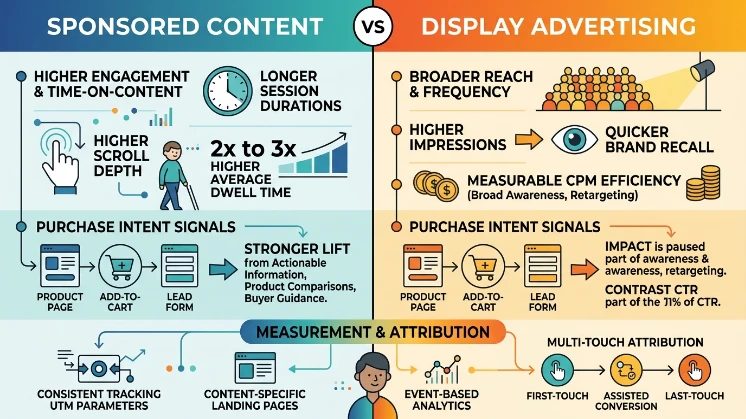
Performance varies by metric. Sponsored content typically yields 2x to 3x higher average dwell time compared with standard display placements on the same site. Click-through rates for sponsored content are generally higher for content-driven audiences but lower for high-volume reach goals. Display advertising delivers measurable CPM (cost per 1,000 impressions) efficiency for broad awareness and retargeting. Purchase intent signals—measured by product page visits, add-to-cart events, and lead form starts—show stronger lift from sponsored articles that include actionable information, product comparisons, or buyer guidance.
Measurement requires consistent tracking UTM parameters, content-specific landing pages, and event-based analytics. For direct attribution, combine first-touch, last-touch, and assisted conversion metrics to view how each format contributes along the funnel.
How does audience targeting differ between the two formats?
Sponsored content targets through topical context and publisher audience demographics; display advertising targets through behavioral, contextual, and cohort signals. Sponsored content leverages reader intent based on article topic and publisher section (e.g., finance, technology). Publishers supply audience segments by age, profession, or interest; editorial alignment enhances relevance. Display advertising uses third-party data, first-party site data, and contextual keywords to build targeting sets such as retargeting lists, lookalike audiences, and interest cohorts.
Sponsored content benefits when a high-intent audience visits specific editorial verticals. Example: a B2B finance article on procurement reaches procurement managers. Display advertising benefits when campaigns require wide exposure across multiple sites or when using programmatic channels to reach specific demographic cohorts like gender, age, or region.
What measurement methods validate purchase intent from each channel?
Combine behavioral analytics, event tracking, and lift studies to validate purchase intent; use content-specific KPIs for sponsored content and impression/engagement KPIs for display. For sponsored content, measure time on page, scroll depth, content click-throughs, and subsequent product or resource page visits. For display advertising, measure viewable impressions, click-through rate, ad engagement rate, and post-click behavior. Both require tracking conversions like product views, cart additions, and form completions.
Run A/B or geo lift tests to isolate impact. Example: expose region A to sponsored content and region B to display ads, then compare product page visits and lead starts per 1,000 users. Use incremental lift analysis to quantify incremental purchase intent beyond organic performance. Attribution models must include assisted conversions to account for multi-touch journeys.
Where in the purchase funnel does intent most often emerge for each format?
Sponsored content frequently drives mid-funnel intent through education and comparison; display advertising primarily drives top-funnel awareness, with retargeting nudging lower-funnel behavior. Sponsored content educates readers, answers product questions, and compares options; this activity moves users from awareness to consideration. Display advertising establishes initial brand recognition and captures attention at scale. When display ads retarget users after site visits, they convert awareness into action by reminding or promoting time-limited offers.
Measure intent emergence by tracking sessions that progress from content consumption to product interaction within 7 days. Sponsored content shows a higher proportion of sessions moving to consideration signals (e.g., multiple product page views). Display advertising shows larger volumes of first exposures that later enter retargeting pools.
What content elements within sponsored content increase purchase intent?
Clear product comparisons, actionable takeaways, data points, and in-content links to product pages increase purchase intent. Use explicit headings that outline benefits, numbered steps for feature use, and real metrics or case examples. Include product specifications, pricing ranges, and calls-to-action that lead to informational landing pages rather than hard-sell pages. Use images or charts to present performance data. Provide quotes or short interviews from verified industry figures to add credibility.
Example: an industry comparison article with a 3-column table showing features, pricing bands, and best-use cases generates measurable click-throughs to product pages. Embed one link per major section with UTM tagging to trace downstream behaviors.
How does creative and messaging differ between the formats to influence intent?
Sponsored content uses informative, research-based messaging display advertising uses concise, benefit-driven messaging and bold visuals. Sponsored content presents detailed explanations, stepwise guides, or long-form reviews. Messaging includes evidence, performance numbers, and contextual use cases. Display creatives prioritize short headlines, singular value propositions, and actionable buttons to trigger immediate clicks or ad recall.
For intent influence, sponsored content should present comparison points and buyer criteria. Display creatives should prepare audiences for the content experience by aligning visual tone and headline with the sponsored article topic to improve continuity between ad and content.
What role does publisher selection play in purchase intent delivery?
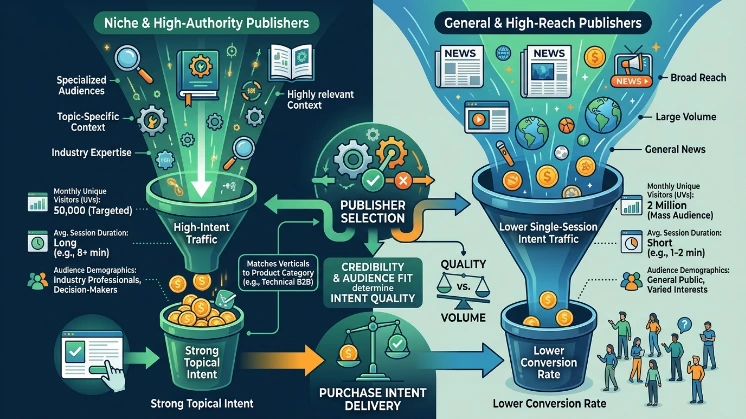
Publisher credibility and audience fit determine intent quality: high-authority niche publishers produce higher-intent traffic; high-reach general publishers produce larger volume. Niche publishers with specialised audiences deliver readers with stronger topical intent. General news publishers deliver scale but lower single-session intent. Match publisher verticals with product category to maximise intent. Check publisher metrics: monthly unique visitors, average session duration, and audience demographic breakdown.
Example: a technical B2B purchase shows higher intent when content runs on a trade publication with 50,000 monthly specialised readers than on a general news site with 2 million monthly readers.
How should UK marketers allocate budgets between sponsored content and display to capture intent?
Allocate based on objective: use display for reach (brand awareness) and sponsored content for intent (consideration); split budget toward sponsored content when the goal is qualified leads. For upper-funnel brand goals, allocate 60% display and 40% sponsored content. For mid-funnel consideration or lead generation, invert to 60% sponsored content and 40% display. For campaigns focused on purchase intent metrics such as product page visits or lead starts, increase sponsored content spend and run coordinated display retargeting.
Set time-bound measurement windows (7-day, 30-day) and evaluate cost per intent action (e.g., cost per product-page visit, cost per lead start) to refine allocation. Rebalance monthly based on observed conversion efficiency.
Which KPIs reliably indicate purchase intent in the UK market?
Reliable KPIs include product page views, add-to-cart events, lead form starts, time on content exceeding 120 seconds, and assisted conversion counts. For sponsored content, track scroll depth >50%, content link click-through rate, and downstream product interactions. For display advertising, track viewable CPM, click-through rate, and retargeting conversion rate. Use cohort analysis segmented by source to compare intent velocity and lifetime value predictions.
Explore More Expert Insights:
Why UK Consumers Flag AI-Generated Content as Less Trustworthy Than Editorial
Why AI-Generated Sponsored Content Is Failing UK Audiences in 2026
What are practical use cases where sponsored content outperforms display for purchase intent?
Sponsored content outperforms for complex B2B buying journeys, high-consideration consumer purchases, and education-driven product categories. Use sponsored content for software procurement guides, financial product explainers, and durable goods comparisons. Display underperforms when buyers need detailed information before action. Sponsored content captures readers researching solutions and comparing features.
Example: a multi-page sponsored guide on procurement workflows generated higher qualified inquiries for enterprise products than a month-long banner campaign on the same publisher network.
How do regulatory and brand-safety considerations affect format choice in the UK?
Regulations require clear labelling for sponsored content; brand-safety measures apply equally to both formats via pre-bid filters and publisher policies. UK advertising rules demand transparency: sponsored material must be labelled as paid or sponsored. Display ads must respect content category exclusions. Use brand-safety tools to exclude sensitive sections and apply negative contextual targeting. Maintain records of publisher placements and labeling to meet compliance audits.
Discover the Full Information:
Sponsored Content Calendar Planning: A 12-Month UK Framework for B2B Brands
Sponsored content drives stronger mid-funnel intent via in-depth information and publisher context; display advertising drives top-funnel reach and supports retargeting. Use sponsored content when the objective is consideration or qualified lead generation. Use display when the objective is awareness and scale. Combine both formats in sequential strategies: display for reach, sponsored content for education, and display retargeting for conversion nudges.
Explore the Complete Guide:
How a 3-Month Sponsored Content Campaign on 10 UK Sites Drove 620 Qualified Leads



