

A sponsored content package is a paid editorial-style placement that combines native articles, display ads, and distribution to reach a publisher’s audience. A package bundles specific deliverables, placement guarantees, and performance metrics. Publishers sell tiers often labeled bronze, silver, gold, or custom that scale by reach, content volume, creative formats, and reporting. Each tier defines publication pages, run-length, and amplification channels.
What a package includes: size and placement of native article on desktop and mobile pages, homepage exposure (number of hours or days), section placements (such as business or lifestyle), programmatic or direct display ad impressions, and social or newsletter boosts. Measurement components include guaranteed impressions, viewability rates, click-through rates, and post-campaign reporting with audience demographics. Contracts include editorial guidelines, approval windows, and disclosure language mandated by the Advertising Standards Authority (ASA) in the UK.
How do tiers differ in reach and placement?
Higher-tier packages guarantee larger audience exposure, premium homepage slots, and multiple section placements. Entry tiers typically secure a single article on a section page with minimal homepage time. Mid tiers add homepage features for set hours or days, syndicated placement across topic hubs, and one or two newsletter inclusions. Top tiers guarantee homepage takeovers, front-page carousel slots, and multi-day headlines. Publishers quantify reach as guaranteed unique visitors or guaranteed page views over the campaign duration.
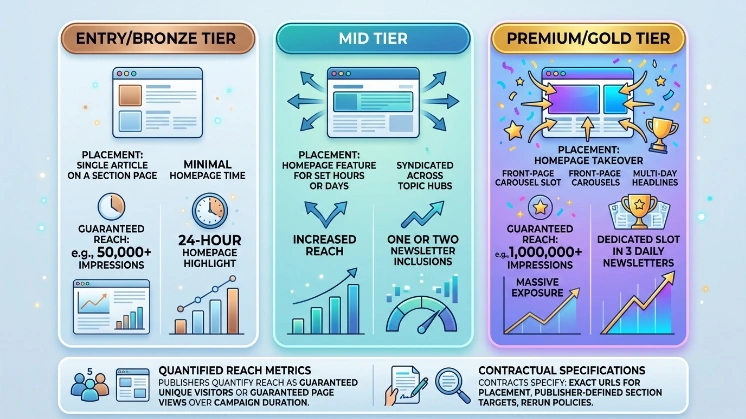
A bronze tier might promise 50,000 guaranteed impressions and a 24-hour homepage highlight. A gold tier can include 1,000,000 guaranteed impressions, 72 hours on the homepage carousel, and a dedicated slot in three daily newsletters. Contracts list exact URLs for placement or publisher-defined section targets and specify rerun policies.
What editorial elements come with each tier?
Packages provide varying editorial support: from a brief content template to journalist-written features and multimedia production. Low-cost tiers often offer an advertiser-provided article published with minimal edits and a required sponsorship label. Mid-range tiers include an editorial brief, journalist drafting, two rounds of client edits, and basic image sourcing. High-end tiers include journalist-led reporting, professional photography or video production, interactive graphics, and headline optimisation by the publisher’s editorial team.
Example deliverables by tier: bronze = one 600–800-word article using client copy, silver = one 800–1,200-word journalist-written feature plus two images, gold = two journalist-written features, a short video (30–60 seconds), infographic, and bespoke imagery. Each deliverable includes an editorial timeline: briefing (day 0), first draft (day 7), revisions (day 10), and publication slot (day 14), unless a custom production schedule is agreed.
What creative formats do publishers offer within packages?
Publishers offer native articles, branded video, interactive graphics, display ads, and newsletter placements as package components. Native articles follow editorial style but include a sponsorship disclosure. Branded video runs as in-article embeds and on-site video players. Interactive formats include data visualisations, quizzes, and microsites hosted on the publisher domain. Display formats include leaderboard, MPU, and skin placements. Newsletter placements appear as sponsored slots or branded sponsorship banners inside targeted email editions.
Example format mix by tier: basic = native article and MPU (300×250) for two weeks; intermediate = native article, short video embed, leaderboard (728×90), and one newsletter mention; premium = native article, exclusive homepage hero, interactive graphic, full-screen skin, video pre-roll, and three newsletter inclusions with custom subject line placement.
How do publishers measure performance for each tier?
Publishers report impressions, unique visitors, time on page, viewability, clicks, and audience demographics as standard metrics. Contracts list guaranteed metrics and post-campaign analytics. Impressions capture total ad or content views; unique visitors count distinct users exposed to the content. Time on page shows engagement depth, while viewability tracks how often the content appeared in the user’s visible browser area. Click metrics show direct action, and demographic breakdowns show age, gender, and geographic concentration. Premium packages include third-party verification such as IAS or Moat reporting.
Example reporting cadence: weekly snapshot reporting during the campaign and a final report within 7 calendar days after the campaign ends. Final reports include a CSV export of performance data, heatmap screenshots for interactive assets, and audience cohort analysis.
What compliance and disclosure standards apply in the UK?
All sponsored content must display clear commercial disclosure and follow the ASA and CAP Code rules for advertising transparency. Publishers label sponsored content with terms such as “Sponsored,” “Paid-for content,” or “Paid post.” Labels appear near the article headline and inside the meta tags for search engines. Content cannot present claims without substantiation. Editorial independence claims must be accurate; the publisher must not mislead readers about authorship or the commercial nature of content.
Example compliance items: a visible “Sponsored” label at the top of the article, a linked sponsorship statement, and substantiation documents for any factual claims cited in the piece. Publishers often provide legal review to ensure copy and creative meet ASA standards prior to publication.
What pricing models and payment terms do packages use?
Publishers price packages using fixed fees, CPM (cost per mille), or hybrid models combining flat fees with performance bonuses. Fixed-fee pricing sets a single cost for the entire package and includes guarantees. CPM pricing charges per 1,000 impressions and links final cost to actual delivery. Hybrid models set a base fee plus bonuses tied to performance thresholds, such as additional payments for exceeding guaranteed viewability or engagement targets. Payment terms commonly require a 50% deposit on signing and remaining 50% on publication or within 30 days after invoice.
Example price ranges: small regional publishers list bronze tiers from £1,500–£5,000; national titles list mid tiers from £10,000–£50,000; top-tier national packages with video production, homepage takeovers, and newsletter domination range from £75,000–£250,000. Custom enterprise programs for long-term partnerships run into six figures annually.
What are the benefits for advertisers at each tier?
Lower tiers provide targeted niche reach and cost efficiency; higher tiers deliver wide reach, credibility via publisher context, and stronger engagement. Entry-level packages suit product launches aimed at focused audiences and produce measurable site traffic. Mid tiers support thought-leadership campaigns and drive qualified leads through richer content and multiple distribution points. High-end tiers deliver brand-building at scale, sustained visibility across top pages, and integrated creative assets that drive deeper engagement metrics such as extended time on page and repeated exposures.
Bronze drives 2,000–10,000 direct clicks depending on targeting; silver results include improved lead form submissions with integrated CTAs; gold fosters measurable uplift in brand search volume and earned media pickup.
How should advertisers select the right tier for their goals?
Choose a tier that matches target audience size, campaign objectives, production needs, and measurement expectations. Define objectives as brand awareness, lead generation, or conversions. Map objectives to package elements: awareness requires homepage exposure, video, and newsletter boosts; lead generation requires long-form native content plus clear CTA placements and landing pages; conversions require integrated tracking, retargeting, and performance metrics. Confirm timelines and approval windows to align internal teams with publisher milestones.
Example selection process: set a target reach number (for example, 500,000 unique users), then request publisher tiers that guarantee that reach. Compare editorial involvement if the campaign requires journalist storytelling, select a mid or premium tier that includes editorial production.
Explore More Expert Insights:
Sponsored Content Pricing in UK Media: What £5K, £15K and £30K Buys
Sponsored Content ROI Tracker: A 6-Month UK News Campaign Dissected
How do case examples show real outcomes by tier?
Case examples demonstrate scale, engagement, and ROI differences between tiers using concrete metrics and timeframes. A regional charity using a bronze package saw 8,400 unique visitors and 1,200 direct sign-ups over a 14-day run. A technology vendor using a silver package achieved 150,000 impressions, 12,000 unique visitors, and a 2.1% conversion on a gated whitepaper over 30 days. A finance brand using a gold package reached 2.2 million impressions, 420,000 unique visitors, a 3.5-minute average time on page, and a 0.8% lead conversion across a six-week campaign.
Read the Detailed Explanation:
Why UK Consumers Flag AI-Generated Content as Less Trustworthy Than Editorial
How do publishers handle long-term partnerships and measurement?
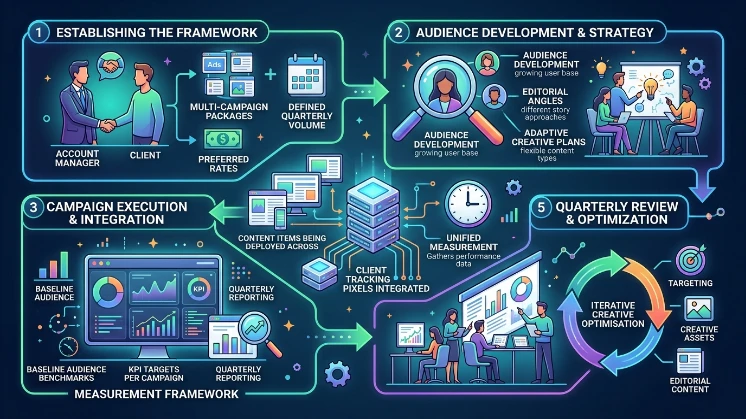
Publishers provide multi-campaign packages with quarterly reporting, audience development, and iterative creative optimisation. Long-term deals include defined quarterly volume, preferred rates, and adaptive creative plans. Measurement frameworks include baseline audience benchmarks, KPI targets per campaign, and quarterly reviews to adjust targeting, creative assets, and editorial angles. Publishers assign an account manager and often integrate client tracking pixels for unified measurement.
For decision-oriented next steps, request detailed line-item proposals from publishers that map deliverables to guarantees, ask for examples of previously published sponsored content in the requested section, and require ASA compliance statements. If you want side-by-side comparisons of typical bronze, silver, and gold deliverables in a procurement-ready format, I can produce that table and editable checklist
Explore More Expert Insights:
How to Brief a UK Publisher for Sponsored Content That Feels Like Real Journalism



