
A sponsored content ROI tracker is a system that measures revenue, engagement, and downstream actions tied to paid placements over time. It links spend to outcomes so marketers evaluate value precisely during and after a 6-month publisher campaign.
A sponsored content ROI tracker defines inputs, outputs, and attribution rules. Inputs include media spend, placement dates, creative variants, and targeting segments. Outputs include pageviews, time on page, conversions, leads, and revenue. Attribution rules assign credit across touchpoints: first click, last click, time-decay, and custom multi-touch models. For UK news campaigns, trackers must align with GDPR and UK data-protection rules. Trackers require unique identifiers per placement, consistent UTM tagging, and secure data storage.
Trackers ingest server-side analytics, publisher analytics, CRM records, advertising platform reports, and third-party measurement (for example, Nielsen Digital Ad Ratings). Each source supplies one part of the attribution puzzle impressions and viewability from ad tech, engagement metrics from site analytics, and revenue from CRM.
Use unique campaign IDs, placement IDs, and creative IDs in URLs and server logs. Apply standardised UTM parameters for campaign, source, medium, content, and term. Implement server-side tagging for conversion events to reduce loss from browser limitations and cookie restrictions.
How do you set attribution rules for a 6-month sponsored content campaign?
Define explicit attribution windows and models before launch; common choices are 30-day, 60-day, and 90-day windows with last-click, first-click, or multi-touch time-decay models. Apply the same model consistently to compare placements.
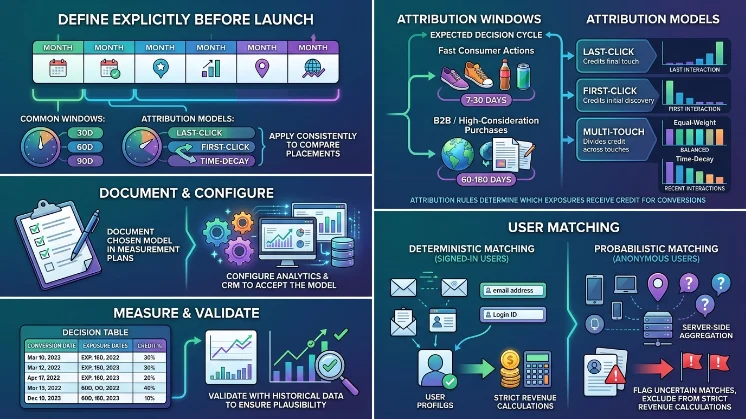
Attribution rules determine which exposures receive credit for conversions. For a 6-month campaign, set an attribution window that covers the expected decision cycle. B2B or high-consideration purchases use longer windows: 60–180 days. Fast consumer actions can use 7–30 days. Choose a model: last-click credits the final touch; first-click credits the initial discovery; multi-touch divides credit across all touches using equal-weight or time-decay formulas. Time-decay weights recent interactions more heavily.
Document the chosen model in measurement plans. Configure analytics and CRM to accept the model. Use a decision table: conversion date, exposure dates, and credit percentages. Validate with historical data to ensure plausibility.
Use deterministic matching (email or login IDs) for signed-in users. For anonymous users, use probabilistic matching and server-side aggregation. Flag uncertain matches and exclude them from strict revenue calculations.
What metrics should the tracker report every month during the campaign?
Monthly reports must include spend, impressions, viewable impressions, click-through rate, unique visitors, average time on page, assisted conversions, last-touch conversions, leads, and revenue attributed under the chosen model.
Spend and impressions show reach and efficiency. Viewable impressions and viewability rate confirm exposure quality. CTR and engagement rates indicate creative effectiveness. Average time on page and scroll depth measure content resonance. Assisted conversions show contribution without final credit. Last-touch conversions show closing power. Leads with validation status tie into CRM. Revenue must show gross and net values, including refunds or churn within the measurement window.
Month, Spend (£), Impressions, Viewable Impressions, CTR (%), Unique Visitors, Avg Time on Page (s), Assisted Conversions, Last-Touch Conversions, Leads, Revenue (£).
How do you attribute revenue from subscription or lead-based outcomes to sponsored articles?
Map article-driven actions to CRM events and assign monetary values to leads and subscriptions; apply your attribution model to credit revenue across exposures within the chosen conversion window.
For subscriptions, capture a subscription event and its revenue value including recurring payments and expected lifetime value (LTV) when appropriate. For leads, assign a lead value based on historical close rates and average deal size. Feed these values into the tracker. When an article exposure matches a conversion event in the attribution window, allocate partial or full revenue per the model. For multi-touch, distribute revenue percentages across exposures.
A lead with expected LTV £3,000 closes at 10% historically. Assign lead value = £300. If three exposures fall in the 90-day window and you use equal-weight multi-touch, credit £100 per exposure. Aggregate credits per placement to compute ROI.
Provide monthly export files with attributed revenue and identifiers. Reconcile tracker totals with invoiced publisher payments and CRM revenue reports to detect discrepancies.
What tracking architecture ensures reliable data in the UK environment?
Use a hybrid architecture: client-side measurement for deep engagement, server-side tagging for conversions, and a data warehouse for aggregation and long-term analysis. Ensure GDPR-compliant consent capture and data minimisation.
Client-side analytics capture real-time engagement metrics but suffer from ad-blockers and browser restrictions. Server-side tagging records conversions and server events reliably. A central data warehouse ingests event streams, ad platform reports, and CRM data. Use deterministic user IDs for logged-in users and hashed identifiers for matching. Implement consent management platforms (CMP) to log user consent context for each tracked event.
Store personal data encrypted. Maintain data retention policies: default 12 months for granular logs, 36 months for aggregated reporting. Provide data access logs and processes for subject access requests. Use Data Protection Impact Assessment (DPIA) for cross-border transfers.
What components influence ROI most in a 6-month UK news campaign?
Primary drivers are creative relevance, placement quality, audience match, and attribution window length; secondary drivers include seasonality, editorial alignment, and measurement fidelity.
Creative relevance determines engagement. Placement quality affects viewability and brand safety. Audience match establishes intent alignment. Attribution windows change how much credit content receives for downstream revenue. Seasonality alters baseline demand; political or economic events shift engagement patterns in the UK. Measurement fidelity influences accuracy: poor tagging undercounts conversions and inflates apparent CPA.
Test creative headlines, article formats (long-form vs short-form), and placement contexts (homepage vs section pages). Run A/B tests with clear variant IDs and measure lift in CTR and conversions. Compare editorial-sponsored formats vs purely native formats for engagement and trust.
A headline variant increased CTR from 0.15% to 0.30% and doubled assisted conversions in month two, improving overall campaign ROI by 18% under the same spend.
How do you run post-campaign analysis and present ROI to stakeholders?
Deliver a final report showing spend, attributed revenue, net ROI, cohort performance over six months, and lessons tied to measurable changes include raw data exports and methodology notes for auditability.
Start with executive summary: total spend, total attributed revenue, net ROI = (Attributed Revenue − Spend) / Spend. Present month-by-month performance and cohort breakdowns by placement, creative, and audience segment. Show retention or churn for subscription outcomes over the measurement window. Provide a methodological appendix describing attribution rules, data sources, matching rates, and known limitations.
Supply charts for cumulative revenue vs spend, funnel conversion rates, and placement-level ROI. Include CSV exports with placement IDs, dates, spend, impressions, clicks, conversions, and attributed revenue. Archive raw logs for 12 months to allow reprocessing.
Use statistically significant uplift in conversions or lower cost-per-attributed-revenue as renewal thresholds. Flag placements with negative ROI for pause or renegotiation.
Explore More Expert Insights:
Multi-Site Sponsored Content: How 10 UK News Properties Multiply Reach
B2B Sponsored Content Packages for UK Platforms
What are common pitfalls and how does the tracker avoid them?
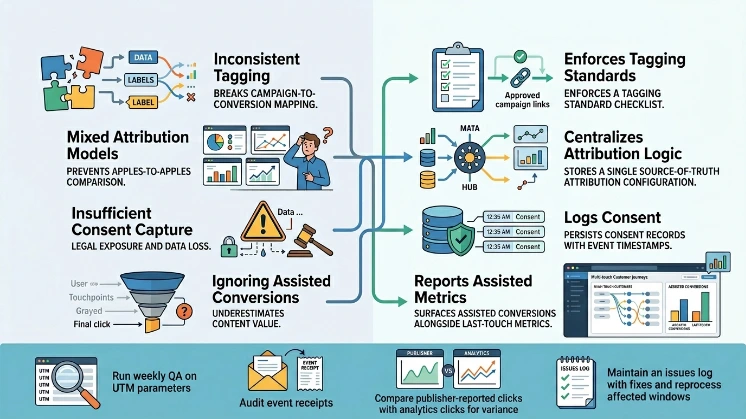
Inconsistent tagging, mixed attribution models, insufficient consent capture, and ignoring assisted conversions; a well-designed tracker enforces tagging standards, centralises attribution logic, logs consent, and reports assisted metrics separately.
Inconsistent tagging breaks campaign-to-conversion mapping. Mixed attribution models prevent apples-to-apples comparison. Lack of consent causes legal exposure and data loss. Ignoring assisted conversions underestimates content value. The tracker enforces a tagging standard checklist, stores a single source-of-truth attribution configuration, persists consent records with event timestamps, and surfaces assisted conversions alongside last-touch metrics.
Run weekly QA on UTM parameters, audit event receipts, and compare publisher-reported clicks with analytics clicks for variance. Maintain an issues log with fixes and reprocess affected windows.
Use cases and decision outcomes from a 6-month analysis
Use cases include publisher negotiation, budget reallocation, creative optimisation, and long-term channel strategy; decisions follow from quantitative thresholds such as ROI > 20% for scale, ROI between −10% and 20% for test adjustments, and ROI < −10% for pause or renegotiation.
For publisher negotiation, present placement-level ROI and viewability to request price adjustments or added-value placements. For budget reallocation, shift spend to placements with higher attributed revenue per £1 spent. For creative optimisation, prioritise high-engagement variants for replication. For channel strategy, use cohort LTV to determine whether sponsored news placements earn long-term value relative to search or programmatic channels.
Explore the Complete Guide:
How to Brief a UK Publisher for Sponsored Content That Actually Converts
If placement-level net ROI ≥ 0.20 and viewability ≥ 60%, allocate additional 20% of remaining budget to that placement in months 4–6.
Check Out the Full Article:
91% of UK B2B Marketers Increased Content Output in 2025: What Works?