

UK consumers view AI-generated content as less reliable because they perceive it as lacking human accountability and editorial oversight, reducing trust in accuracy and intent.
Research from multiple surveys shows 62–75% of UK adults express concern about automated content accuracy. Consumers link trust to identifiable authors, editorial bylines, and cited sources. Editorial content typically displays a named journalist, newsroom affiliation, and editorial process details. AI content often appears without those signals. The absence of visible provenance creates uncertainty about who is responsible for errors. Consumers use responsibility signals—bylines, editor names, and institutional reputation—to judge credibility. When those signals are missing, perceived risk rises.
What features of editorial content increase trust compared with AI output?
Editorial content includes named authors, editorial standards, source citations, and clear corrections processes, which produce measurable trust signals.
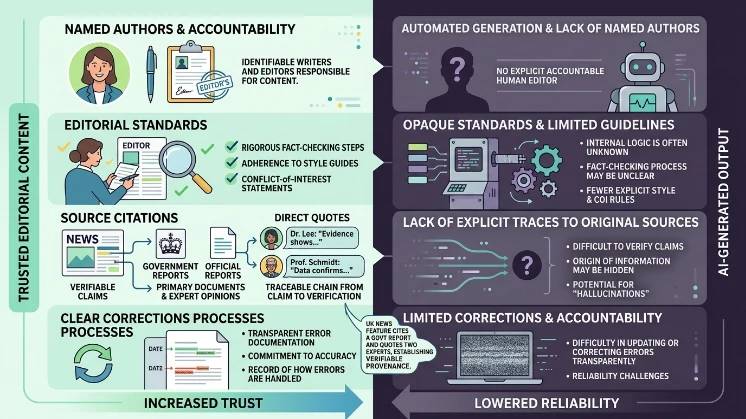
Named authors provide accountability. Editorial standards include fact-checking steps, style guides, and conflict-of-interest statements. Source citations let readers verify claims against primary documents, official reports, or direct quotes. Corrections policies show a commitment to accuracy by documenting how errors are handled. Each element creates a traceable chain from claim to verification. For example, a UK news feature that cites a government report and quotes two experts establishes verifiable provenance. AI-generated pieces often lack explicit traces to original sources or to an accountable human editor, lowering perceived reliability.
How does perceived bias differ between AI-generated content and editorial journalism?
Consumers see AI-generated content as more prone to hidden bias because algorithmic processes and training data are opaque, while editorial journalism has declared editorial lines and accountability.
Algorithms train on large text corpora with little transparency about data selection. Readers cannot inspect the training set or weighting. Editorial outlets disclose editorial perspective, ownership, and editorial guidelines. Visibility of these factors allows readers to contextualise potential bias. In the UK, media literacy studies show readers apply different standards: editorial pieces receive scrutiny through known biases; AI content receives scepticism because bias sources are unknown. This lack of transparency fuels concerns that AI output embeds unexamined patterns or commercial influences.
How do transparency and provenance affect consumer trust?
Transparency about authorship, sources, and editorial review increases trust, while opaque provenance decreases it.
Consumers use explicit signals—author name, role, publication date, and source links—to assess content provenance. Editorial workflows often list reporters, editors, and publication timestamps. These details let readers cross-check information. When content lacks these markers, readers assume lower reliability. Transparency also includes disclosure of methods: editorial pieces reference interviews, FOI requests, or data analysis. AI content rarely lists such methods. In the UK context, trust correlates with the ease of verifying claims: content that links to primary sources receives higher trust scores.
How do errors and factual mistakes influence trust differently for AI and editorial content?
Consumers penalise AI-generated errors more severely because they expect human authorship to provide judgement and correction.
Editorial teams apply fact-checking and editorial review to reduce errors before publication. When mistakes occur, outlets issue corrections with editorial oversight. Readers expect that human editors anticipate and correct errors. AI output errors signal to consumers that automated processes lack judgment. Studies indicate that when readers encounter a factual mistake in AI content, they generalise that flaw to other machine-generated material. For editorial errors, readers tend to attribute the problem to a specific lapse and trust is restored when a public correction appears.
What role does explanation of methods play in trust for AI content?
Clear explanations of how content was generated, including human involvement and source use, raise trust in AI content.
Method statements list the role of human editors, the datasets used, and verification steps. For example, an AI-assisted report that notes human editing, source checks, and expert review shows accountability. Consumers respond positively when content explains the human checks that accompany automation. In the UK, where public discussion of AI regulation increases demand for disclosure, method transparency acts as a proxy for editorial oversight. Absence of method details leaves readers uncertain about reliability and intent.
How do visual and interface cues affect perceptions of trustworthiness?
Bylines, mastheads, author bios, and source hyperlinks increase perceived credibility; generic layouts and anonymous blocks reduce it.
Design elements function as trust cues. A byline with a linked author profile signals expertise. A masthead or publication logo implies institutional standards. Inline links to primary sources enable verification. Conversely, AI-generated text often appears as unbranded or in generic containers, reducing perceived legitimacy. In experiments, readers rate identical content higher when presented with a recognizable news brand and author than when presented without those cues. Consequently, presentation determines initial trust before content evaluation.
How does regulatory environment influence consumer expectations in the UK?
Regulation and public debate increase expectations for disclosure, accuracy, and accountability in both AI and editorial content.
UK policy discussions about AI transparency and media standards shape reader expectations. Consumers follow regulatory news and expect publishers and platforms to label AI use, disclose datasets, and provide redress for errors. When regulatory frameworks require disclosure, consumers treat labeled content as more trustworthy because the label implies oversight. In the absence of regulation, readers assume less protection and rate AI content lower on trust scales.
What demographic or attitudinal differences shape trust in AI versus editorial content?
Younger adults show higher acceptance of AI content forms older adults place higher value on traditional editorial signals such as bylines and brand reputation.
Surveys in the UK split responses by age, media literacy, and education. Adults aged 18–34 report greater familiarity with AI tools and lower baseline suspicion. Adults aged 55+ rely more on institutional reputation and named authors. Readers with higher media literacy evaluate methods and sources more critically and adjust trust based on transparency. Those less familiar with digital verification rely entirely on visible trust cues, so format and labeling matter more for them.
What practical steps improve trust in AI-assisted content for UK audiences?
Combine clear authorship, visible source citations, method statements, and human editorial review to align AI content with editorial trust signals.
Publishers should state author names and roles, list sources with links to primary documents, and add brief method notes describing AI involvement and human checks. Editorial review should verify facts and add expert quotes or named interviews. Corrections policies should appear alongside content. These steps create a visible chain of responsibility and make claims verifiable. For example, a news explainer that credits a named reporter, links to government statistics, and states that an editor reviewed the piece delivers trust signals similar to purely human journalism.
Explore More Expert Insights:
Why AI-Generated Sponsored Content Is Failing UK Audiences in 2026
91% of UK B2B Marketers Increased Content Output in 2025: What Works?
What are common use cases where AI content is acceptable versus problematic?
AI content suits routine summaries, draft generation, and structured data reporting; it performs poorly for investigative journalism, exclusive interviews, and nuanced analysis requiring domain judgement.
Routine tasks include summarising public datasets, creating quick explainers from public reports, and drafting neutral backgrounders. These uses allow clear source citation and human oversight. Problematic tasks include deep investigative reporting, stories needing source protection, and sensitive public-interest journalism. These tasks require ethical judgement, verification of anonymous claims, and nuanced interview techniques that rely on human discretion. Consumers trust AI use in low-risk contexts more than in high-stakes reporting.
How should content creators measure changes in consumer trust over time?
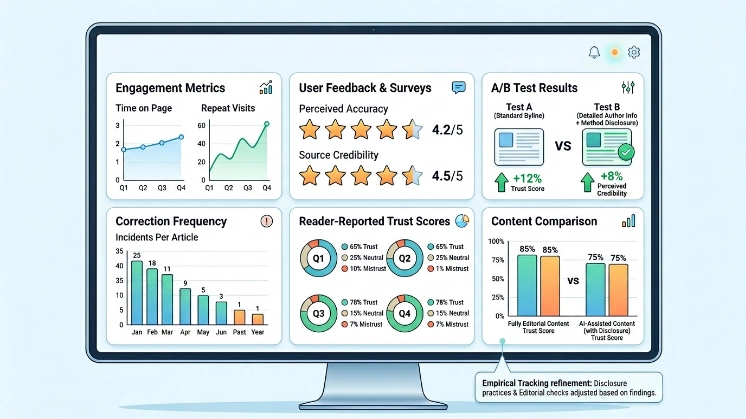
Track engagement metrics, correction frequency, user feedback, and direct surveys that measure perceived accuracy and source credibility.
Metrics include time on page, repeat visits, correction incidents per article, and reader-reported trust scores from periodic surveys. Introduce A/B tests that vary byline visibility, source linkage, and method disclosure. Compare user trust metrics for fully editorial content versus AI-assisted content with clear disclosure. Use these measurements to refine disclosure practices and editorial checks. Empirical tracking ties editorial processes to changes in audience trust.
Discover More Insights:
How to Brief a UK Publisher for Sponsored Content That Feels Like Real Journalism
UK consumers evaluate trust through visible accountability, source transparency, editorial oversight, and presentation cues. AI-generated content scores lower when these signals are absent. Publishers increase trust by naming authors, linking sources, describing methods, and applying human editorial review. These measures create verifiable provenance and align AI-assisted pieces with established editorial expectations.
Learn More Here:
Sponsored Content Packages on UK News Sites: What Each Tier Delivers



