
Banner advertising is a digital display ad format that promotes content, events, or shows through static or animated images on web pages and apps. Banner ads deliver concise visual messages with a clear creative, a headline, and a destination URL or tracking pixel for measurement.
Banner advertising is a form of online display advertising. Publishers place rectangular ad units across web pages and apps. Ad sizes follow standards such as 300×250, 728×90, and 160×600 pixels. Formats include static image (JPEG/PNG), animated GIFs, HTML5 creatives, and rich media with limited interactivity. Delivery uses programmatic auctions or direct buys through ad networks. Measurement uses impressions, viewable impressions, click-through rate (CTR), post-click events, and pixels for tracking conversions.
How do entertainment brands use banner ads to reach audiences?
Entertainment brands use banner ads to target audience segments with creative tied to shows, releases, or events and place those ads on sites where target audiences spend time. Targeting employs demographic filters, interest categories, contextual site placement, and device type to deliver relevant creatives to likely viewers.
Placement includes entertainment portals, news sites, lifestyle blogs, and social apps. Frequency caps limit how often an individual sees an ad per day. Dayparting schedules ads for peak consumption windows, such as evenings and weekends. Device targeting separates mobile phone, tablet, and desktop creative versions. Creative rotates to avoid banner fatigue and to test messages for different content types.
What creative elements increase engagement in banner advertising?
High-engagement banners use bold imagery, succinct headlines, clear value statements, and a single visual action cue aligned to the content promoted. Creative elements include focal imagery from the content, a concise headline of 3–7 words, a supporting subline or offer, and a visible action cue such as a play icon or arrow. Animation must run under 15 seconds or loop minimally.
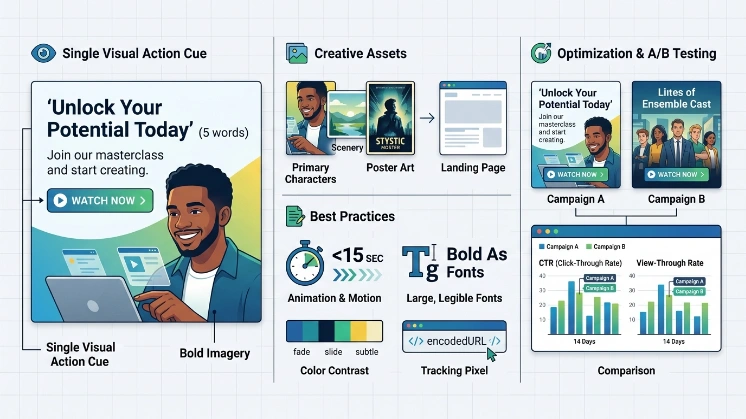
Imagery should feature primary characters, scenery, or poster art that links visually to a landing page. Typography uses large, legible fonts at common ad sizes. Colour contrast ensures legibility across devices. Motion draws attention; recommended animation types are fade, slide, and subtle scale. Include a tracking pixel or encoded URL to collect clicks and view-throughs. Use A/B testing to compare headline variations and image selections. Campaign A uses protagonist close-up; campaign B uses ensemble scene. Compare CTR and view-through rate for 14 days.
How does banner ad targeting work for entertainment audiences?
Targeting combines first-party audience segments, third-party interest data, contextual keywords, and geographic filters to place ads in front of relevant users. Audience segments originate from site registrations, newsletter lists, and authenticated user behaviour. Third-party data supplies interests such as “film fans” or “concert-goers.” Contextual targeting places ads on pages about specific genres or topics with matching keywords.
Geographic filters restrict delivery to the United Kingdom or to regions within the UK. Language filters ensure creatives match audience language. Device and connection-speed filters optimize creative size and bitrate for mobile cellular or Wi-Fi. Lookalike audiences expand reach by finding similar users to an existing subscriber dataset. Privacy-compliant methods use aggregated signals and consented identifiers. Frequency and recency settings control exposure and prioritise recent site visitors for higher relevance.
What metrics measure engagement from banner advertising?
Primary engagement metrics include viewable impressions, click-through rate (CTR), time on landing page, view-through rate (VTR), and post-impression conversions. Viewable impressions count ads with at least 50% of pixels in view for one second for display and two seconds for video. CTR equals clicks divided by impressions. VTR equals completed views divided by served impressions for animated or video banners. Post-impression conversions track downstream actions where users convert after seeing an ad without clicking, using attribution windows such as 1 day, 7 days, and 28 days.
Supplementary metrics: bounce rate on landing pages, pages per session, and engagement depth (scroll or play events). Use cohort analysis to track engagement by creative variant, placement, and audience segment. Set baseline KPIs: target CTR range 0.10%–0.50% for standard display in entertainment campaigns; target VTR 15%–40% for short animated banners. Compare against industry benchmarks and historical campaign performance.
How do banner ads integrate with broader entertainment marketing funnels?
Banner ads act as top-of-funnel drivers for awareness, feeding audiences into retargeting lists and content discovery pathways for deeper engagement. Initial banner impressions expose large-reach audiences to visual cues about a show, event, or release. Users who click or view are added to audiences for sequential messaging across programmatic and social channels. Integration requires consistent creative language and measurement alignment across channels using shared pixels and unified analytics tags.
Sequence examples: exposure banner introduces the show, mid-funnel banner highlights reviews or clips, and retargeting banners push trailers or subscription offers. Use duration-based sequencing: users with at least two impressions within seven days move to the mid-funnel creative set. Tag all creatives with consistent campaign IDs to attribute downstream conversions accurately.
What components are required to run a successful banner campaign?
A successful campaign requires clear audience definitions, optimised creatives for standard sizes, reliable ad delivery infrastructure, and analytics for measurement and iteration. Audience definitions include demographics, interests, and behavioural triggers. Creative production must supply multiple sizes and formats with fallbacks for limited bandwidth. Delivery uses demand-side platforms (DSPs) or direct buys with active monitoring for viewability and fraud. The analytics stack includes tag management, server-side event collection, and reporting dashboards for daily performance.
Operational components: creative asset repository, audience segmentation lists, frequency and daypart rules, and a QA process for click destinations. Compliance components: privacy notices, consent mechanisms, and adherence to regional advertising rules. Measurement setup uses UTM parameters and server-to-server events for reliable conversion tracking.
What benefits do entertainment brands gain from banner advertising?
Benefits include broad reach for new content, measurable engagement signals, efficient retargeting list building, and control over creative placement and timing. Banners reach audiences across publisher networks and niche editorial sites. Measured engagement produces signals for lookalike modeling and retargeting. Controlled placement supports thematic alignment with content pages, increasing relevance. Time-based campaigns allow sync with premieres, release dates, and promotional windows for coordinated impact.
Quantitative gains: campaigns deliver scalable impressions in the millions for national-level launches and construct retargeting lists of 10,000+ users within days for high-traffic sites. Use metrics to quantify lift in search interest, trailer views, and subscription intent for downstream analysis.
What use cases demonstrate effective banner advertising in entertainment?
Use cases include new show launches, event ticket promotions, trailer exposure, and playlist or channel discovery campaigns. For new show launches, banners provide mass awareness prior to premiere dates. Event ticket promotions use urgency messaging and geographic targeting to drive local attendance. Trailer exposure uses animated or video banners to generate view-throughs and increase video completion rates on landing pages. Playlist discovery banners drive users to curated content hubs or programme guides.
Real example scenarios: a national streaming release reaches 5 million impressions, yields a CTR of 0.18%, and builds a 60,000-person retargeting pool; an event campaign concentrates ads in city-specific sites to increase local ticket page visits by 22% in two weeks.
Explore More Expert Insights:
How Music Platforms Increase Streams Using Banner Ads
How Ticketing Platforms Boost Sales Using Display Campaigns
How do brands optimise banner campaigns for higher engagement?
Optimisation requires iterative creative testing, placement pruning based on performance, and audience refinement using engagement signals. Run A/B tests with at least two image and two headline variants for a four-cell test matrix. Monitor performance for 7–14 days before making decisions. Pause placements with CTR below 0.05% and reallocate budget to placements with CTR above 0.20%. Expand high-performing audiences via lookalike modeling with a 1%–3% similarity threshold. Rotate creatives every 10–14 days to prevent fatigue. Use sequential messaging to raise engagement depth and pair banners with on-site content recommendations.
How do privacy and measurement changes affect banner advertising?
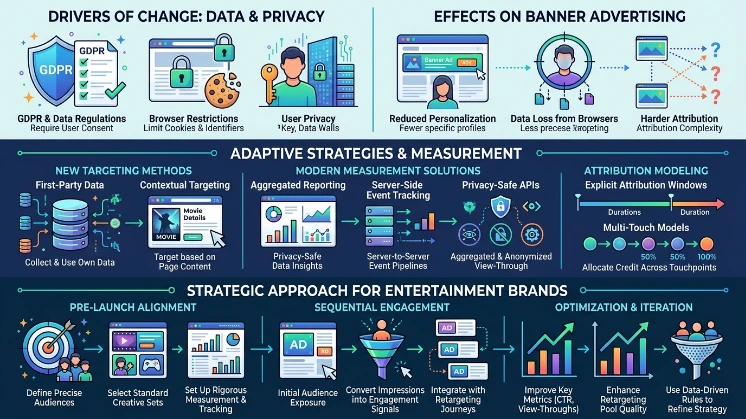
Privacy regulations and identifier changes require consented data collection, aggregated measurement, and server-side event tracking to maintain attribution fidelity. Consent frameworks such as GDPR require documented user consent for personalised targeting. Cookieless environments rely on contextual targeting and first-party data. Measurement solutions use aggregated reporting, probabilistic matching, and privacy-safe APIs for view-through attribution. Implement server-to-server event pipelines to reduce data loss from browser restrictions. Keep attribution windows explicit and use multi-touch models to allocate credit across exposure touchpoints.
Read More to Understand Better:
How Entertainment Brands Improve Subscription Intent Using Retargeting Ads
Banner advertising provides entertainment brands with a measurable, scalable channel for initial audience exposure. Clear audience definitions, standard creative sets, rigorous measurement, and sequential integration with retargeting enable brands to convert impressions into meaningful engagement signals. For practical next steps, align creative, targeting, and analytics before launch and iterate with data-driven rules to improve CTR, view-throughs, and retargeting pool quality.
Get the Full Insights Here:
Entertainment Retargeting Ads That Turn Engagement Into Subscription Conversions