
Display campaigns are paid digital advertising efforts that show visual ads across websites and apps; ticketing platforms use these ads to increase awareness, drive traffic, and sell event tickets at scale.
Display campaigns deliver image, banner, and rich-media ads to target audiences across publisher networks. Ticketing platforms buy placements through ad exchanges, demand-side platforms (DSPs), and publisher direct deals. Campaigns run on audiences defined by demographics, interests, contextual signals, and behavioural data. Platforms track impressions, clicks, view-through conversions, and assisted conversions to attribute outcomes to display activity.
How do display campaigns reach and target likely ticket buyers?
Display campaigns reach likely buyers by combining demographic filters, interest signals, geographic targeting, and behavioural data to place ads in front of users with demonstrated affinities for events.
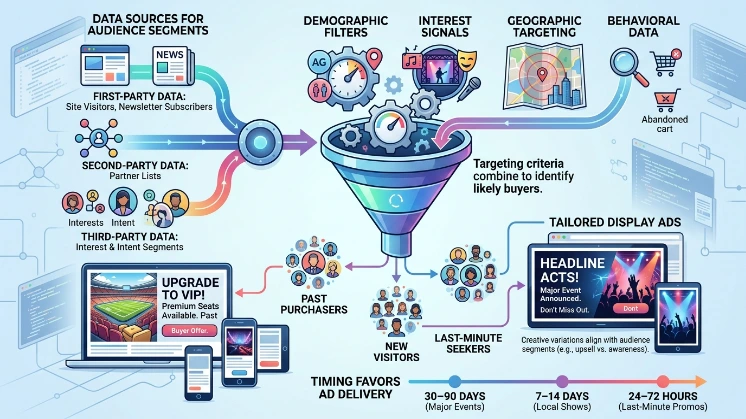
Platforms create audience segments using first-party data (site visitors, newsletter subscribers), second-party data (partner lists), and third-party data (interest and intent segments). Geographic targeting limits delivery to cities or postal codes near event venues. Interest targeting uses taxonomy labels such as live music, theatre, or comedy. Behavioural targeting uses past search and site activity: users who viewed event pages, added seats to carts, or abandoned checkout receive tailored creative.
Creative variations align with audience segments. For example, past purchasers receive upsell creative for premium seats. New visitors see broad awareness creative highlighting headline acts. Timing rules favor ad delivery during peak planning windows: 30–90 days before major events, 7–14 days for local shows, and 24–72 hours for last-minute promotions.
What specific ad formats drive ticket sales most effectively?
Display formats that drive sales include responsive banners, native ads, rich media (video and interactive), and dynamic creatives that show event-specific details.
Responsive banners adapt to placements and improve fill rates across devices. Native ads integrate with page content and increase engagement on editorial sites. Rich media video, animated banners, and expandable units—deliver higher attention and click-through rates. Dynamic creative optimisation (DCO) swaps images, headlines, and CTAs based on user signals and inventory. Dynamic seat-level ads show available sections and price ranges in real time when integrated with ticket inventory feeds.
How do ticketing platforms measure the impact of display campaigns on sales?
Platforms measure impact with multi-touch attribution, conversion tracking pixels, and incremental lift testing to link display exposure to ticket purchases.
Conversion tracking records completed orders attributed to clicks or view-throughs within defined windows. Multi-touch attribution models allocate credit across multiple exposures during the purchase path; common models include time-decay and data-driven attribution. Incrementality tests use randomised holdout groups to isolate the causal effect of display ads on sales by comparing exposed and unexposed cohorts.
Advanced measurement integrates CRM and order data to match ad exposures to purchaser records while maintaining privacy. Attribution reports include assisted conversions that show how display ads supported later direct or paid-search purchases. Reporting cadence typically runs daily for pacing and weekly for performance analysis.
What creative elements increase conversion rates on display ads?
High-converting display creative uses clear headlines, event visuals, date and venue details, price cues, and a concise call-to-action that aligns with the landing page.
Effective creatives emphasise a single message: headline act, limited availability, or ticket price. Visuals use artist photography or venue imagery sized to match ad placement. Date and location display removes friction by confirming relevance. Price or starting-price badges reduce uncertainty and improve CTR. CTAs use precise verbs such as “Buy Tickets,” “Reserve Seats,” or “See Dates.” Landing pages mirror ad messaging to maintain message match and improve conversion rates.
Dynamic elements include countdown timers for sales windows and inventory-driven messaging that updates available sections. Creatives are A/B tested for headline copy, imagery, and CTA placement. Performance data guides creative refresh cadence, commonly every 7–21 days for high-traffic campaigns.
How do ticketing platforms use targeting windows and timing to increase ticket sales?
Platforms schedule display delivery based on event lead time, purchase patterns, and user intent signals to reach buyers when they plan and convert.
Long-lead events (60–180 days) use broad awareness campaigns to build interest. Mid-lead windows (14–60 days) focus on consideration with targeted creatives showing lineups and price tiers. Short-lead windows (0–14 days) emphasise urgency with last-chance messaging. Platforms increase bid multipliers during peak purchase hours and days: mobile conversions rise on evenings and weekends, while desktop conversions peak during weekday lunch hours for some demographics.
Timing strategies include dayparting, frequency caps to avoid ad fatigue, and bid adjustments by device and geography. Retargeting windows tighten as events near, with higher bid aggressiveness for users who viewed seat maps, added tickets to carts, or opened confirmation emails.
How do display campaigns work with other channels to boost ticket sales?
Display campaigns integrate with search, email, social, and on-site experience to create cohesive purchase pathways and increase conversion probability.
Display ads generate initial interest and drive users to event pages. Paid search captures high-intent queries from users ready to buy. Email campaigns re-engage known users with tailored offers and reminders. Social campaigns extend reach with user-generated content and targeting overlaps. On-site widgets and seat maps capture intent signals that feed back to audience segments for precise retargeting.
Attribution ties cross-channel paths using multi-channel funnels. Cross-channel tactics include syncing creative messages—awareness imagery in display, detailed pricing in search, and personalised offers in email—to reduce friction and improve conversion rates.
What benefits do ticketing platforms gain from running display campaigns?
Display campaigns increase event awareness, scale audience reach, lower cost per acquisition through optimisation, and improve conversion rates via targeted retargeting.
Awareness lifts expand the pool of potential buyers beyond existing lists. Targeted reach lowers wasted impressions by focusing on likely buyers. Dynamic creative personalisation increases conversion probability by showing relevant events and prices. Measurement practices provide data to optimise media mix and creative allocation, which reduces CPA and increases ROAS. Incrementality testing validates spend decisions and identifies high-performing inventory sources.
Quantifiable outcomes include increased site sessions, higher ticket conversion rates, and measurable assisted conversions credited to display exposure.
Explore More Expert Insights:
How Event Organizers Increase Attendance Using Banner Ads
How Gaming Companies Increase Downloads Using Banner Advertising
What common challenges affect display performance and how do platforms resolve them?
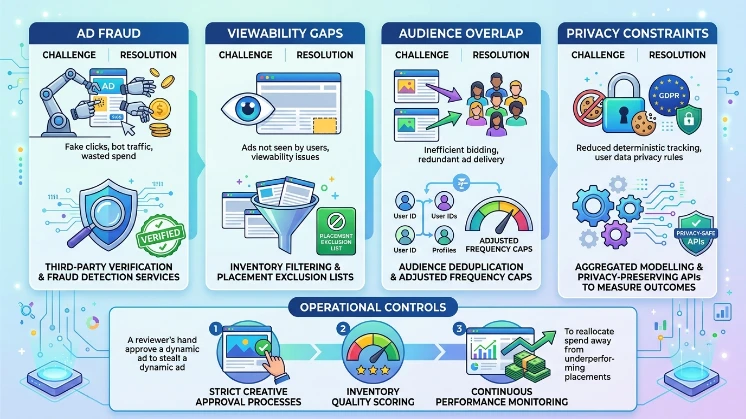
Challenges include ad fraud, viewability gaps, audience overlap, and privacy constraints; platforms resolve these with verification tools, viewability thresholds, identity-resilient signals, and anonymised modelling.
Ad fraud is mitigated by third-party verification and fraud detection services. Viewability issues require inventory filtering and placement exclusion lists. Overlapping audiences across campaigns cause inefficient bidding; platforms implement audience deduplication and adjusted frequency caps. Privacy rules reduce deterministic tracking; platforms apply aggregated modelling and privacy-preserving APIs to measure outcomes while respecting regulations.
Operational controls include strict creative approval processes, inventory quality scoring, and continuous performance monitoring to reallocate spend away from underperforming placements.
What real-world use cases show display campaigns boosting ticket sales?
Use cases include headline-artist tours, citywide festival promotions, and local theatre runs where display ads increase reach, drive reservations, and sell surplus inventory.
For headline-artist tours, programmatic display builds national awareness early and converts fans through dynamic seat-level retargeting. For festivals, contextual display on music and lifestyle sites drives discovery and package sales. For local theatre runs, geotargeted display promotes weekday and off-peak shows to nearby audiences, improving seat-fill rates and reducing unsold inventory.
Each use case highlights specific tactical choices: national DSP buys for tours, content-targeted native ads for festivals, and hyper-local inventory feeds for theatre runs.
Read More to Understand Better:
How Ticketing Platforms Nurture Buyers Using Event Reminder Ads
Display campaigns provide ticketing platforms with scalable awareness, precise targeting, dynamic creative capabilities, and cross-channel synergy that together increase ticket sales and improve marketing efficiency. Measurement through attribution, incrementality testing, and inventory-integrated creative enables platforms to optimise spend and maximise conversions while managing fraud, viewability, and privacy constraints.
Get the Full Insights Here:
Ticketing Retargeting Ads That Turn Event Browsers Into Buyers