Financial markets change rapidly. Sharp price movements, reduced liquidity, and unexpected financial events place significant pressure on FinTech businesses. During these periods, reputation becomes one of the most valuable business assets. Customers, investors, regulators, journalists, and commercial partners closely examine every public statement, operational update, and customer interaction.
Understanding how reputation changes during a market volatility or liquidity crisis helps organisations prepare clear communication strategies and maintain public confidence.
Why does market volatility affect a FinTech brand’s reputation?
Market volatility increases uncertainty across customers, investors, regulators, employees, and media organisations. Every operational decision receives greater scrutiny. Communication speed, factual accuracy, transparency, and service continuity become central factors that directly influence public trust and long-term corporate reputation during financial instability.
Market volatility refers to rapid and significant price changes across financial markets. These movements often affect equities, cryptocurrencies, foreign exchange, commodities, and digital assets.
A liquidity crisis occurs when businesses or markets struggle to access sufficient cash or liquid assets to meet immediate obligations.
Although volatility and liquidity are different financial events, both increase public attention.
Why stakeholders pay closer attention
Every stakeholder group evaluates risk differently.
- Customers examine platform reliability and account accessibility.
- Investors monitor financial resilience and governance.
- Regulators review compliance and disclosure obligations.
- Journalists seek verified information.
- Business partners assess operational continuity.
Higher scrutiny increases reputational exposure.
Reputation becomes part of operational resilience
Operational performance and public perception become closely connected during financial stress.
A delayed payment, temporary outage, or unclear announcement receives significantly more attention than during stable market conditions.
What happens when customers lose confidence?
Customer confidence declines when reliable information becomes unavailable, conflicting messages appear, or essential services experience disruption. Users seek certainty during financial uncertainty, making consistent communication, visible customer support, and transparent operational updates essential elements of reputation protection throughout every crisis stage.
Customer trust depends on predictable service.
During financial disruption, customers typically ask practical questions.
- Is my money secure?
- Are transactions operating normally?
- Has the company explained the situation?
- Are customer support teams responding?
Unanswered questions increase concern.
Information gaps increase speculation
Silence encourages external speculation.
News reports, social media discussions, and online forums often fill missing information with assumptions rather than verified facts.
Clear factual updates reduce uncertainty.
Customer experience influences public perception
Customer experiences spread rapidly through review platforms and social networks.
Examples include Trustpilot reviews, discussions on Reddit, and comments on LinkedIn.
Consistent customer service reduces negative public narratives.
Which reputation risks emerge during a liquidity crisis?
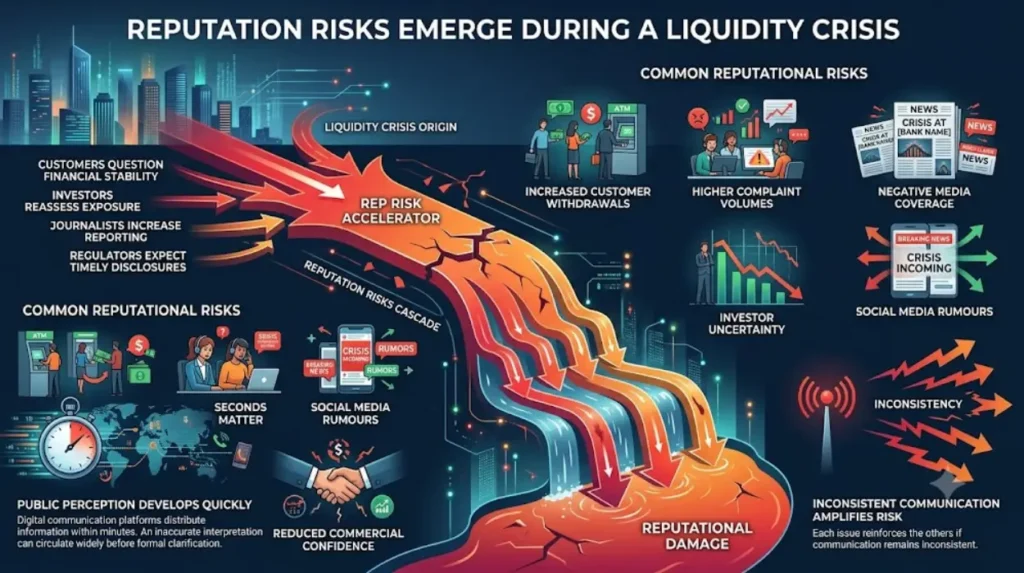
Liquidity pressure creates multiple reputation risks simultaneously. Customers question financial stability, investors reassess exposure, journalists increase reporting activity, and regulators expect timely disclosures. Every communication influences public understanding of organisational resilience and financial transparency throughout the developing situation.
Liquidity concerns extend beyond financial metrics.
Public perception often develops before detailed financial information becomes available.
Common reputation risks
Several issues commonly emerge.
- Increased customer withdrawals
- Higher complaint volumes
- Negative media coverage
- Investor uncertainty
- Social media rumours
- Reduced commercial confidence
Each issue reinforces the others if communication remains inconsistent.
Public perception develops quickly
Digital communication platforms distribute information within minutes.
An inaccurate interpretation can circulate widely before formal clarification appears.
Speed and factual accuracy become equally important.
How do media reports influence public confidence?
Media coverage shapes public understanding by presenting verified developments, expert analysis, regulatory announcements, and corporate statements. Balanced reporting improves public awareness, while incomplete information increases uncertainty. Timely factual communication supports accurate journalism during rapidly developing financial events and market disruption.
Financial journalists report developments using available evidence.
Coverage often includes:
- Regulatory announcements
- Financial statements
- Executive comments
- Market performance
- Industry analysis
These sources influence public expectations.
News cycles accelerate during crises
Financial news operates continuously.
A developing story often receives multiple updates throughout one trading day.
Companies releasing verified information promptly contribute to more accurate reporting.
Headlines influence first impressions
Many audiences read headlines before full articles.
Clear corporate messaging reduces opportunities for misunderstanding.
Why does transparent communication matter during financial uncertainty?
Transparent communication explains verified facts, operational status, known risks, and ongoing actions without speculation. Consistent messaging across every public channel strengthens organisational credibility, supports informed decision-making, and reduces unnecessary uncertainty among diverse stakeholder groups during financial instability and heightened scrutiny.
Transparency means sharing confirmed information.
It does not involve predicting future market behaviour.
Effective transparency includes clear facts
Useful updates explain:
- Current operational status
- Customer service availability
- Product availability
- Regulatory disclosures
- Confirmed organisational actions
Each statement uses verified information.
Consistency builds credibility
Information published through websites, media statements, customer emails, and social media platforms must remain aligned.
Conflicting information damages trust faster than delayed information.
Readers seeking practical communication approaches can continue with:
Crisis Communication Frameworks.
How does social media influence reputation during a crisis?
Social media accelerates information sharing between customers, journalists, investors, analysts, and regulators. Accurate updates limit misinformation, while inconsistent messaging encourages speculation. Active monitoring identifies emerging concerns early and supports faster factual clarification across digital communication channels throughout evolving events.
Digital platforms distribute information immediately.
Examples include X, LinkedIn, Reddit, Facebook, and YouTube.
Each platform reaches different audiences.
False information spreads rapidly
Unverified claims often circulate alongside factual reporting.
Organisations benefit from correcting inaccuracies using verified evidence rather than emotional responses.
Public conversations remain visible
Customer comments, executive interviews, and media reports remain searchable.
These public records contribute to long-term reputation.
Which stakeholders examine a FinTech business during financial disruption?
Different stakeholder groups evaluate different organisational risks during financial disruption. Customers focus on service reliability, investors examine financial performance, regulators review compliance, employees assess stability, and business partners evaluate operational continuity before making commercial decisions or public responses.
Every stakeholder group requires relevant information.
One message rarely satisfies every audience.
Customers
Customers prioritise access to services.
Examples include payment processing, account balances, and transaction completion.
Investors
Investors assess financial indicators.
Examples include liquidity position, governance quality, and financial reporting.
Regulators
Regulators review compliance obligations.
Examples include disclosure timing, consumer protection, and operational resilience.
Employees
Employees seek organisational clarity.
Internal communication reduces uncertainty and improves operational consistency.
What long-term effects can a reputation crisis create?
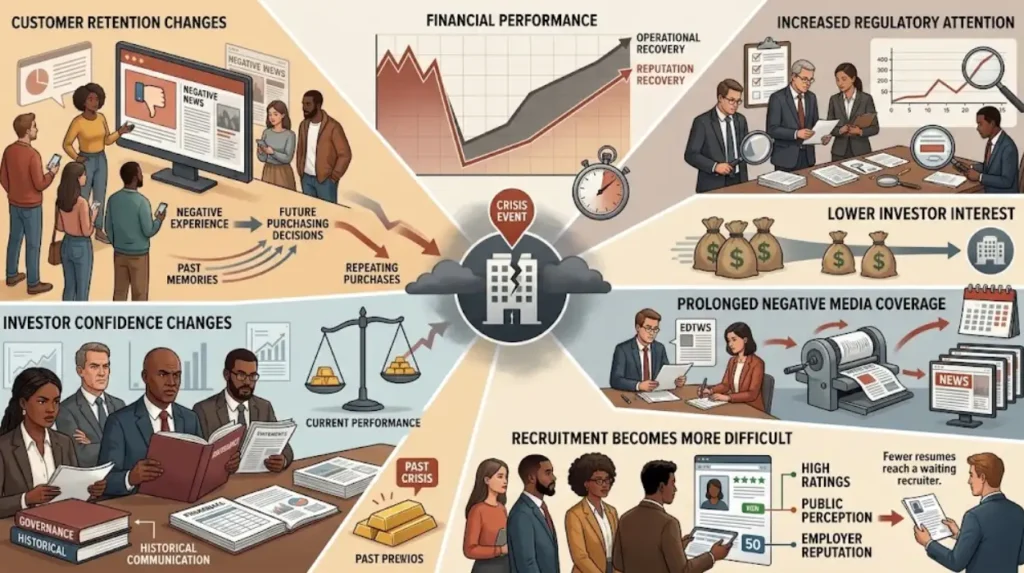
Reputation damage extends beyond immediate financial events. Reduced customer confidence, increased regulatory attention, lower investor interest, and prolonged negative media coverage influence organisational performance long after market conditions stabilise and financial recovery begins across the wider industry.
Reputation recovery often takes longer than operational recovery.
Trust develops through consistent performance over time.
Customer retention changes
Customers evaluate previous experiences when selecting financial providers.
Negative experiences influence future purchasing decisions.
Investor confidence changes
Institutional and retail investors assess historical governance alongside financial performance.
Past communication quality becomes part of future risk assessments.
Recruitment becomes more difficult
Potential employees examine employer reputation before accepting job offers.
Public perception influences recruitment competitiveness.
Explore More Expert Insights:
How Financial Journalists Filter Through Hundreds of Pitch Releases from Unknown Startups
Why Continuous Media PR is Essential for Struggling Startups Sustaining Investor Relations
How can organisations prepare before a reputation crisis begins?
Preparation establishes governance processes, communication responsibilities, stakeholder mapping, approval workflows, monitoring systems, and factual response procedures before financial disruption occurs. Predefined planning enables faster, more consistent communication during periods of elevated operational pressure and increased public attention.
Preparation starts before market instability.
Documented procedures improve response consistency.
Develop communication frameworks
Preparation includes:
- Crisis communication plans
- Approved spokespersons
- Stakeholder contact lists
- Internal escalation procedures
- Media response processes
These frameworks improve organisational readiness.
Monitor public sentiment
Monitoring identifies emerging issues early.
Useful sources include:
- Customer support enquiries
- Financial news coverage
- Social media discussions
- Industry publications
- Regulatory announcements
Regular monitoring provides better situational awareness.
Readers interested in implementation strategies can continue with:
A FinTech brand’s reputation changes rapidly during periods of market volatility or liquidity stress. Public confidence depends on transparent communication, operational consistency, factual reporting, and stakeholder trust. Customers, investors, regulators, employees, journalists, and commercial partners all evaluate organisational behaviour during financial uncertainty.
Understanding these reputation dynamics enables organisations to communicate clearly, reduce confusion, and support informed public understanding throughout every stage of financial disruption.