
Gaming banner ads or animated visual ads placed on web or app inventory that display a game’s value proposition, link to install pages, and track clicks and installs for conversion measurement.
Gaming banner ads display in web pages, in-app feed slots, and ad networks. They use image files (JPEG, PNG) or HTML5 animations. Ads include a creative, a click-through URL, and tracking pixels or SDK events. Ad servers deliver banners based on targeting signals: geography, device type, operating system, user interests, and programmatic auction outcomes. When a user clicks, the ad redirects to an app store page or a landing page that captures an install. Attribution systems record an install event and attribute it to the banner using postback, device identifiers, or fingerprinting.
Ad formats include leaderboard (728×90), medium rectangle (300×250), and mobile banner (320×50), plus responsive HTML5 creatives. Creative size and resolution affect viewability. Tracking requires an attribution provider or SDK that sends install and in-app event data to the advertiser for conversion counting.
How do publishers and advertisers measure banner ad performance?
Advertisers measure banner performance using click-through rate (CTR), install rate (IR), cost per install (CPI), and post-install metrics such as day-1 retention and day-7 retention.
Measurement starts with impressions and clicks. CTR equals clicks divided by impressions. Install rate equals installs divided by clicks. Cost per install equals ad spend divided by installs. Post-install metrics include retention (percentage of users still active after a set number of days) and lifetime value (LTV), which equals cumulative revenue per user over a defined period. Viewability (percentage of ads that appeared in a viewable area) and fraud detection (invalid traffic rates) also affect reported performance.
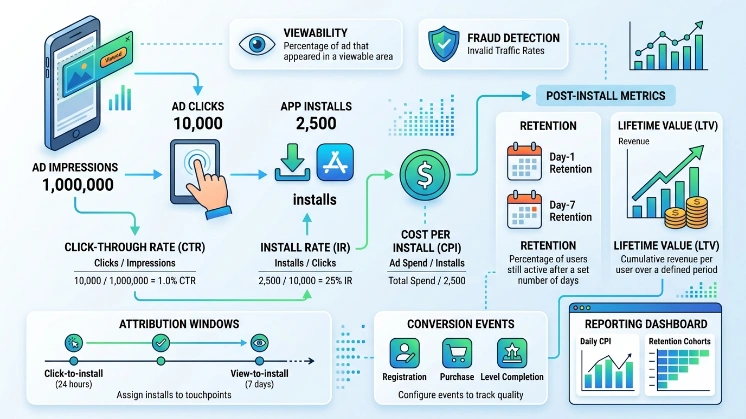
Advertisers use attribution windows commonly 24 hours for click-to-install and 7 days for view-to-install to assign installs to touchpoints. They configure conversion events such as registration, purchase, or level completion to track quality. Reporting dashboards commonly present daily and cohort views for CPI and retention. Real examples: a campaign with 1,000,000 impressions and 10,000 clicks has CTR 1.0%; if clicks produce 2,500 installs, IR is 25% and CPI equals total spend divided by 2,500.
What creative elements drive conversions in gaming banner ads?
High-conversion banner ads include a clear game title, one-line value statement, visible call-to-action, platform icons, and an eye-catching image or short animation showing gameplay or rewards.
Creative must present the core gameplay or reward instantly. Use concise text: a title (3–5 words), a benefit line (4–8 words), and a CTA (install, play, or download). Show platform icons (iOS, Android) and a rating or age marker when available. Use contrasting colours and readable typography sized for mobile screens. Animations that loop 3–5 seconds highlight core mechanics: combat, puzzles, or progression. Include localised text and currency for UK audiences when applicable.
A/B test creative variations with control and incrementality measurement. Rotate at least 3 creative variants per campaign to avoid fatigue. Replace creatives after 7–14 days if CTR decreases by more than 20%.
How do targeting and bidding strategies improve conversion rates?
Targeting combines device, operating system, location, and user behavior signals; bidding uses CPI or CPA goals with real-time optimisation to prioritise higher-likelihood converters.
Segmentation targets United Kingdom users on Android or iOS, age cohorts (18–34), and affinity for similar game categories. Use lookalike audiences created from high-value players. Exclude audiences with high invalid traffic or low retention. Set bid strategies: target CPI for install volume, target CPA for specific post-install actions, and ROAS-based bidding for revenue-driven optimisation. Adjust bids by device model, carrier, and time of day based on performance curves.
Real-time bidding auctions iterate per impression. Use automated bid adjustments when campaign CPI deviates by more than 10% from target. Scale budgets on placements and audiences with CPI below target and day-7 retention above the benchmark.
What technical components ensure successful banner campaigns?
Successful campaigns include an ad server, creative delivery via CDN, an attribution provider, an SDK or server-to-server postback, and campaign analytics with cohort-level reporting.
The ad server schedules creatives, tracks impressions, and serves creatives via a content delivery network for low latency. The attribution provider links clicks to installs using device identifiers or probabilistic matching. SDKs embedded in the game report in-app events such as first session, purchase, and retention. Server-to-server postbacks send conversion confirmations to ad networks for billing reconciliation.
Implement viewability tags to measure whether the banner reached a viewable threshold. Integrate fraud detection that monitors install velocity, click-to-install timing, and anomalous device patterns. Enable creative prefetching for in-app environments to reduce load time. Use secure HTTPS creatives and verify that app store links resolve on both iOS and Android.
What campaign setup and optimisation steps convert players effectively?
Set clear KPIs (CPI target, day-1 retention, day-7 retention, and LTV), run short A/B creative tests, allocate budget to top-performing segments, and iterate on targeting and creatives weekly.
Start with a pilot: allocate 10% of total budget to test 3 creative variants across 3 audience segments for 7 days. Measure CPI, CTR, and day-1 retention. Select the top-performing creative and audience combination, then scale by incrementally increasing budget 20% per day while monitoring CPI. Pause placements with CTR below 0.5% or anomalous install patterns. Re-evaluate attribution windows and postback configuration after initial scaling to ensure accurate reporting.
Optimise landing flow: ensure the store page contains the same creative, accurate screenshots, and a short description aligned with the banner. Improve onboarding inside the app to register the user within the first session, track registration rate, and connect early in-app rewards to retention.
What benefits do banner ads deliver for gaming companies?
Banner campaigns deliver scalable reach, predictable cost per install, measurable attribution, and the ability to retarget users for higher lifetime value.
Banners reach large user bases via web and app inventories and integrate with programmatic marketplaces for scale. Campaigns provide clear unit economics through CPI and CPA metrics. Attribution ties installs to ad spend, enabling ROAS calculations. Retargeting banners re-engage lapsed players with offers and events, which increases day-7 retention and revenue per user.
Examples: a campaign with CPI £0.90 and day-7 retention 15% results in predictable user acquisition costs. Retargeting that increases day-30 revenue per user by 40% improves overall ROAS. Use cohort analysis to quantify LTV versus acquisition cost to determine sustainable spend levels.
Explore More Expert Insights:
Film Trailer Ads That Convert Hype Into Box Office Ticket Sales
TV Channel Ads That Turn Program Interest Into Viewer Conversions
What use cases show banner ads turning interest into active players?
Use cases include new title launches for rapid scale, soft launches for market validation, event-driven re-engagement for lapsed users, and cross-promotion between titles to increase portfolio retention.
For a new title launch, run wide-reach banners with direct app store links to generate initial installs and measure CPI. For soft launches, limit banners to target segments in the UK to validate retention before global scale. For event-driven re-engagement, serve banners offering in-game rewards to users who stopped playing within 14–30 days. For cross-promotion, display banners for related titles to existing players, using in-app inventory to convert players with known interest.
How should teams evaluate whether to scale or stop a banner campaign?
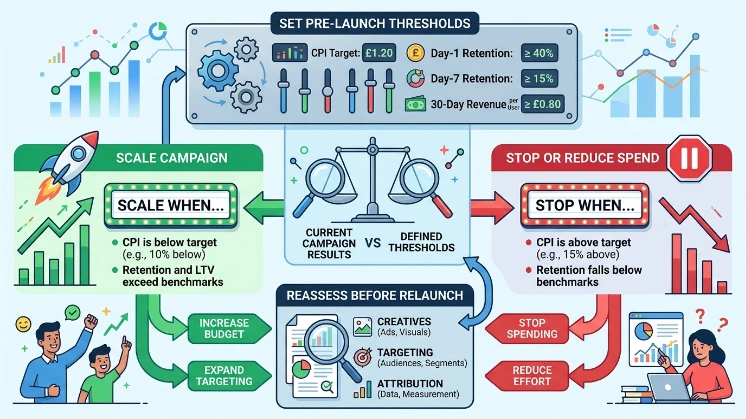
Evaluate against predefined thresholds for CPI, day-1 retention, day-7 retention, and 30-day revenue; scale when CPI is below target and retention and LTV exceed benchmarks, stop when CPI is above target and retention falls below benchmarks.
Set numeric thresholds before launch. Example thresholds: CPI target £1.20, day-1 retention ≥ 40%, day-7 retention ≥ 15%, and 30-day revenue per user ≥ £0.80. Scale when CPI is 10% below target and day-7 retention meets or exceeds threshold. Reduce or stop spend if CPI exceeds target by 15% and day-7 retention drops below threshold. Reassess creatives, targeting, and attribution before relaunch.
Read More About This Topic:
How Gaming Companies Increase Downloads Using Banner Advertising
Gaming banner ads function as a measurable acquisition channel that links visual creatives to app installs and post-install events. Use precise targeting, standardised KPIs, rigorous measurement, and iterative creative testing to convert interest into active players.
For campaign continuity and deeper strategy comparisons, see:
How Gaming Companies Build Player Interest Using Banner Campaigns