
Banner advertising for TV channels is display advertising placed on digital platforms to raise awareness about TV programs and drive tune-in intent. It uses static images, animated creatives, or interactive formats on websites and apps.
Banner advertising for TV channels targets audiences on news sites, streaming platforms, social apps, and program guides. Channels define creative sizes and placements, for example 300×250, 728×90, and 300×600. Ads run during promotion windows: 14–7 days before premiere, 3 days before, and on-air day. Targeting relies on first- and third-party data: age brackets (18–24, 25–34, 35–49), geographic regions (city or postcode), and interest segments (drama fans, sports viewers). Measurement uses viewable impressions, click-through rate (CTR), and attributed tune-ins via panel data or set-top box logs.
How do channels plan banner campaigns to build interest?
Channels plan banner campaigns through campaign briefs, audience segmentation, creative calendars, and media-buy schedules to align ads with programming timetables.
Planning begins with a campaign brief that defines objectives, awareness, consideration, or tune-in. Channels set key performance indicators (KPIs): target 2–5% CTR for interactive banners, 50–70% viewability for premium placements, and reach 30–60% of target audience within three weeks. Audience segmentation divides viewers by demographics and viewing habits. Channels map creatives to the viewing calendar: awareness creatives run 14–7 days before launch, reminder creatives run 3 days prior, and live alert creatives run on broadcast day.
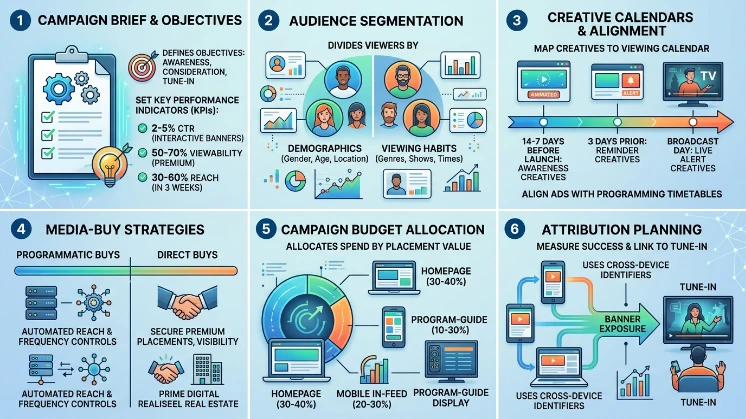
Campaign budgets allocate spend by placement value, homepage takes 30–40% of budget, mobile in-feed 20 to 30%, and program-guide display 10–20%. Channels select programmatic or direct buys based on control needs. Programmatic buys provide automated reach and frequency controls. Direct buys secure premium placements for guaranteed visibility. Attribution planning uses cross-device identifiers and log-level data to link banner exposure to tune-in.
What creative elements do banners use to interest viewers?
Banners use concise headlines, strong imagery of talent or scenes, clear airtime details, and optional interactive elements like countdowns or click-to-set reminders.
Headlines state the program name and a defining hook in 3–7 words. Imagery features a lead character, a key moment, or event branding. Airtime details include day, time, channel number, and platform availability. Callouts highlight unique elements: premiere, exclusive episode, live coverage, or special guests. Animated banners rotate scenes or show a countdown. Interactive banners allow users to set calendar reminders or tap to send a reminder via SMS or push notification. File formats include JPEG, PNG, GIF, and HTML5; weight limits typically stay under 150 KB for mobile and 200 KB for desktop to preserve load speed.
A/B testing compares variants: headline A vs headline B, image A vs image B, or static vs animated. Tests run with equal impressions and measure CTR and conversion to reminder or click-to-watch action. Results guide creative iteration within 48–72 hours during live campaigns.
How do channels choose placements and audiences for banners?
Channels select placements by audience concentration and context relevance, and they choose audiences using demographic, behavioural, and contextual signals.
High-value placements include site homepages, streaming platform discovery pages, and entertainment news pages. Contextual placement targets pages with related content, for example sports news pages for live match promos. Audience signals combine registration data, subscription information, and behavioural indicators such as recent searches and streaming history. Channels create lookalike segments from core viewers to expand reach. Geographic targeting narrows exposure to broadcast regions or national coverage when applicable. Frequency caps limit exposure to 3–7 impressions per user per week to avoid ad fatigue.
Measurement partners supply panel-based lift metrics and device-level analytics. Channels use these metrics to refine placement weightings and audience lists during the campaign. For cross-platform consistency, channels control creative variants and messaging across mobile, desktop, and connected TV inventory.
How is performance tracked and attributed?
Performance is tracked via viewable impressions, CTR, completion rate for animated creatives, and tuned-in attribution using panel data, set-top box logs, or ID-based matching.
Viewability tracks ads that appear in a user’s viewport for at least one second for display and two seconds for video. CTR measures direct engagement. For interactive banners, completion rate measures how many users completed an action such as setting a reminder. Attribution to tune-in uses three approaches: panel uplift analysis, deterministic ID matching, and probabilistic modelling. Panel uplift compares exposed and unexposed control groups to measure incremental tune-in rate. Deterministic matching links ad exposure to logged viewer behaviour via hashed identifiers from apps or set-top boxes. Probabilistic modelling estimates likelihood of tune-in based on exposure patterns and historical correlations. Reporting cadence typically uses daily performance snapshots and a final campaign post-analysis.
What benefits do banner campaigns deliver to TV channels?
Banner campaigns deliver reach across digital audiences, reminder actions that increase tune-in probability, measurable engagement metrics, and a cost-effective way to complement on-air promos.
Digital banners reach users outside linear TV environments. Reminder features convert passive interest into active intent, quantified by calendar additions or reminder taps. Measurable metrics allow channels to optimize spend toward placements and creatives that deliver the highest incremental tune-in per thousand impressions (ITPM). Cost efficiency compares CPMs: programmatic display CPMs often range from £1 to £6 in the UK market for standard inventory; premium placements cost more. Banners support multi-touch campaigns that guide viewers from awareness to consideration to action across seven to ten touchpoints on average.
What common use cases demonstrate banner effectiveness?
Common use cases include new series launches, live event promotion, episode-level reminders, and seasonal schedule changes where banners raise awareness and drive tune-in.
For new series launches, banners generate early awareness across 2–4 content platforms and secure initial audience sampling. Live event promotion uses countdown banners and live alerts to maximise live audiences for sports or awards. Episode-level reminders target viewers who watched previous episodes and remind them of the next broadcast. Seasonal schedule banners inform audiences about time-slot changes, helping retain habitual viewers. Each use case defines a specific campaign plan: a 21-day awareness window for new series, a 7-day intensive window for live events, and ongoing weekly reminders for serial programming.
How do channels coordinate banners with other promo channels?
Channels coordinate banners with on-air spots, social posts, email, and app push notifications to create consistent messaging and reinforce tune-in prompts.
Coordination begins with a unified creative brief and a release timetable. Banners carry the same headline and imagery as on-air spots to reinforce recognition. Email and app push communicate direct reminder links that match banner destinations. Social posts use short clips and link to the same landing pages the banners target. Synchronised timing increases message salience: banners increase reach in the 14–7 day window, social amplifies 7–3 days before, and push notifications and on-air spots act on the day of broadcast.
Explore More Expert Insights:
How Streaming Services Increase Watch Intent Using Display Ads
How OTT Platforms Nurture Viewers Using Show-Based Banner Campaigns
What risks and controls should channels use for banner advertising?
Channels control brand suitability, viewability thresholds, frequency caps, and fraud prevention measures to manage risk and protect ad effectiveness.
Brand suitability filters exclude categories that conflict with program tone. Viewability thresholds set minimums for buy guarantees. Frequency caps prevent oversaturation. Fraud prevention uses verification vendors to detect non-human traffic and domain spoofing. Performance anomalies trigger mid-campaign audits. Data privacy controls ensure compliance with UK and EU regulations, including lawful bases for targeting and proper user consent for tracking identifiers.
Read the Detailed Explanation:
How TV Channels Boost Viewership Using Display Campaigns
How do banner campaigns evolve with measurement improvements?
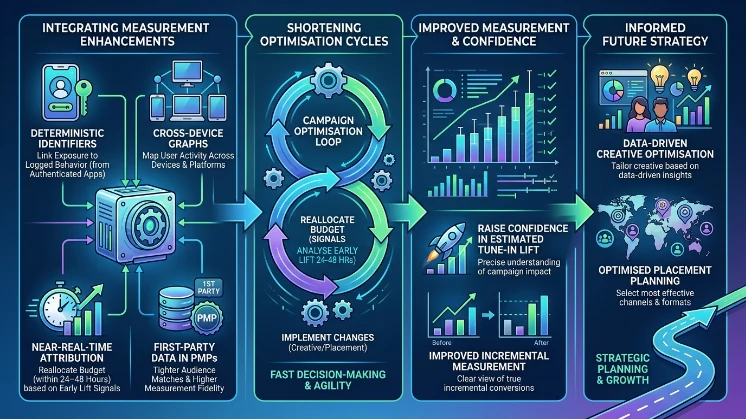
Banner campaigns evolve by integrating deterministic identifiers, cross-device graphs, and near-real-time attribution to shorten optimisation cycles and improve incremental measurement.
Deterministic identifiers from authenticated apps link exposure to logged behaviour. Cross-device graphs map user activity across devices and platforms. Near-real-time attribution allows campaign managers to reallocate budget within 24–48 hours based on early lift signals. Channels incorporate first-party data into private marketplaces (PMPs) to secure tighter audience matches and better measurement fidelity. These improvements raise confidence in estimated tune-in lift and inform future creative and placement strategies.
Click Here to Explore More:
TV Channel Ads That Turn Program Interest Into Viewer Conversions