
A banner ad is a rectangular digital advertisement that displays visual and textual content to prompt interest in entertainment subscriptions, placed on websites, apps, or streaming platforms. Banner ads present images, short copy, and a single action element. They target users by demographics, behavior, or contextual content. Banner sizes follow standards such as 300×250, 728×90, and 160×600 pixels.
Formats include static images, animated GIFs, and HTML5 rich media. Measurement uses impressions, clicks, viewable rate, and click-through rate (CTR). Advertisers calculate cost with CPM (cost per 1,000 impressions) or CPC (cost per click).
How do banner ads move viewers from interest to subscription?
Banner ads move viewers through staged messaging: awareness, consideration, and conversion, by using targeted creatives and measured calls-to-action.Campaigns begin with wide-reach placements to build awareness. Next, ads use mid-funnel creatives that highlight key features, pricing tiers, or trial options to increase consideration.
Finally, conversion-focused banners present time-limited offers or simplified sign-up prompts to close subscriptions. Tracking uses unique campaign parameters and event pixels to link ad exposure to subscription events. A typical funnel path measures View → Click → Landing Page Visit → Trial Sign-up → Paid Conversion.
Which targeting methods work best for subscription growth?
Effective targeting combines demographic, behavioural, contextual, and retargeting signals to reach users with higher propensity to subscribe. Demographic targeting selects age ranges and household profiles aligned with content genres. Behavioural targeting uses past streaming activity, search queries, and app usage. Contextual targeting places banners next to related content, such as show reviews or episode recaps.
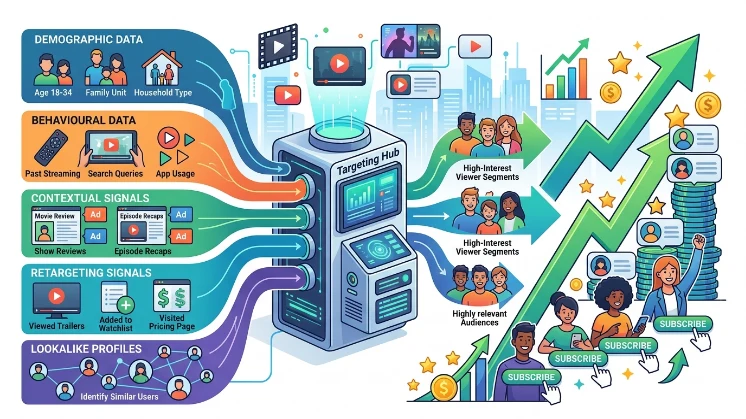
Retargeting serves ads to users who viewed trailers, added shows to watchlists, or visited pricing pages. Lookalike modelling expands reach to users who resemble known subscribers using device and browsing patterns.
What creative elements increase banner ad effectiveness?
High-performing banners use a clear value proposition, concise copy, strong visuals, and a focused action cue to drive clicks and sign-ups. Value proposition states the subscription benefit in one line, such as exclusive series access or ad-free viewing. Copy limits words to a short headline and a supporting line. Visuals use recognizable show imagery or genre cues. Action cues use verbs tied to subscription actions, for example “Start 7-day Trial.” Contrast between elements increases legibility. Animated banners rotate messages to show benefits, pricing, and social proof sequences. Text overlays remain under 18 characters for mobile formats to preserve clarity.
How should landing pages connect to banner creatives?
Landing pages must mirror banner messaging, simplify sign-up fields, and display clear pricing or trial information to convert clicks into subscriptions. Match headline and imagery between ad and page to preserve continuity. Present pricing tiers or trial length within the first screen. Reduce form fields to email and password or use single-click social/device authentication where allowed. Provide trust signals such as accepted payment methods and data privacy mentions. Track landing page events with the same pixel used in ad measurement to attribute conversions accurately.
What measurement metrics determine success for subscription ads?
Key metrics include click-through rate (CTR), landing page conversion rate, cost per acquisition (CPA), trial-to-paid conversion rate, and subscriber lifetime value (LTV). CTR measures initial engagement. Landing page conversion rate measures trial or account creation per click. CPA equals total ad spend divided by paid subscribers acquired. Trial-to-paid conversion rate equals number of trials converted to paid divided by total trials. LTV projects revenue per subscriber over a set period, such as 12 months. Combine short-term metrics (CTR, CPA) with long-term metrics (LTV, churn) for complete performance assessment.
What components of a technical setup ensure reliable attribution?
A reliable setup includes campaign identifiers, event pixels, server-side tracking, and hashed user identifiers to link ad exposure to subscription events. Use UTM or custom IDs on ad click links to pass campaign data to landing pages. Deploy client-side pixels for immediate event captures and server-side events for payment confirmations to reduce data loss. Hash emails or device IDs for deterministic matching where privacy rules allow. Reconcile ad platform reporting with internal subscription records daily. Use attribution windows such as 7-day click and 14-day view to align exposure with conversions.
Which pricing and offer structures optimise trial conversions?
Free trials with clear duration, time-limited discounts, and tiered entry pricing increase trial sign-ups and early paid conversions. A 7-day free trial, a 30-day discounted first month, or a basic tier with limited features at lower cost. Trials that require no credit card reduce friction in sign-ups but lower initial revenue per trial; card-required trials increase friction but raise intent quality. Display trial length and next-step pricing prominently in the banner creative and landing page to set expectations.
How do privacy regulations in the UK affect banner ad campaigns?
UK privacy rules require transparent consent for cookies and clear lawful bases for processing personal data used in ad targeting and attribution. Sites must provide cookie banners that obtain consent for non-essential cookies used for tracking and advertising. Advertisers must offer opt-out choices for personalised ads and document legal bases for processing. For deterministic matching, use consented hashed identifiers only. Maintain retention schedules and deletion processes for user data linked to ad campaigns. Keep records of consent and provide users with methods to access or delete their data.
What creative testing frameworks improve banner performance?
A structured A/B testing plan that isolates one variable per test and runs with statistically significant sample sizes reveals reliable performance differences. Test headline variations, image treatment, CTA text, and colour contrasts one at a time. Run tests until reaching a pre-defined confidence level, such as 95%, or until minimum sample sizes are met, for example 1,000 impressions per variant for low-CTR formats. Use multi-armed bandit approaches when rapid optimisation matters. Use sequential testing to refine winning variants progressively and then validate at scale.
Which benefits do entertainment platforms gain from banner-driven subscriber growth?
Banner ads lower customer acquisition costs, accelerate funnel velocity, and increase reach into niche audience segments when combined with precise targeting. Banners scale impressions across publisher networks and apps to acquire initial interest. Precise targeting reduces wasted impressions and lowers CPA. Rapid creative rotation shortens the time from awareness to trial. Cohort analysis links specific campaigns to LTV and churn rates, allowing budget reallocation to high-yield channels.
Explore More Expert Insights:
Mid-Funnel Food Ads That Turn Engagement Into High-Intent Customers
Review-Based Restaurant Ads That Convert Trust Into First-Time Orders
What are practical use cases of banner ads in entertainment campaigns?
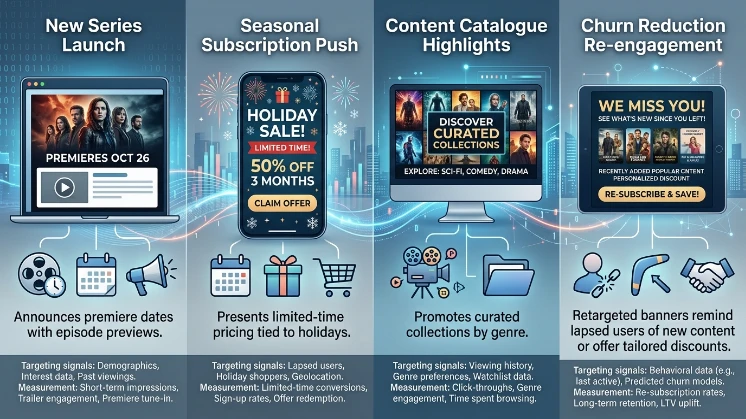
Use cases include new-series launches, seasonal subscription pushes, content catalogue highlights, and churn-reduction re-engagement campaigns. For a new-series launch, banners announce premiere dates with episode snippets. For seasonal pushes, banners present limited-time pricing tied to holidays. For catalogue highlights, banners promote curated collections by genre. For churn reduction, retargeted banners remind lapsed users of new content or offer tailored discounts. Each use case requires different targeting signals and measurement windows.
How do platforms combine banner ads with other mid-funnel tactics?
Platforms pair banners with email sequences, personalised recommendations, and push notifications to nurture interested users toward paid subscriptions. After a banner click, email flows deliver relevant show suggestions and pricing reminders. In-app messages display content previews for logged-in users. Cross-channel frequency capping ensures coherent exposure without excess impressions. Attribution links connect mid-funnel touchpoints to final subscription events.
For More Details, Explore:
How Entertainment Platforms Build Subscription Interest Using Banner Ads
Start by defining target cohorts with clear demographic and behavioural signals. Design banners with single-message clarity and matching landing pages. Implement tracking with client and server events and hashed identifiers. Test creatives methodically and measure CTR, conversion rates, CPA, and LTV. Use retargeting and multi-channel follow-ups to convert trials to paid subscriptions while observing UK privacy rules.