
Educational finance campaign ads teach prospects specific financial concepts while directing them toward a final purchase or signup. These ads combine instruction, product-context, and conversion triggers to move users from informed interest to a measurable outcome such as an account opening, loan application, or paid advisory booking.
Educational finance campaign ads define three entities: the advertiser (financial institution), the learner (target user), and the conversion event (account, application, purchase). They use measurable learning objectives (for example, 3-minute video explaining APR, a checklist with 5 steps, or a calculator with 4 inputs) tied to concrete conversion actions. Typical formats include display banners, native content, short video, and interactive calculators. Campaign metrics track learning engagement (time on content), micro-conversions (form starts), and macro-conversions (completed application, funded loan).
How do these ads guide users through the decision process?
They present a defined learning path, clear next steps, and conversion mechanics at each stage. Campaigns map content to decision stages and insert conversion triggers where user intent increases. Early creative teaches an essential concept (for example, how interest compounds). Mid-funnel creative compares solution types (for example, fixed-rate vs variable-rate products) and links to tools. Late-funnel creative highlights the exact steps to convert: required documents, time to approval, and direct application links.
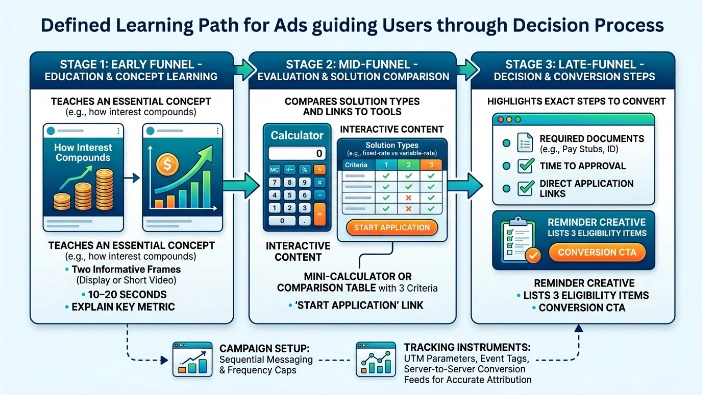
Campaign setup uses sequential messaging and frequency caps. First impression: two informative frames (display or short video) that explain a key metric in 10–20 seconds. Second impression: interactive content such as a mini-calculator or comparison table with 3 criteria and a “start application” link. Third impression: reminder creative that lists 3 eligibility items and a conversion CTA. Tracking instruments include UTM parameters, event tags, and server-to-server conversion feeds for accurate attribution in closed environments.
What components make these ads effective at converting?
Effectiveness depends on targeted learning content, precise calls-to-action, measurable micro-conversions, and technical tracking. Targeted learning content defines the problem and the metric used to measure outcomes. Examples: saving-rate breakdowns for deposit accounts, amortisation table for mortgages, fee breakdown for investment accounts. Precise CTAs specify the conversion action and the expected user commitment: “Start application 7 minutes, ID required.” Micro-conversions capture intent: tool use, document upload start, scheduler click. Technical tracking uses first-party data, conversion APIs, and event-level tagging to align ad exposure and final conversion.
Single learning objective per ad, numeric proof points (for example, “£1,200 saved per year at 3% interest”), and an explicit conversion window (for example, “complete in 10 minutes”). Use-case examples include a display ad linking to a mortgage affordability calculator and a native article that embeds an application-start button after a 3-step checklist.
How are these campaigns measured for return on investment?
Measurement combines engagement metrics, micro-conversion funnels, and end-to-end revenue attribution. Click-through rate (CTR), tool interaction rate, micro-conversion rate (form starts), macro-conversion rate (completed application), cost per acquisition (CPA), and lifetime value (LTV) of converted customers. Measure engagement depth: average time on education asset, completion rate of video or interactive module, and repeat visits within 14 days.
Attribution uses last-click for simple reports, multi-touch models for nuanced insight, and incrementality tests for causal evidence. A/B tests compare educational creative variants and landing experiences. Example: run a holdout test where 50% of exposed users see an educational calculator and 50% see a standard product page; measure delta in funded accounts at 30 days.
What legal and compliance components must these ads include?
Ads must include clear disclosures, risk statements, and eligibility criteria aligned with UK financial regulation. Disclosures state APR, fees, and terms when required. Risk statements appear on any content that discusses investments or borrowing. Eligibility criteria include minimum age, residency, and credit checks. Maintain audit trails for claims and retain versioned creatives. For regulated products, maintain approval workflows with the compliance team and archive signed approvals.
Include data handling notices that specify tracking and cookie use. Store consent records for personalised messaging. Provide links to regulated documentation (for example, a downloadable terms PDF) and ensure landing pages replicate required disclosures present in the ad when those disclosures materially affect decision-making.
How do targeting and segmentation improve conversion rates?
Precise segments expose the right educational content to users with matching intent and behaviours. Credit score ranges, income brackets, age bands, life events (home purchase, child education), and past product interactions. Use first-party CRM signals to create lookalike segments of high-LTV customers. Exclude ineligible users to reduce wasted spend. Example segments: renters aged 25–40 with mortgage inquiries in the past 90 days; savers aged 40–60 with existing ISAs.
Deliver bespoke education per segment. Example: provide an ISA tax-benefit primer to savers, and an affordability-deep-dive to first-time buyers. Measure lift per segment and reallocate budget to segments with lowest CPA and highest 24-month LTV.
What creative formats drive the best final conversions?
Interactive tools, concise explainer video, and document-ready landing pages show the highest conversion yield. Ccalculators, eligibility checkers, and document checklists yield high intent signals because they require active input. Short explainer videos (20–45 seconds) with a direct CTA achieve higher ad recall and increased click-through. Document-ready landing pages pre-fill required fields and list exact documents to reduce drop-off. Use one learning objective per creative, show one numeric outcome, and include a single conversion CTA.
Read More About This Topic:
How Finance Companies Improve Conversions Using Display Ads
How do teams operationalise an educational conversion campaign?
Teams structure campaign phases, align stakeholders, and deploy measurement primitives before launch. Product owners, legal, compliance, analytics, creative, and paid media. Product conversion flow; legal required copy analytics event schema; creative asset set; paid media audience strategy. Pre-launch checklist includes QA of tracking pixels, verification of disclosure copy, and a 3-day smoke test with real traffic.
What benefits do organisations realise from these campaigns?
Benefits include higher conversion rates, improved customer quality, and measurable acquisition cost efficiency. Educational creatives increase qualified applicant rates because users self-select based on learning outcomes. Metrics show a 20–40% increase in conversion-to-complete rates when users interact with an interactive tool prior to application. Campaign data improves product refinement: product teams use engagement insights to reduce friction in the application process. Improved targeting reduces CPA by 10–30% when first-party segments replace broad audience buys.
These campaigns also lower default risk by educating applicants about affordability and obligations before application, which improves portfolio performance metrics over 12–24 months.
Explore More Expert Insights:
Security-Focused Finance Ads That Convert Trust Signals Into Customer Leads
Loan Funnel Ads That Turn Applicants Into Completed Submissions
What use cases fit best for educational finance campaign ads?
Use cases include mortgages, personal loans, savings products, credit cards, and investment accounts. Aaffordability calculators and documented checklists that drive mortgage applications. Personal loans: APR comparisons and repayment-schedule simulators that lead to quick online application. Savings: compounded interest simulators that lead to savings-account signups. Credit cards: fee and reward comparisons that drive pre-qualification requests. Investment accounts: risk-profile quizzes and fee transparency modules that lead to advisory bookings or account openings.
Each use case requires tailored disclosures and a conversion funnel that reduces friction. A mortgage ad that leads to a pre-approval form should request only 4 essential inputs initially to preserve conversion rate.
Learn More Here:
How Financial Institutions Guide Users Using Educational Campaign Ads
How should organisations optimise post-conversion journeys?
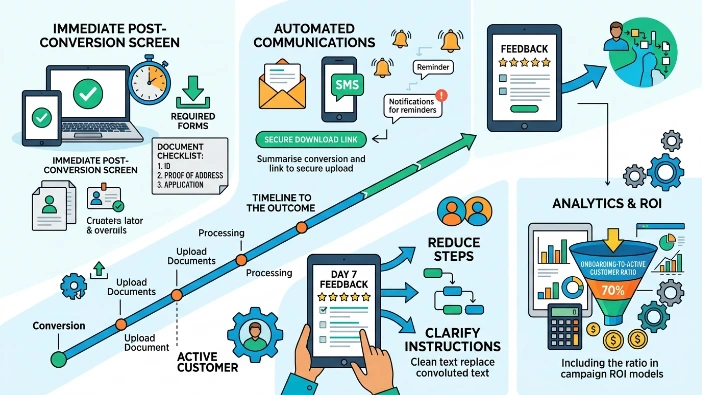
Optimise onboarding with confirmation of next steps, a document checklist, and a timeline to the outcome. Immediately after conversion, provide a confirmation screen with estimated processing time, a download of required forms, and a short checklist of 3 documents required. Send an email or SMS summarising the conversion and linking to a secure document upload. Track onboarding completion as a secondary KPI and run automated reminders for incomplete steps.
Collect feedback at 7 days to detect onboarding friction. Use that feedback to reduce required steps or clarify instructions. Report onboarding-to-active-customer conversion and include that ratio in campaign ROI models.