Educational campaign ads are paid digital messages that teach users about financial topics, such as savings, loans, taxes, or fraud prevention, while promoting trust and awareness. Educational campaign ads define a clear learning objective, state the target audience, present factual content, and measure engagement.
Educational campaign ads explain a product category, a decision process, or financial literacy topics without immediate hard selling. Entities involved include advertisers (financial institutions), publishers (websites, apps), ad platforms (display networks, programmatic exchanges), creatives (visuals, copy), and measurement tools (analytics, conversion pixels). Examples of topics include how interest rates work, steps to open an account, and signs of phishing emails.
How do financial institutions design an educational campaign ad?
Audience segmentation, learning objective, creative development, and measurement plan. Design begins with data. Institutions segment users by age, income band, credit score band, and life stage. They set one learning objective per ad group, Explain how fixed-rate mortgages differ from variable-rate mortgages. Creatives use short headlines, one educational point, and a single call-to-action that offers more learning (e.g., “Read the guide”). Measurement plans include viewability, click-through rate (CTR), time on page, and micro-conversions such as guide downloads.
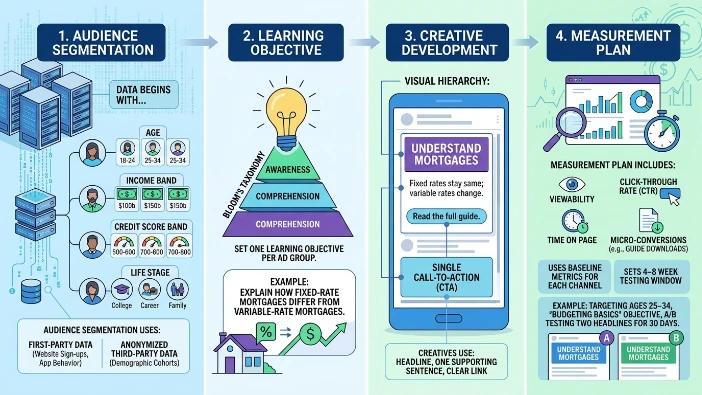
Audience segmentation uses first-party data (website sign-ups, app behaviour) and anonymised third-party data (broad demographic cohorts). Learning objectives use Bloom’s taxonomy at the awareness and comprehension levels. Creative development defines a visual hierarchy: headline, one supporting sentence, and a clear link. Measurement uses baseline metrics for each channel and sets a 4–8 week testing window. Targeting ages 25–34 with a “budgeting basics” objective and A/B testing two headlines for 30 days.
What components make an educational campaign ad effective?
Effective ads combine clear audience targeting, concise educational content, strong visuals, and measurable calls-to-action. Targeting ensures relevance. Content focuses on one concept per ad. Visuals draw attention and communicate the subject quickly. Calls-to-action lead to a learning asset such as a checklist, explainer page, or calculator. Tracking captures engagement and learning outcomes.
Define each component precisely. Demographic bands and behavioural signals. Content: 15–25 words on screen, one learning outcome, 1–3 supporting lines on landing page. Visuals: single focal image or icon, brand-safe palette, 1:1 and 16:9 sizes for placement. Call-to-action: “Download checklist” or “Try calculator.” Measurement: CTR target set by channel historical average, landing page bounce rate under 60%, time on page over 90 seconds for deep content. Example: display ad promoting a mortgage repayment calculator with a headline, one stat, and a CTA to use the calculator.
Check the Complete Explanation:
How Finance Companies Improve Conversions Using Display Ads
How do institutions choose channels and placements?
Choice of channels depends on audience habits, content length, and campaign KPIs, using display networks, social feeds, and content recommendation platforms. Channel selection aligns with where the target audience spends time and how they consume information. Short-format concepts suit social feeds and banner networks. Longer explainers suit content recommendation widgets and native placements. Programmatic buying adds scale and frequency control.
Placement decisions use viewability thresholds and brand-safety lists. Devices are split by desktop versus mobile traffic and page context. Frequency caps set to 3–7 impressions per week depending on funnel stage. 60% of budget to open web display for ages 45–64 seeking retirement content, 40% to social for ages 25–34 seeking budgeting tips.
How do institutions create compliant, trustworthy educational content?
Compliance requires accurate claims, clear disclosures, product-neutral language, and audit trails for approvals. Financial content follows regulations from the Financial Conduct Authority (FCA) in the UK. Ads present facts with supporting sources and use neutral descriptions when explaining categories. Disclosures include risk statements for products like investments and buy-to-let mortgages. All creatives pass legal and compliance review with timestamps and version control.
Use citations for specific figures and link to primary sources on landing pages. State “3-year fixed rate at 4.5% APR” only when current and verifiable. Maintain editorial separation between educational content and product offers. Example: an ad explains pension tax relief alongside a link to the government guidance page.
How do institutions measure learning and conversion in these ads?
Measurement uses layered KPIs: awareness (impressions, reach), engagement (CTR, time on page), learning (quiz completion, checklist downloads), and conversion (account sign-ups, application starts). Set primary KPI per campaign. For pure education, use learning KPIs such as completion rates for short quizzes and resource downloads. For Campaigns, monitor micro-conversions like savings calculator use and newsletter sign-ups. Attribution models include last-click for direct conversions, and multi-touch models for educational impact over time.
Implement event tracking and server-side analytics to avoid cookie loss. Use randomly controlled experiments (A/B tests) for creative and placement decisions. Example: a campaign that tracks 25% increase in calculator use and 8% lift in account sign-ups among engaged users over an 8-week period.
What targeting strategies increase relevance without hard selling?
Use persona-driven messaging, behaviour triggers, and contextual placement to match educational content to user intent. Personas map to life events: first-time homebuyers, parents saving for education, pre-retirees. Behaviour triggers include time on mortgage content, search queries, and app events. Contextual placement locates ads beside articles about home renovation or tax changes. These strategies focus on education and do not push immediate product sign-ups.
Retargeting works using engaged cohorts, not raw site visitors. Create lookalike audiences from users who completed educational modules. Use exclusion lists to avoid users currently inside an active application process to reduce friction. Example: retarget users who completed a retirement planning quiz with a follow-up explainer on pension consolidation.
How do institutions test and optimise educational campaign ads?
Testing uses A/B and multivariate tests on headlines, visuals, and landing experiences with statistical significance thresholds of 90% or higher. Run controlled experiments for at least 2,000 impressions per variant or until the sample reaches statistical power. Test one variable at a time. Evaluate using pre-defined success metrics: CTR uplift, quiz completion lift, and downstream account starts. Optimisation cycles run weekly for creative tweaks and monthly for strategy shifts.
Use learnings to refine messaging hierarchy. If a headline increases CTR but reduces time on page, prioritise relevance over clickbait. Example: testing “How interest rates affect repayments” against “Calculate your monthly mortgage” and measuring both CTR and calculator use.
Explore More Expert Insights:
How Finance Companies Build Trust Using Security-Focused Banner Ads
How Loan Providers Nurture Applicants Using Mid-Funnel Display Ads
What benefits do educational campaign ads provide for financial institutions?
Educational ads increase user trust, improve campaign relevance, reduce acquisition cost, and raise lifetime value through informed customers. Trust builds when institutions demonstrate expertise and transparency. Relevant education reduces drop-offs during application processes. Educated users complete forms faster and present fewer errors. These outcomes reduce operational costs and increase conversion efficiency.
Reduce time-to-complete application by 12–25% when pre-education occurs, lower customer support contacts by 10–30% for educated cohorts, and increase first-year retention by 6–15% for users who engaged with onboarding education. Example: a cohort using an onboarding video required 18% fewer support calls in the first 90 days.
Which use cases show the most impact for educational ads?
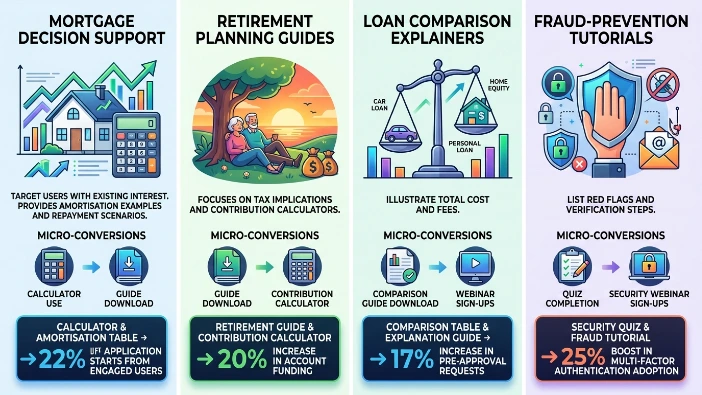
High-impact use cases include mortgage decision support, retirement planning guides, loan comparison explainers, and fraud-prevention tutorials. These use cases target users with existing interest. Mortgage decision support provides amortisation examples and repayment scenarios. Retirement planning shows tax implications and contribution calculators. Loan comparisons illustrate total cost and fees. Fraud-prevention tutorials list red flags and verification steps.
Calculator use, guide download, quiz completion, and webinar sign-ups. Mortgage decision support that includes a calculator and downloadable amortisation table sees a 22% lift in application starts from engaged users.
Check Out the Full Article:
Educational Finance Campaign Ads That Turn Users Into Final Conversions