
An investment insight ad is a targeted digital advertisement that delivers concise, data-driven market analysis to prospects and drives them toward a measurable onboarding action. These ads present timely insights, a clear value proposition, and a conversion path such as an account signup, meeting booking, or advisory application.
An investment insight ad defines a clear audience, uses precise market data, and links to a conversion endpoint. Typical formats include banner ads, native placements, and social feed cards. Core metrics track impressions, click-through rate (CTR), lead form completion rate, and onboarding conversion rate.
How do firms design the workflow from ad exposure to client onboarding?
Targeted exposure, insight delivery, lead capture, qualification, and onboarding completion. Each stage uses specific tools and measurable triggers to move prospects to the next step.
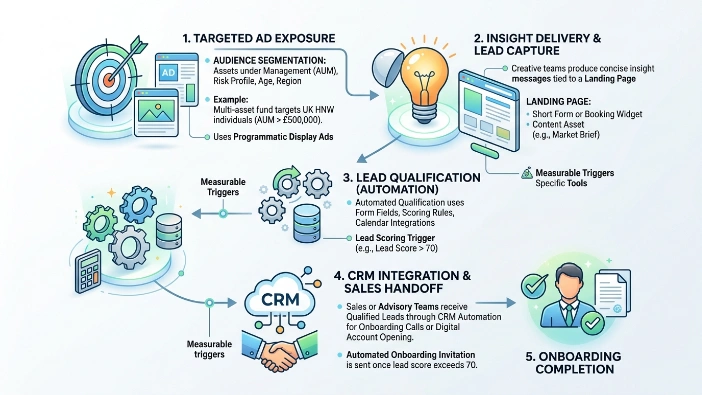
Design begins with audience segmentation by assets under management (AUM), risk profile, age, and region. Next, creative teams produce concise insight messages tied to a landing page. The landing page contains a short form or booking widget and a content asset such as a market brief. Automated qualification uses form fields, scoring rules, and calendar integrations. Sales or advisory teams receive qualified leads through CRM automation for onboarding calls or digital account opening. A multi-asset fund targets UK HNW individuals (AUM > £500,000), serves programmatic display ads, and automates an onboarding invitation once a lead score exceeds 70.
Which data sources and analytics power effective investment insight ads?
Effective ads rely on primary market data, proprietary research, third-party feeds, and real-time analytics for performance optimisation. Data sources include exchange feeds, economic calendars, internal research reports, and vendor datasets.
UK equity exchanges, fixed-income yield servers, and macroeconomic releases (ONS, Bank of England). Proprietary sources: firm research notes, portfolio performance snapshots, and proprietary risk models. Third-party feeds: Bloomberg, Refinitiv, and MSCI indexes. Analytics uses A/B testing, attribution models, and cohort analysis to measure ad-to-onboarding latency and lifetime value. A firm uses Bank of England rate announcements to trigger creative refreshes; CTR increases by 25% when ads reference the latest PMI release.
How do firms select targeting parameters for UK audiences?
Firms use a layered targeting strategy combining demographics, behavioural signals, contextual placement, and CRM lookalikes. Targeting must reflect regulation on financial promotions in the UK.
Age ranges (30–55), income bands (annual income > £75,000), and region (Greater London, Southeast). Behavioural signals: recent visits to retirement planning pages, searches for “investment ISA,” or consumption of market commentary. Finance news sites, investment podcasts, and regulatory update pages. CRM lookalikes use existing client data to expand reach to similar prospects. A firm targets users who viewed pension calculators and serves ads during weekday financial news consumption windows (07:00–10:00 and 17:00–20:00).
What compliance checks are essential before launching ads in the UK?
Essential checks include regulatory approval for financial promotions, accuracy of claims, required disclosures, and retention of evidence of approvals. Firms must follow Financial Conduct Authority (FCA) rules for financial promotions.
Ensure messaging is fair, clear, and not misleading; verify all numerical claims with source citations; include risk warnings where investments lose value; confirm the target audience is restricted to appropriate categories (e.g., retail, professional); obtain internal compliance sign-off and archive versioned creatives. Record approvals and timestamps for audits. Compliance requires pre-approval of any headline referencing returns and confirmation that the ad links to a suitability assessment before account opening.
How do firms measure ROI and the onboarding success rate for insight ads?
Firms measure return on ad spend (ROAS), cost per onboarded client (CPO), onboarding conversion rate, and long-term client lifetime value (LTV). Metrics align with sales and compliance systems for accurate attribution.
CTR, cost per lead (CPL), lead-to-onboard conversion rate, average time to onboard, and 12‑month retention rate. Attribution uses first-click, last-click, and multi-touch models to reconcile marketing and sales data. Example: an exchange-traded fund provider reports CPL of £120, 8% lead-to-onboard conversion, and CPO of £1,500 after including advisory time costs.
What technical infrastructure supports scalable ad-to-onboard journeys?
Infrastructure includes ad servers, tag management, CRM, marketing automation, analytics platforms, and secure onboarding systems. Integration reduces manual handoffs and shortens the conversion path.
Ad servers manage creative rotation. Tag managers ensure consistent tracking pixels. CRMs ingest leads and apply scoring rules. Marketing automation triggers emails, SMS, or calendar invites. Analytics platforms stitch user journeys across devices. Secure onboarding uses eID verification, electronic signatures, and KYC modules.
Explore the Complete Guide:
How Investment Firms Attract Clients Using Banner Advertising
What benefits do investment insight ads produce for firms and clients?
Benefits include higher-quality leads, shortened sales cycles, measurable conversion paths, and improved client fit through early qualification. Clients receive timely, relevant market context that informs decisions and streamlines onboarding.
For firms, insight ads produce a higher average AUM per onboarded client and lower acquisition friction. Ads that reference concrete metrics and link to briefings increase lead qualification rates by measurable margins. For clients, concise insights reduce research time and provide a clear next step for professional engagement. Example: a firm reduced time-to-first-advice from 18 days to 7 days after integrating market-insight banners with instant-booking widgets.
Explore More Expert Insights:
Finance Display Ads That Convert Warm Leads Into High-Intent Customers
Fintech Campaign Ads That Turn Feature Awareness Into Active Users
What use cases show the highest conversion potential for these ads?
High-conversion use cases include timely macro commentary during market events, portfolio rebalancing prompts after volatility, and product-specific onboarding for ISAs and SIPPs. Each use case ties an insight to a clear onboarding action.
Rate changes, major CPI releases, or election results. Rebalancing prompts: after a 5% portfolio drift threshold. Product-specific: end-of-tax-year ISA campaigns with deadline messaging and instant account opening. The ISA campaign during tax season increased onboarding by 42% when paired with a 2-page tax-optimisation brief.
What implementation checklist ensures a successful campaign launch?
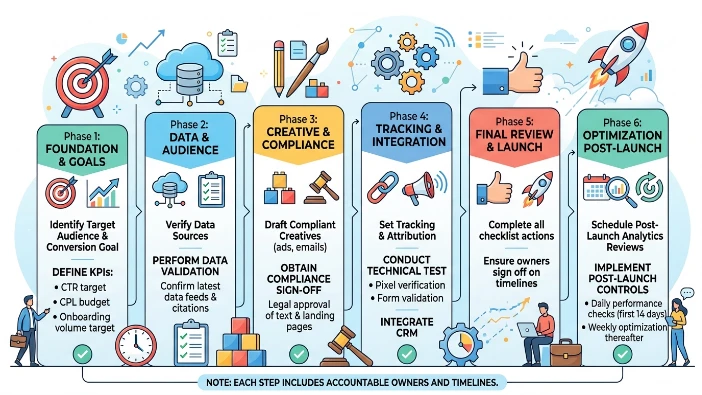
Target audience and conversion goal, verify data sources, draft compliant creatives, set tracking and attribution, integrate CRM, and schedule post-launch analytics reviews. Each step includes accountable owners and timelines.
CTR target, CPL budget, and onboarding volume target. Data validation: confirm latest data feeds and citations. Compliance sign-off: legal approval of text and landing pages. Pixel verification and form validation. Post-launch: daily performance checks for first 14 days, weekly optimisation thereafter.
Dive Deeper Into This Topic:
How Investment Firms Build Awareness Using Market Insight Ads