
A display campaign is a paid online advertising program that shows visual ads on websites, apps, and social media to reach target audiences. Display campaigns deliver image, video, or rich-media ads through ad exchanges, demand-side platforms (DSPs), and publisher networks. They use targeting signals such as demographics, interests, and browsing behaviour to place ads in real time.
Display campaigns use real-time bidding (RTB) and programmatic buying to purchase ad impressions. Ad servers host creatives and track viewability and clicks. Supply-side platforms (SSPs) provide publisher inventory. Advertisers set budgets, bid strategies, and frequency caps. Campaigns measure impressions, click-through rates (CTR), view-through conversions, and return on ad spend (ROAS).
How do finance brands define campaign objectives for credit-card promotion?
Finance brands set explicit campaign objectives such as brand awareness, feature awareness, lead generation, or application completions. Objectives determine creative format, targeting, and measurement. Brand awareness targets large, relevant audiences and values reach and frequency metrics. Lead generation targets users who complete sign-up interest forms or request pre-approval. Application completion targets users who submit full credit-card applications.
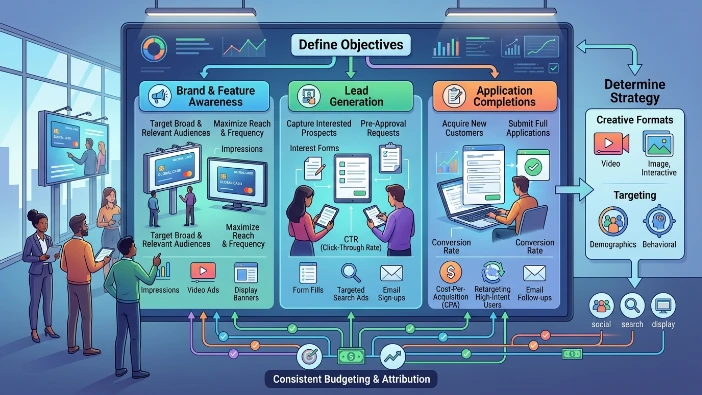
Impressions and ad recall for awareness; CTR and form fills for lead generation; conversion rate and cost-per-acquisition (CPA) for applications. Clear objectives allow attribution across channels and consistent budgeting rules.
What targeting methods do finance brands use in display campaigns?
Advertisers use contextual, behavioural, demographic, and custom audience targeting to reach potential credit card applicants. Contextual targeting places ads on pages matching relevant content categories such as personal finance, travel, or shopping. Behavioural targeting uses browsing signals to reach users who visited comparison sites, reward programmes, or travel booking pages. Demographic targeting filters by age range, household income segment, and location such as United Kingdom regions or cities.
Custom audience targeting includes first-party data lists, hashed emails for matched audiences, and lookalike audiences built from cardholders. Frequency capping limits ad exposure per user, commonly set between 3 and 10 impressions per week. Geographic targeting narrows delivery to United Kingdom postal regions or metropolitan areas when regulations or product availability require it.
What creative formats work for credit-card display ads?
Effective creative formats include static banners, HTML5 rich media, short video, and interactive feature banners that highlight card benefits. Static banners communicate simple messages such as rewards rate or introductory APR. HTML5 and rich media support animated storytelling and interactive elements such as swipeable benefit cards. Short video (6–15 seconds) conveys benefit hierarchies and eligibility prompts. Interactive formats collect basic interest signals such as intent clicks or mini-quizzes without leaving the page.
High-performing creatives list specific numeric benefits: cashback rates (e.g., 1.5%–5%), introductory APR periods (e.g., 0% for 12 months), or travel credit amounts (e.g., £100 statement credit). Use clear calls-to-information rather than calls-to-action to remain educational in awareness campaigns. Ensure creatives meet UK advertising and financial promotion rules for clarity and risk disclosure.
How do finance brands ensure regulatory compliance in display advertising?
Advertisers follow financial promotion rules by presenting clear, fair, and non-misleading information, including eligibility and key terms where required. Regulatory frameworks require accuracy for pricing, rates, and benefits. Ads that include representative examples must show representative APR numbers and relevant qualification criteria. Disclosures appear in the ad or via an accessible link. Targeting must avoid discriminatory criteria and respect data-protection laws such as the UK GDPR. Consent mechanisms apply to personalised targeting and remarketing audiences.
Ad review workflows include legal and compliance sign-off before launch. Automated creative checks validate mandatory disclosures and prevent prohibited claims. Publishers and ad platforms provide tools to limit sensitive targeting and to flag policy violations in real time.
How do finance brands measure display campaign performance for credit cards?
Measurement uses a mix of view metrics, engagement metrics, and conversion metrics to evaluate awareness and downstream application behaviour. Primary view metrics include impressions and viewable-impression rate. Engagement metrics include CTR and interaction rate for rich media. Conversion metrics include form fills, pre-approval requests, and completed applications tracked via pixels, server-to-server events, or post-click landing pages. Attribution uses multi-touch models, with view-through attribution for display impressions that later convert via search or direct visits.
Common KPIs: CPM (cost per 1,000 impressions), CTR (typically 0.05%–0.5% for finance display), cost-per-lead (CPL), and CPA. Campaigns run A/B tests on creative variants and targeting segments. Comparing creative A with 0.08% CTR and creative B with 0.15% CTR, then scaling the higher performer while monitoring CPA.
What role does audience segmentation play in campaign effectiveness?
Audience segmentation isolates high-relevance groups so campaigns deliver tailored messages and improve conversion rates. Segmentation splits audiences by credit-product interest, lifecycle stage, reward preference, spending behaviour, and propensity scores from first-party data. Example segments: frequent travellers, grocery spenders, balance-transfer seekers, or users with high likelihood to apply within 30 days. Each segment receives creatives that emphasise the most relevant benefits, such as travel insurance for travellers or low APR for balance-transfer seekers.
Segmentation reduces wasted impressions and lowers CPA by focusing budget on users with higher propensity to convert. It enables sequential messaging: awareness creatives, then education creatives, then intent-focused creatives across display placements.
How do finance brands use programmatic buying for credit-card display campaigns?
Programmatic buying automates media buying across exchanges using DSPs and algorithmic bidding to optimise for campaign KPIs. Advertisers set audience definitions, bid strategies, and inventory restrictions in a DSP. The DSP uses algorithms to bid on impressions in real time. Bid strategies include target CPM for awareness and target CPA for conversion campaigns. Inventory controls exclude unsafe categories and low-viewability placements.
Programmatic setups use private marketplace (PMP) deals for premium finance inventory. Viewability optimisation and brand-safety gates ensure ads appear in quality contexts. Programmatic also enables dynamic creative optimisation (DCO) to assemble personalised ad variations at scale.
What campaign components improve creative relevance and measurement?
Key components include dynamic creatives, landing-page alignment, tracking pixels, and A/B testing frameworks. Dynamic creative optimisation swaps headlines, images, and benefit snippets based on segment data. Landing-page alignment ensures the landing page reflects the ad’s exact offer and disclosure language to reduce drop-off. Tracking pixels and server-to-server event tracking capture conversions and attribution. A/B testing compares creative variants and audience settings with statistical significance thresholds such as 95% confidence.
Data-layer events on landing pages pass structured data such as product type, reward rate, and form progression stage. This structured data supports deterministic matching and better attribution.
Dive Deeper Into This Topic:
How Fintech Platforms Educate Users Using Feature Banner Campaigns
What benefits do display campaigns deliver for credit-card promotion?
Display campaigns deliver broad reach, scalable awareness, measurable engagement, and the ability to target users by intent signals. They create top-of-funnel exposure to relevant segments across the open web and app environments. Programmatic buying scales with audience segments while maintaining control over inventory quality. Measurable engagement metrics allow optimisation toward downstream KPIs such as CPL and CPA. Display campaigns also support sequential journeys that guide users from awareness to application.
Display media preserves a persistent presence during product launches and seasonal pushes such as summer travel or holiday spending periods.
Explore More Expert Insights:
How Insurance Companies Generate Leads Using Banner Ads
How Banks Increase Loan Applications Using Banner Advertising
What are typical use cases and examples for display campaigns in finance?
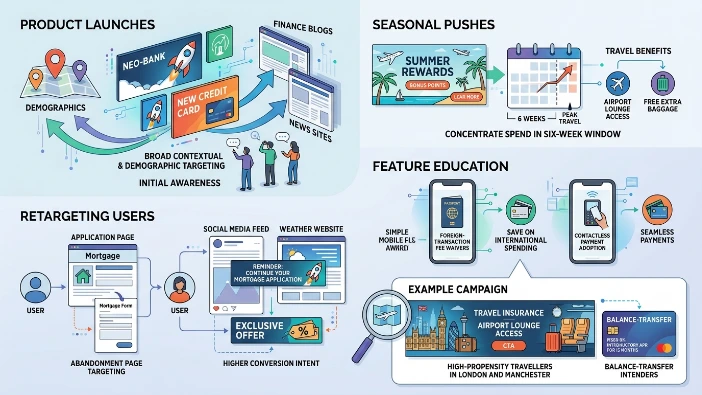
Use cases include product launches, seasonal reward pushes, education about new features, and retargeting users who visited application pages. Product launches use broad contextual and demographic targeting to build initial awareness. Seasonal pushes focus on relevant benefits, such as travel rewards during summer, and concentrate spend in the six-week window prior to peak travel. Feature-education campaigns highlight specific benefits like foreign-transaction fee waivers or contactless payment adoption. Retargeting campaigns reach users who viewed pricing or started applications but did not complete forms.
A campaign targets high-propensity travellers in London and Manchester with rich-media creatives promoting travel insurance and airport lounge access. Another example targets balance-transfer intenders with creatives detailing a fixed 0% introductory APR for 12 months.
Explore the Complete Guide:
Fintech Campaign Ads That Turn Feature Awareness Into Active Users
How do finance brands handle privacy and data concerns in display advertising?
Advertisers implement consent management, data minimisation, and hashed or anonymised audience matching to comply with data-protection rules. Consent management platforms record user consent for personalised advertising. First-party data processing uses hashed identifiers for list matching. Advertisers avoid sensitive attribute targeting and maintain retention limits such as 180 days for remarketing lists. Data processing agreements govern third-party vendors and DSPs. Regular audits validate compliance with UK GDPR and industry guidelines.
Display campaigns for credit-card promotion use targeted, measurable visual ads across web and app inventory. Advertisers define clear objectives, select contextual and behavioural targeting, deploy static and rich-media creatives, and measure using view and conversion metrics. Programmatic buying, dynamic creative optimisation, and structured measurement improve efficiency. Campaigns require regulatory oversight, privacy controls, and aligned landing experiences to convert awareness into measurable interest.