
Insurance retargeting advertising is the practice of displaying targeted ads to users who previously interacted with an insurer’s website or content, using tracking pixels and CRM data to show personalised creative that drives signups.
Retargeting uses a tracking pixel or identifier to record user actions. Typical tracked events include page visits, quote starts, form fills, and abandonment. Platforms match identifiers to ad inventories across display networks, social channels, and programmatic exchanges. Campaigns serve sequential creatives to move users from consideration to conversion. Common signals used: visited product pages, quote progress (1–5 steps), time on site, and previous policy type.
Retargeting funnels follow three phases: awareness reinforcement, objection handling, and conversion nudges. Awareness reinforcement reminds a user of a viewed policy. Objection handling addresses price, coverage gaps, and exclusions. Conversion nudges include limited-time pricing, simplified sign-up links, and one-click quote resumption.
Why do insurers use retargeting ads to increase signups?
Insurers use retargeting ads to raise conversion rates by re-engaging users who showed intent, reducing cost per acquisition by up to 50% versus cold display, and shortening the average sales cycle.
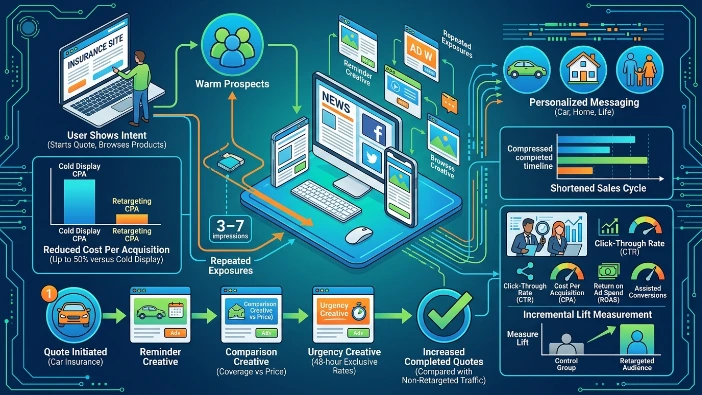
Retargeting targets warm prospects, lowering acquisition costs because audiences already show intent. Data-driven creative personalises messaging to the product of interest (car, home, life). Retargeting raises conversion probability via repeated exposures—typically 3–7 impressions are required to drive action. Campaigns measure incremental lift using control groups or holdout audiences. Metrics tracked include click-through rate (CTR), cost per acquisition (CPA), return on ad spend (ROAS), and assisted conversions.
Example: an insurer tracks users who initiated a car insurance quote and serves a retargeting sequence: reminder creative, comparison creative (coverage vs price), and an urgency creative with 48-hour exclusive rates. This sequence increases completed quotes by defined percentage points when compared with non-retargeted traffic.
For more information explore:
How Insurance Companies Generate Leads Using Banner Ads
What data sources and signals power effective retargeting?
Effective retargeting uses first-party website events, CRM identifiers, email engagement, and hashed customer lists combined with contextual signals and device IDs.
First-party data is primary. Events include page views, product views, quote starts, partial form fields, and policy number lookups. CRM identifiers such as hashed emails enable deterministic matching to social and programmatic platforms. Email open and click signals indicate engaged customers for higher-intent segments. Server-to-server event collection reduces data loss from ad blockers. Supplementary signals include IP ranges for corporate fleets, device ID for mobile app users, and cookie-based interest segments.
Data hygiene rules: retain event timestamps, event type, product SKU, and campaign source. Segment events by recency: 0–3 days (high intent), 4–14 days (mid intent), 15–90 days (longer nurture). Use exclusion lists to avoid targeting current policyholders for the same product. Maintain GDPR compliance: provide clear consent, allow opt-out, and process hashed identifiers when required.
Which ad creatives and messages convert consideration into signups?
High-converting creatives deliver clear price signals, step-by-step next actions, trust indicators (ratings), and tailored benefits tied to the user’s earlier behaviour.
Format and sequencing: start with reminder creative showing the specific product viewed. Follow with comparison creative that contrasts two coverage levels and shows the exact benefits. Conclude with conversion creative offering a fast-signup route and a specific incentive. Use dynamic creative to insert user-specific data, such as the make and model for motor insurance or postcode for home cover.
Dynamic banner shows “Your quote for 2018 Ford Focus from £XX/month” and a button “Complete quote 2 minutes.”
How do insurers structure retargeting campaigns and budgets for outcomes?
Insurers structure campaigns by intent segment, assign higher bids to high-intent segments, and allocate 20–40% of the digital acquisition budget to retargeting for conversion focus.
What targeting and privacy practices protect compliance in the UK?
UK-compliant retargeting requires lawful basis for processing, clear cookie consent, data minimisation, and transparent opt-out options, with documentation of consent and data flows.
Lawful basis: use consent for advertising cookies and legitimate interests for some CRM-based processing where assessment shows minimal privacy impact. Provide granular cookie settings and serve consent banners before collecting advertising cookies. Offer an easy mechanism to withdraw consent.
Data minimisation: store only the identifiers and timestamps required for retargeting segments. Hash emails and identifiers prior to matching. Maintain a Data Protection Impact Assessment (DPIA) for large-scale profiling.
Record-keeping: log consent records with timestamps and consent scope. Include opt-out signal handling and suppression lists to avoid contacting individuals who withdraw consent. Work with vendors who provide UK/EU data processing agreements and standard contractual clauses when necessary.
How do insurers measure retargeting success and attribute signups?
Insurers measure retargeting success using multi-touch attribution, holdout tests, and incrementality studies, focusing on CPA, assisted conversions, and conversion lift.
Key metrics:
- Cost per acquisition (CPA) for completed policies.
- Assisted conversion value from retargeting channel.
- Incremental lift from control/holdout groups.
- Time-to-conversion median in days.
- Frequency and view-through conversions.
Attribution approaches:
- Use multi-touch attribution to value retargeting exposures across the funnel.
- Run a 10–15% control holdout group to measure incremental lift. Compare conversion rates between exposed and holdout groups.
- Employ server-side event matching to reconcile impressions with backend policy signups, ensuring accurate CPA.
Example measurement plan: isolate users who started a quote but did not finish, split them into exposed and holdout groups, run the retargeting sequence for 14 days, then compare completed policy rates.
Explore More Expert Insights:
Banking Display Ads That Turn Loan Interest Into Approved Applications
Financial Services Banner Ads That Convert Trust Into Customer Applications
What creative testing and optimisation processes increase signup rates?
Optimise creatives with A/B tests for messages, dynamic content tests for personalisation, and sequential testing for ad frequency and timing to increase completed policies.
Testing focus areas:
- Message testing: price-first vs benefits-first.
- Creative format: static banner vs short video vs carousel.
- Dynamic elements: vehicle details, postcode, premium estimate.
- Timing: immediate retarget vs delay of 24–72 hours after abandonment.
- Frequency caps: test 3, 5, and 7 impressions per week.
Example finding: a campaign that tested immediate retargeting versus a 48-hour delay found a 22% higher conversion rate with a 24-hour delay when paired with a time-limited price incentive.
What are practical use cases and outcomes for retargeting?
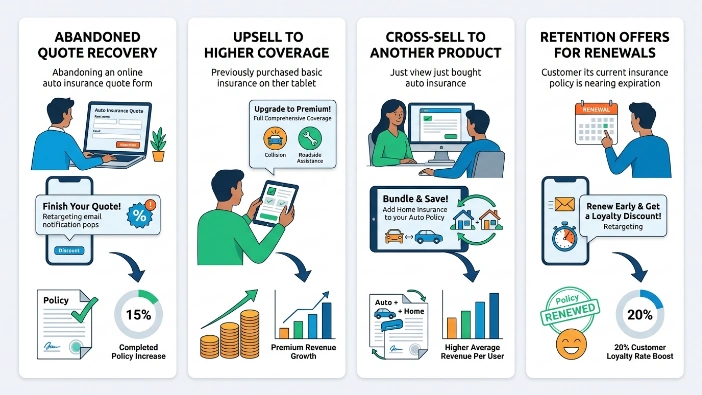
Use cases include abandoned quote recovery, upsell to higher coverage, cross-sell from one product to another, and retention offers for renewal renewals — each showing measurable increases in completed policies and revenue per user.
Use case examples:
- Abandoned quote recovery: resume-quote creative reduces drop-off and increases completed policies by defined percentage points.
- Upsell to higher coverage: comparison creative increases average revenue per policy by showing benefit differentials.
- Cross-sell: users who purchased car insurance receive home insurance retargets with combined-discount messaging.
- Renewal capture: retarget current customers 60 days before renewal with retention incentives to reduce churn.
Measured outcomes: retargeting increases completed policy signups by specific lift amounts in controlled tests, lowers CPA versus prospecting channels, and increases average lifetime value when cross-sell messages convert.
This guide defines insurance retargeting, explains data and creative components, outlines campaign structure and compliance for the UK, and provides measurement and optimisation steps focused on converting consideration into active signups.
For readers who want solution-awareness and setup details, see:
How Insurance Companies Increase Policy Consideration Using Banner Ads for mid-funnel strategies and testing frameworks.