
Banner ads are rectangular digital images or HTML elements that display on web pages to attract clicks; insurance companies use them to drive traffic to landing pages, collect contact details through forms, and track engagement for lead scoring.
A banner ad is a visual advertising unit placed on websites, apps, and ad networks. Banner sizes follow industry standards such as 300×250, 728×90, and 160×600 pixels. Insurers display product-focused messages, price prompts, or informational offers on these units. When a user clicks a banner, the ad links to a landing page with a quote form, callback scheduler, or downloadable resource. Insurers embed tracking parameters and conversion pixels in the landing page to record lead actions: form submissions, phone calls, or downloads. This click-to-convert pathway turns anonymous web users into identifiable leads.
How do ad networks and programmatic platforms help insurers reach target audiences?
Ad networks and programmatic platforms place banner ads across many sites automatically and use audience data to target users based on demographics, behaviours, and contextual signals.
Ad networks aggregate publisher inventory and accept advertiser bids to serve banners. Programmatic platforms automate bidding through real-time auctions called RTB (real-time bidding). Advertisers set targeting rules: location (United Kingdom), age ranges, device types, and interest segments such as “motor insurance seekers.” Platforms use third-party data, publisher signals, and first-party cookies to decide which banners show to which users. Programmatic buying scales reach to millions of impressions while enforcing frequency caps and viewability thresholds. Insurers use these platforms to prioritise inventory with high viewability rates and to optimise bids toward placements that historically convert into leads.
What metrics define banner ad lead generation performance?
Key metrics include impressions, click-through rate (CTR), cost per click (CPC), conversion rate (CVR), cost per lead (CPL), and return on ad spend (ROAS).
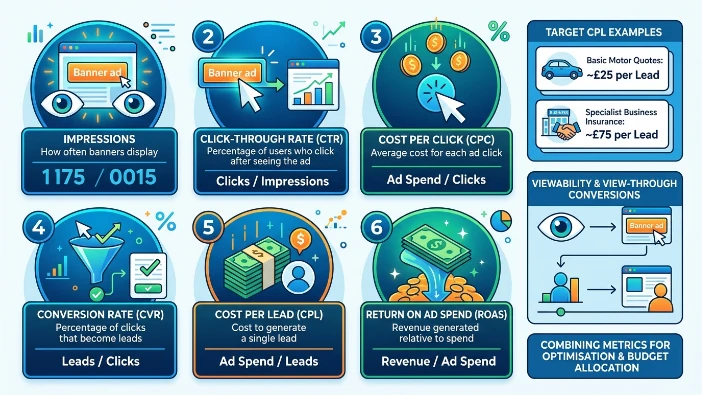
Impressions measure how often banners display. CTR equals clicks divided by impressions. CPC equals ad spend divided by clicks. CVR equals leads divided by clicks. CPL equals ad spend divided by leads. ROAS equals revenue generated divided by ad spend. Insurers set CPL targets by product line: example targets include £25 per leads for basic motor quotes and £75 per leads for specialist business insurance. Viewability and view-through conversions also inform performance by tracking users who saw a banner then converted later. A combination of metrics guides optimisation decisions and budget allocation.
How do insurers design banner creatives for effective lead capture?
Design focuses on concise headlines, clear value propositions, strong visual contrast, and a single call-to-action that links to a lead-focused landing page.
Creative files include static images, animated GIFs, and HTML5 banners. Headlines use no more than 6–8 words. Value propositions state specific benefits such as “Instant motor quote in 60 seconds.” Calls-to-action use verbs like “Get Quote” or “Compare Prices.” Visual elements include product imagery, policy icons, and trust markers such as star ratings or regulatory references relevant to the United Kingdom insurance market. File sizes remain under 150 KB to meet publisher load-time standards. Multiple creative variations test different headlines, colour schemes, and CTAs to identify the highest-converting combinations.
How do insurers build landing pages that convert banner traffic into leads?
Landing pages present a single focused offer, a short form (3–5 fields), privacy and data-use notice, and clear steps for next actions to convert banner clicks into contactable leads.
Landing pages remove navigation distractions and focus on conversion. Forms capture essential fields: name, postcode, email, phone number, and product-specific data (vehicle make for motor, property value for home). Progressive profiling collects additional details later. Pages include trust indicators such as FCA guidance references and simple explanations of data handling under UK law. Mobile-responsive design ensures form usability on smartphones. Fast load times and visible phone numbers increase phone-based lead capture. A successful landing page yields CVR improvements from 1% to 6% depending on audience relevance.
How do insurers use audience targeting to improve lead quality?
Targeting includes demographic filters, behavioural segments, contextual targeting, and first-party data layering to prioritise users most likely to convert into policy leads.
Demographic targeting filters by age bands and household income proxies. Behavioural segments use browsing history such as visits to car comparison or property listing sites. Contextual targeting places banners on pages about driving, homeownership, or small-business topics. First-party data originates from prior website visitors, existing customers, or newsletter subscribers. Insurers create lookalike audiences from high-value customers to expand reach. Combining contextual signals and first-party lists reduces irrelevant clicks and lowers CPL by raising conversion rates.
For more detail explore:
How Insurance Companies Increase Policy Consideration Using Banner Ads
What role does retargeting play in converting banner ad visitors into leads?
Retargeting shows follow-up banners to users who previously visited an insurer’s site; it increases lead conversions by reminding and guiding users back to a quote process.
Retargeting uses cookies and device identifiers to build audiences of site visitors who did not convert. Insurers show sequential messaging: initial banners highlight benefits, subsequent banners offer limited-time incentives or reduced steps to quote. Frequency caps limit impressions per user to prevent ad fatigue. Cross-device retargeting connects desktop and mobile behaviour so users see consistent messages. Retargeting typically increases CVR by 30% to 200% depending on the funnel stage and creative relevance.
For more information explore:
Insurance Retargeting Ads That Convert Policy Consideration Into Active Signups
How do insurers ensure compliance with UK advertising and data rules when collecting leads?
Insurers follow the Financial Conduct Authority (FCA) rules for financial promotions, the Privacy and Electronic Communications Regulations (PECR), and the UK GDPR when collecting and processing personal data.
Banner copy avoids misleading claims and includes clear product descriptions. Landing page forms include affirmative consent checkboxes for electronic contact and processing notices that reference lawful bases such as contract or legitimate interests. When insurers use cookies for targeting, they show a cookie banner giving meaningful choices and record consent where required by PECR. Data retention policies specify storage durations: example retention windows include 36 months for prospect leads and 6 months for short-term campaign tracking. Audit logs record consent timestamps to demonstrate compliance during inspections.
Explore More Expert Insights:
How Banks Increase Loan Applications Using Banner Advertising
How Financial Services Use Banner Ads to Acquire New Customers
What technologies enable banner ad lead tracking and attribution?
Tracking uses UTM parameters, server-side conversion pixels, tag managers, CRM integrations, and attribution models to link banner interactions to lead outcomes.
UTM parameters annotate landing page URLs with campaign identifiers. Client-side pixels record clicks and page events. Server-side conversion APIs send validated lead events from servers to ad platforms to avoid browser-level blocking. Tag managers centralise scripts for efficient deployment. CRM systems ingest leads via APIs and append campaign metadata for lifecycle tracking. Multi-touch attribution models assign credit across impressions and clicks; common models include last-click, linear, and time-decay. Data-driven attribution models use conversion data to weigh touchpoints, improving budget allocation to high-impact banner placements.
What use cases show banner ads delivering insurance leads effectively?
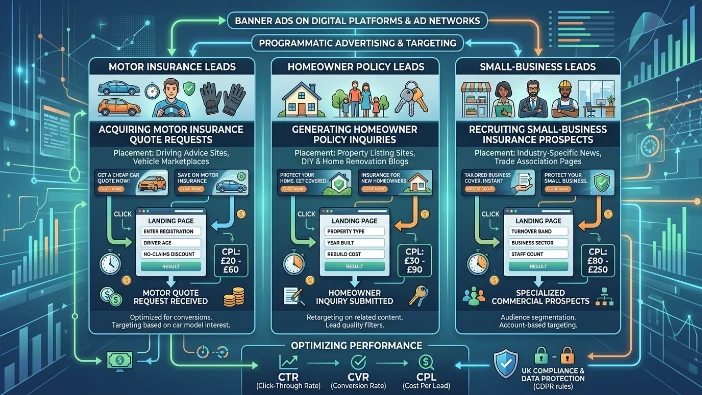
Use cases include acquiring motor insurance quote requests, generating homeowner policy inquiries, and recruiting small-business insurance prospects through targeted content placement.
For motor insurance, banners on driving advice and vehicle marketplace sites convert users seeking quotes. Home insurance banners perform on property listing and DIY websites. Small-business policy banners appear on industry-specific news sites and trade association pages. Each use case pairs audience signals with tailored landing forms: vehicle registration for motor, property age for home, and turnover band for business. Measured CPLs vary by product: example ranges are £20–£60 for motor, £30–£90 for home, and £80–£250 for specialised commercial products.
Banner ads generate insurance leads by presenting concise offers across ad networks and programmatic platforms, driving clicks to conversion-optimised landing pages, and using targeting, retargeting, and tracking technologies to improve lead quality. Metrics such as CTR, CVR, and CPL guide optimisation. Compliance with UK advertising and data protection rules ensures lawful collection and use of lead information. For related tactical guidance, readers can explore How Insurance Companies Increase Policy Consideration Using Banner Ads and Insurance Retargeting Ads That Convert Policy Consideration Into Active Signups