
Remarketing real estate ads turn previously engaged website visitors into final buyer leads by re‑targeting them with personalised property messages, controlled frequency, and conversion‑tracked campaigns across display networks in the UK market.
Remarketing real estate ads are display ads that follow users who visited a real estate website or property listing, using cookie‑based or login‑based audiences to show property‑specific messages and drive them back to book viewings or contact forms.
These ads live on the Google Display Network, social feeds, and partner sites, visible to people who previously browsed listings, saved searches, or started a valuation form.
Remarketing uses tracking tags placed on a website to record page visits, form starts, PDF downloads, and other actions recognised as buyer‑intent signals.
Once an audience is built, agencies or in‑house teams upload it into ad platforms and serve image, video, or rich‑media ads that repeat the property or area focus the user showed in the first visit.
Each campaign targets a defined group, such as “viewed 3‑bed London flats” or “started valuation form but did not submit,” and excludes already‑converted leads.
How do remarketing campaigns convert engagement into buyer leads?
These campaigns convert engagement into buyer leads by serving time‑bound, high‑value offers to warm audiences, then measuring form submissions, viewing bookings, and phone calls as direct conversion outcomes.
Agencies design a sequence: a first‑visit ad for awareness, then more targeted remarketing ads with stronger calls to action such as “Book a viewing today” or “Request a free instant valuation.”
Each ad set links to a specific landing page or form version, which tracks submission events and marks the user as a lead when the form is completed.
Conversion‑focused campaigns also use call‑tracking numbers on remarketing creatives so that phone calls from banner clicks are counted as leads.
Lead‑level data (name, contact, property interest, budget) is fed into a CRM or lead‑management system, where sales teams contact within 30–60 minutes to maximise conversion.
What are the key components of a converting remarketing campaign?
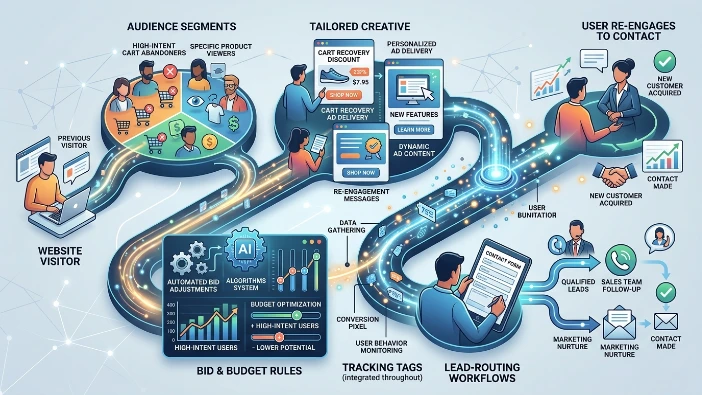
A convertingremarketing campaign combines audience segments, tailored creative, bid and budget rules, tracking tags, and lead‑routing workflows that work together to move users from re‑engagement to contact.
Audience segmentation
Audience segments split users by behaviour and intent.
Common segments include:
- Listing viewers (visited one or more property pages).
- Neighbourhood‑search users (viewed “houses in London” or similar area pages).
- Form‑start users (loaded a valuation or contact form but did not submit).
- Converted users (excluded from active remarketing to avoid over‑exposure).
Segment‑specific bids and messages increase efficiency; agencies assign higher budgets and stronger messaging to high‑intent segments like listing viewers and form‑starters.
Creative and messaging
Creative for remarketing ads uses one clear message, one visual focal point, and a quantitative hook.
Examples include: “3‑bed flat in Islington, £525,000 – view virtual tour” or “Valuation started – finish in 60 seconds.”
Ads are built for mobile‑first placement, with text that fits constrained banner sizes and loads quickly on lower‑bandwidth connections. Agencies rotate creative every 7–14 days per segment to maintain freshness and avoid banner blindness.
Bidding, budget, and timing
Campaigns use conversion‑oriented bidding, raising bids for users who visited high‑intent pages or started a form and lowering them for general visitors. Frequency caps limit impressions to 3–8 per week per user, measured by cookie or device ID, to prevent ad fatigue.
Budgets are paced across the day and week, often increased during peak browsing hours (early evening and weekends) when UK property shoppers are most active. Campaigns are also aligned with property‑listing life cycles, so recently‑listed properties receive more intensive remarketing in the first 14–21 days.
Tracking and measurement
Tracking adds platform conversion tags and event tags on forms, PDF downloads, and viewing‑booking buttons.
Each completed form or booking is recorded as a lead‑conversion event and linked back to the remarketing impression or click.
Cross‑channel attribution models (last‑click, time‑decay, or data‑driven) show how remarketing assisted in the final step, even if the user later arrived via search or email. Agencies export lead‑cost and conversion‑rate data by segment and adjust budgets and creatives weekly.
What are the measurable benefits for UK real estate firms?
Remarketing real estate ads deliver higher click‑through rates, more repeat site visits, more form submissions, and a lower cost per qualified lead compared with generic display campaigns.
UK‑based agents report uplift in buyer engagement metrics when remarketing is layered on top of standard display: repeat visits increase by 15–35%, and form‑completion rates rise by 10–25% for warmed audiences.
Cost per lead often falls because remarketing focuses spend on users who already showed interest instead of broad, untargeted audiences.
Lead‑quality impact
Remarketing‑driven leads tend to be warmer; they have already viewed a property or neighbourhood, so they answer questions faster and book more viewings.
Sales teams observe shorter conversion cycles for remarketing‑sourced leads, with higher viewing attendance and faster movement toward offers.
Visibility and brand reinforcement
Repeated exposure reinforces brand recognition and property availability without direct sales pressure. Users who see the same agent’s remarketing ads across multiple sessions are more likely to recognise the brand when they later search on portals or ask for a specific agent.
How do UK agents use remarketing in practice?
UK agents use remarketing to re‑engage listing viewers, recover abandoned valuation forms, support local‑area campaigns, and complement their portal and search activity.
Re‑engaging listing viewers
A user visits a 2‑bed flat in Bristol, spends 60+ seconds on the details page, and leaves. The remarketing system adds that user to a “listing viewer” audience and shows dynamic ads featuring that exact flat, a price tag, and a “Book a viewing” button.
These ads typically outperform generic “property in Bristol” banners because the creative matches what the user already saw. Agents report 1.5–2× higher click‑through rates and 20–40% more viewing bookings from listing‑specific remarketing.
Recovering abandoned valuation forms
A seller starts a valuation form, selects a property type and postcode, but exits before submitting.
The remarketing system tags that session as “valuation‑form‑started” and shows a follow‑up ad with a headline such as “Your valuation is ready – finish in 30 seconds.”
The ad links to a pre‑populated version of the form or a short survey that reduces friction.
This approach recovers 8–15% of abandoned form sessions as completed valuations, which agents then convert into valuer appointments.
Supporting local‑area buyer campaigns
Agencies build remarketing audiences for “searched North London 3‑bed homes” and serve creatives that highlight multiple listings in that area and a “Find 3‑bed homes in North London” CTA.
These campaigns keep the agent visible while the buyer compares options on portals and other sites.
Once the buyer is ready, they click back to the agent’s site and submit a contact form or booking request.
Explore More Expert Insights:
Virtual Tour Ads That Turn Property Views Into Buyer Trust and Action
Listing-Based Property Ads That Convert Investors Into High-Value Leads
Complementing portals and search ads
Remarketing does not replace Rightmove, Zoopla, or search ads; it supplements them. When a user views a listing on a portal and then visits the agent’s site, remarketing ads appear as they continue browsing the web, reinforcing the agent brand.
This combination helps agencies compete with portals by keeping their own site in front of users who have already shown intent. Leads that touch both portals and remarketing often show higher conversion rates than those that come from a single channel.
What are the best practices agencies use?
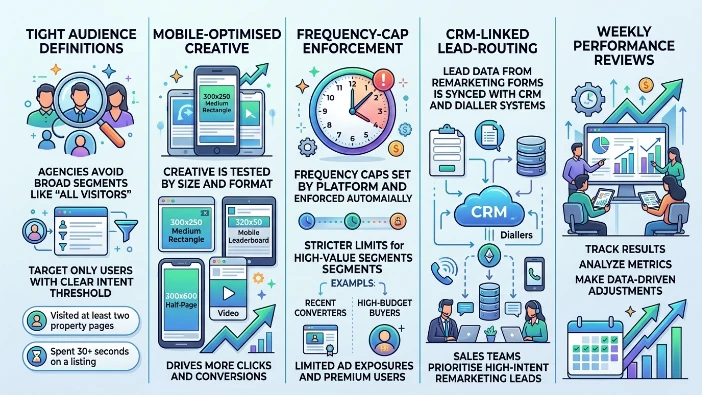
Best‑practice remarketing campaigns use tight audience definitions, mobile‑optimised creative, frequency‑cap enforcement, CRM‑linked lead‑routing, and weekly performance reviews.
Agencies avoid broad segments like “all visitors” and instead target only users who meet a clear intent threshold, such as visiting at least two property pages or spending 30+ seconds on a listing. Creative is tested by size and format (300×250, 320×50, 300×600, and video) to see which drives the most clicks and conversions.
Frequency caps are set by platform and enforced automatically, with stricter limits for high‑value segments such as recent converters or high‑budget buyers. Lead data from remarketing forms is synced with CRM and dialler systems so that sales teams can prioritise high‑intent remarketing leads.