
Visual property ads are digital display creatives that combine high-quality images, short videos, and concise text to present residential or commercial properties; they deliver targeted impressions to potential buyers across websites, apps, and social platforms and drive measurable inquiry signals.
Visual property ads define a class of paid media. They use photographic assets, floorplan snippets, 10–30 second video tours, and branded overlays. Distribution channels include programmatic display networks, social feeds, and publisher placements. Targeting layers use audience segments (demographics, intent, behaviour), geotargeting by postcode or radius, and contextual placements by real-estate content. Measurement uses click-through rate (CTR), view-through conversions, cost per lead (CPL), and assisted-conversion attribution.
Creative variants run A/B tests on hero image, headline, and call-to-action text. Example: a 12-image carousel with 20-second video and a highlighted 2‑bed price range on a regional publisher yields richer engagement than single-image banners in comparative tests.
How do visual display ads move prospects from consideration to shortlists?
Display ads move prospects by raising awareness, presenting property details, and prompting micro-conversions such as brochure downloads, virtual tour sign-ups, and viewing requests that indicate shortlist intent.
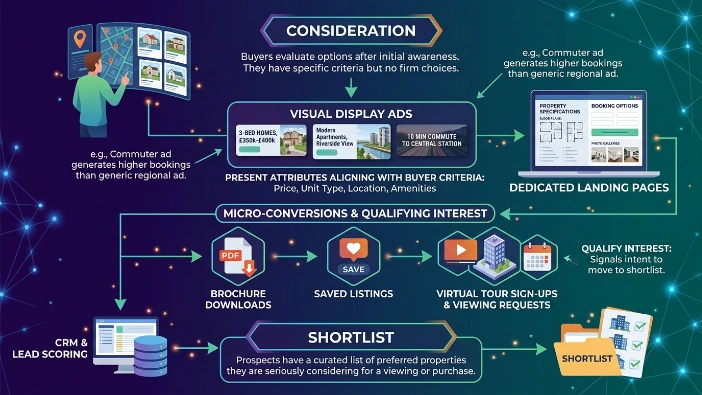
Buyers enter consideration after initial awareness. Visual ads present attributes that align with buyer criteria: price band, unit type, location, and amenities. Ads link to dedicated landing pages with property specifications and booking options. Micro-conversions such as brochure download, saved listing, and video tour sign-up qualify interest. Platforms record these actions and feed them into CRM systems for lead scoring. Example: an ad that highlights “3-bed homes, £350,000–£400,000, 10-minute commute to central station” generates higher booking rates from commuters than generic regional ads.
What components must high-converting visual property ads include?
High-converting ads include a clear hero image or short tour video, concise headline with price or USP, a readable call-to-action, and metadata like location and unit type; they deliver one primary message per creative.
Define each component precisely. Hero image: high-resolution exterior or staged interior photo at 1200×628 pixels for landscape placements and 1080×1080 for square placements. Video: 15–30 seconds, 1920×1080, with captions and a first-frame hook. Headline: 5–8 words with price band or main benefit. CTA: single imperative verb phrase such as “Book Tour” or “Download Brochure.” Metadata: tag with locality, unit size (sq ft or m²), and price range. Creative format variations include static images, carousels, short videos, and HTML5 rich media. Example: use floorplan snippets and length-of-stay amenities in a carousel where slide 1 shows exterior, slide 2 shows living area, and slide 3 shows floorplan with sqm.
How do you target audiences effectively with visual property ads?
Targeting uses location, demographic, behavioural intent, and lookalike segments to reach in-market buyers and exclude irrelevant users; use radius targeting, postcode lists, and custom intent keywords for precision.
Location targeting narrows exposure to relevant catchment areas and feeder towns. Demographic targeting includes age bands, household income ranges, and family status. Behavioural intent targets users who searched mortgage terms, property listings, or comparable developments in the last 30 days. Lookalike segments expand reach to profiles matching existing buyers or leads.
Exclusions prevent wasting spend on users who already purchased or clicked but did not convert after qualified follow-up. Use first-party data (CRM lists, past website visitors) for retargeting. Example: retarget all website visitors who viewed a 3‑bed unit page in the last 14 days with a tailored carousel emphasising availability and commute time.
What landing page elements increase conversion from display traffic?
Landing pages must present unit details, transparent pricing, available dates, floorplans, a short booking form, and a visible privacy statement to convert display visitors into leads.
Lead capture requires minimal friction. Present price ranges and available unit counts near the top. Include downloadable brochures in PDF and a 1–2 minute virtual tour. Floorplans require dimensions and orientation. Booking form: maximum five fields (name, email, phone, preferred date, unit interest) with progressive profiling for later stages.
Add trust signals: planning reference, energy ratings, and certified agent details. Integrate with CRM for instant lead routing and automated acknowledgement emails or SMS. Example: a landing page with a 3-step enquiry form and instant PDF brochure download increases lead completion vs. a long multi-step form.
How does measurement and attribution for display ads work in property campaigns?
Measurement tracks impressions, CTR, micro-conversions, leads, and downstream outcomes such as site visits and reservations; attribution uses multi-touch models to credit display as an assist or direct driver.
Set conversion events by priority: brochure download, virtual tour signup, viewing booking, and completed reservation. Use pixel-based tracking and server-side events for consistency. Record assisted conversions where display ads influence later direct search or organic visits. Apply time decay or position-based attribution to weigh touchpoints appropriately. Use cohort analysis to measure time from first ad exposure to viewing booking in days and weeks. Example metrics: CTR target 0.5–1.5%, CPL target depending on market (e.g., £80–£250 per qualified lead for mid-market housing), and view-through-to-lead ratio for video assets at 0.8–1.2%.
What are the expected benefits of using visual property ads for housing projects?
Visual property ads increase qualified inquiries, improve lead quality, shorten sales cycles, and support price transparency by presenting factual property details to targeted buyer segments. Qualified inquiries rise when ads match buyer filters such as budget and commute. Lead quality improves because micro-conversions indicate intent before sales contact. Sales cycles shorten because informed buyers progress faster through decision steps.
Pricing transparency reduces time wasted on mismatched expectations. Ads also provide scalable audience reach for launch phases and selective retargeting for remaining inventory. Example outcome: a regional housing launch using targeted display assets shows a 25% higher viewing booking rate and a 14% faster time-to-reservation compared to generic search-only campaigns.
Which use cases suit visual display ads in property marketing?
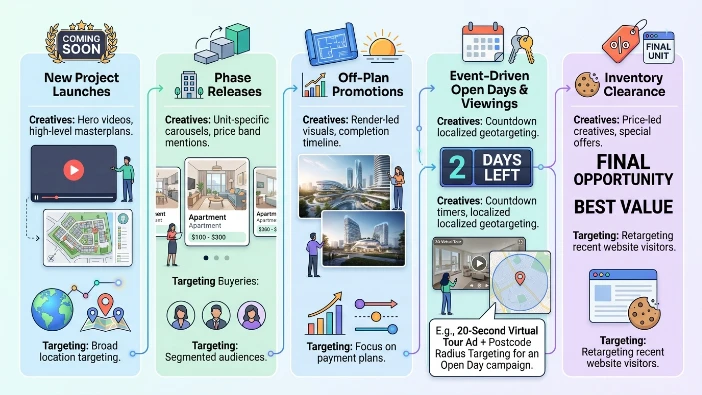
Use cases include new project launches, phase releases, off-plan promotions, event-driven open days, and inventory clearance; each use case maps to specific creative formats and targeting profiles. New project launches require hero videos, high-level masterplans, and broad location targeting. Phase releases need unit-specific carousels and price band mentions for segmented audiences.
Off-plan promotions use render-led visuals and emphasise completion timeline and payment plans. Open days and viewing events use countdown timers and localised geotargeting to drive attendance. Inventory clearance focuses on price-led creative and retargeting to recent website visitors. Example: use a 20-second virtual tour ad plus postcode radius targeting for an open day campaign to boost weekend bookings.
Explore More Expert Insights:
Real Estate Advertising That Drives Qualified Site Visit Conversions
Property Showcase Campaigns That Turn Leads Into Site Visit Bookings
How should teams organise production and testing for best results?
Organise production with a content calendar, defined asset templates, and A/B tests for hero image, headline, and CTA; run tests in parallel for 3–4 weeks and scale winners. Create templates for each ad size and platform to ensure consistency. Set KPIs for each asset: CTR, video completion rate, and CPL. Test a maximum of three variables per campaign to isolate impact. Run split tests for 21–28 days to gather statistically significant results for typical UK regional audiences.
Use automated creative optimisation to rotate top performers. Maintain an asset library with tagged metadata: unit type, price band, and launch phase. Example process: test two hero images and two headlines across desktop and mobile, then promote the best-performing combination to full budget.
Read:
How Housing Projects Build Consideration Using Visual Display Ads
How do data privacy and compliance affect display advertising in the UK?
UK display ads must comply with data protection laws, obtain lawful bases for processing, and provide clear cookie consent for tracking pixels and retargeting; record consent and honour opt-outs.
Follow UK GDPR and PECR requirements for cookies and consent. Use consent-management platforms to capture and store user consent records. Pseudonymise or aggregate analytics data where possible. Validate vendor data processing agreements for any ad tech provider. Present privacy notice links on landing pages and in ad redirects. Example requirement: record active consent before setting non-essential cookies for retargeting or analytics.
How Housing Societies Boost Inquiries Using Display Campaigns are relevant internal resources for readers who want deeper tactical workflows and conversion-focused creative examples.