
A display campaign is an online advertising strategy that uses visual ads (images, banners, rich media) delivered across websites and apps to reach targeted audiences and drive inquiries. A display campaign places visual ads in digital spaces where potential buyers spend time. Ads run on ad networks and programmatic exchanges that serve impressions based on audience data.
Advertisers define goals such as awareness, traffic, or lead generation. Campaigns use creative assets, targeting rules, bidding strategies, and measurement pixels. Common ad sizes follow IAB standards, for example 300×250, 728×90, and 160×600. Campaigns operate on cost models: CPM (cost per 1,000 impressions), CPC (cost per click), and CPA (cost per acquisition).
How display campaigns function in housing society marketing depends on four linked components: creative, targeting, inventory, and measurement. Creative delivers the property message. Targeting identifies relevant audiences. Inventory defines where ads appear. Measurement tracks performance and attribution.
How do housing societies use display campaigns to increase inquiries?
Housing societies run display campaigns to expose properties to defined segments, retarget interested users, and drive visits to contact or enquiry pages. Campaigns begin with audience segmentation. Societies segment by location, demographics, online behaviour, and property intent. They use first-party data (website visitors, enquiry lists) and third-party data (interest signals, demographic overlays) to form segments.
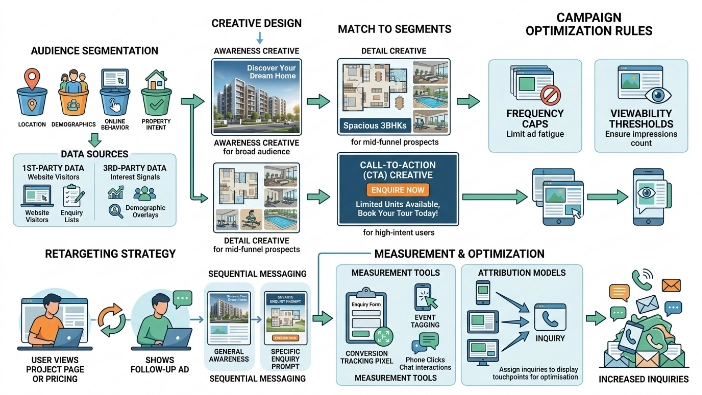
Societies then design creatives that match each segment: awareness creatives for broad audiences, detail creatives for mid-funnel prospects, and call-to-action creatives for high-intent users. Frequency caps limit ad fatigue; viewability thresholds ensure impressions count.
Retargeting raises inquiry rates by showing follow-up ads to users who viewed project pages or pricing. Sequential messaging advances users from general awareness to specific enquiry prompts. Measurement uses conversion tracking pixels on enquiry forms and event tagging for phone clicks and chat interactions. Attribution models assign inquiries to display touchpoints for optimisation.
What creative elements drive inquiries for housing societies?
Effective creatives combine clear property visuals, concise value statements, and explicit contact triggers to prompt enquiries. Visuals require high-resolution photos showing exteriors, show homes, and lifestyle shots. Floor plans and site maps appear in carousel or rich media formats for detail orientation. Headlines state key facts: number of units, starting price, launch date. Subhead text highlights amenities, nearby transport links, and financing options. Call elements include phone numbers, click-to-call buttons, short form fields, and QR codes. Ad creatives follow brand-safe palettes and legible typography sized for mobile screens.
A/B testing evaluates creative variants. Tests compare image types (render vs. photo), headline lengths (6 words vs. 12 words), and CTAs (Enquire vs. Book Visit). Tests run for at least 7 days with a minimum sample of 1,000 impressions to gather stable signals. Creative rotation maintains freshness: rotate every 14–21 days or when CTR drops by 20%.
How does audience targeting work for housing society display campaigns?
Targeting matches ads to specific audiences using geographic, demographic, behavioural, and intent-based signals to raise inquiry relevance. Geographic targeting restricts ads to postal codes or metropolitan areas around the project. Demographics filter by age ranges (e.g., 30–45) and household income bands relevant to the property price. Behavioural signals include searches for “buy apartment near X” or visits to mortgage calculators. Intent audiences include users who viewed multiple property listings in a 30-day window.
Lookalike modelling derives audiences similar to existing enquirers using seed lists. Segments use sizes between 50,000 and 500,000 users for stable delivery. Devices matter: mobile targeting increases for click-to-call and map interactions; desktops perform better for detailed floor plan downloads. Exclusion lists remove current owners or existing customers to conserve budget.
How do housing societies measure and optimise inquiry outcomes?
They track form completions, phone calls, chat interactions, and attributed assisted conversions to measure inquiries and optimise campaigns. Tagging and pixels capture events: form submit, phone click, chat open, and page scroll. CRM integration ingests leads with source metadata for lead quality analysis.
Key performance indicators include CTR (click-through rate), CPL (cost per lead), conversion rate (visits-to-inquiries), and view-through conversions (impressions leading to later direct enquiries). Benchmarks vary by market; a realistic UK display CTR for property ads ranges from 0.05% to 0.20%, and CPL depends on price and intent, often between £20 and £250.
Optimization steps include pausing low-performing placements, reallocating budget to top-performing audiences, and increasing bids for high-value segments. Use time-of-day and day-of-week bid modifiers when enquiry rates peak (for many UK markets, weekdays 18:00–22:00 perform well for contact actions). Attribution windows commonly use 30 days for multi-touch property journeys.
What ad inventory and formats suit housing society campaigns?
Inventory spans open web display, premium publisher placements, programmatic native ads, and in-app banners; formats include static banners, HTML5 rich media, video, and carousels. Open web display offers scale and lower CPMs. Premium publishers provide brand-safe environments and contextual relevance near finance or local news content.
Programmatic native blends ads with editorial for better engagement. In-app placements capture on-the-go users. Video assets of 15–30 seconds showcase walkthroughs and receive higher attention; use muted autoplay for social platforms and publishers.
Format selection aligns with funnel stage: large billboard formats and video for awareness; carousels and interactive floor plans for mid-funnel consideration; click-to-call banners and lead forms for immediate enquiries. Use IAB formats for wide compatibility and ensure creatives meet size and file-weight limits (e.g., HTML5 under 150 KB).
What benefits do display campaigns deliver for housing societies?
Display campaigns increase property visibility, improve lead quantity, support retargeting, and generate measurable inquiry signals for sales follow-up. Visibility expands reach beyond search. Display amplifies brand and project recognition before users search transactional queries. Retargeting lifts conversion rates by 50–150% compared with single-touch outreach.
Measurement yields data to refine sales pipelines: lead timestamps, referral paths, and content engagement metrics inform follow-up priorities. Programmatic buying reduces manual insertion orders and improves bid efficiency through automated targeting and dynamic creative optimisation.
Quantified benefits include faster inquiry cycles: campaigns that retarget website visitors convert those users into enquiries 20–60% faster than first-touch-only strategies. They also reduce average CPL when combined with site optimisation and simplified enquiry forms.
What use cases show display campaigns working for housing societies?
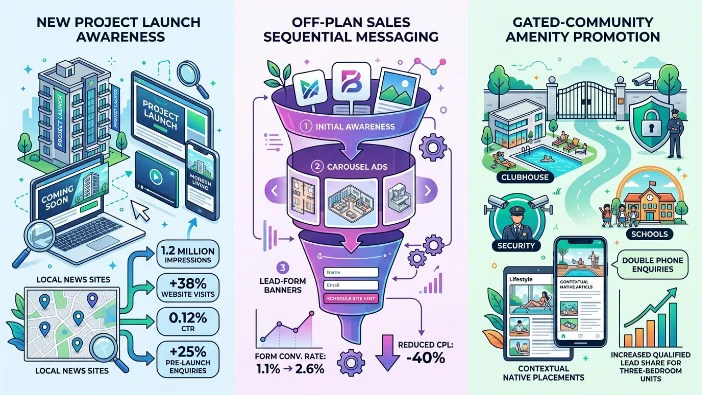
Use case examples include new project launches, off-plan sales pushes, and gated-community amenity promotion that produced measurable inquiry increases.
Example 1: A project launch runs a 6-week awareness campaign with large-format banners and video across local news sites. The campaign delivered 1.2 million impressions and raised website visits by 38%, with a 0.12% CTR and a 25% increase in pre-launch enquiries.
Example 2: An off-plan sale uses sequential messaging: initial awareness creatives, then carousel ads showing floor plans, then lead-form banners offering site visits. The sequence improved form conversion rate from 1.1% to 2.6% and reduced CPL by 40%.
Example 3: A gated-community promotes amenities (clubhouse, security, schools) through contextual native placements on lifestyle sites. The campaign doubled phone enquiries during the 8-week run and increased qualified lead share for three-bedroom units.
Explore More Expert Insights:
How Real Estate Agencies Attract Buyers Using Banner Ads
How Property Developers Increase Sales Using Banner Advertising
How do privacy and compliance affect display campaigns in the UK?
Campaigns must follow UK data protection laws, respect consent frameworks, and use anonymised, aggregated data for targeting when required. Advertisers comply with the UK GDPR and the Privacy and Electronic Communications Regulations (PECR) for electronic marketing.
Consent frameworks such as CMPs capture user choices for cookies and personalised ads. First-party data use requires documented lawful bases and secure handling. Vendors provide privacy-safe options: contextual targeting and cohort-based models reduce reliance on individual identifiers. Retention policies govern how long user-level data remains available for marketing.
Advertisers maintain transparent privacy notices and provide opt-out mechanisms. Regular audits verify vendor compliance and data processing agreements.
Explore:
Visual Property Ads That Convert Consideration Into Buyer Shortlists
How should a housing society plan a display campaign timeline and budget?
Plan a 6–12 week campaign for launches, allocate 60% to awareness and 40% to retargeting, and set a minimum budget that achieves at least 1 million impressions for market visibility. A typical timeline: weeks 1–2 audience research and creative production; weeks 3–8 live campaign with performance reviews every 7 days; weeks 9–12 optimisation and intensified retargeting. Budget allocation splits by objective: CPM-focused awareness and CPC/CPA-focused retargeting. For UK regional projects, a minimum weekly budget of £2,000 commonly secures meaningful reach; adjust upwards for metro areas like London.
Include creative refreshes at weeks 3 and 6. Reserve 10% of the budget for testing new placements or formats. Set KPIs before launch: impressions, CTR, CPL, and lead quality thresholds.
Display campaigns use visual ads across digital inventory to raise awareness and generate enquiries for housing societies. Campaign effectiveness depends on clear creatives, precise targeting, appropriate formats, rigorous measurement, and compliance with UK privacy rules. Structured timelines and budget splits between awareness and retargeting produce measurable inquiry lifts and better sales pipeline data.
How Housing Projects Build Consideration Using Visual Display Ads Would you like a sample 8-week campaign plan and creative checklist tailored to a UK regional housing society?