
Real estate advertising that drives qualified site visit conversions uses targeted ads and optimised landing experiences to attract users who are ready to book viewings or contact agents, producing measurable increases in on-site conversions and qualified leads.
Real estate advertising that drives qualified site visit conversions defines a set of paid and organic promotional activities designed to move potential buyers from awareness to booking an in-person or virtual property viewing. Key entities: audience segments (first-time buyers, investors, downsizers), ad channels (display banners, paid social, search), conversion event (site visit booking or contact form submission), and qualification criteria (budget, timeframe, property type). Campaigns focus on converting high-intent users who match property requirements and local market constraints.
How does the process work to increase qualified site visit conversions?
The process uses audience targeting, creative relevance, landing-page optimisation, and analytics-driven optimisation to convert ad clicks into booked site visits and qualified enquiries.
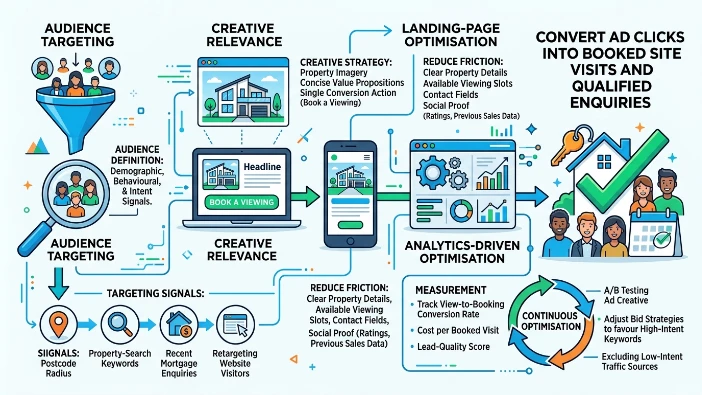
Campaign setup begins with audience definition using demographic, behavioural, and intent signals. Targeting includes postcode radius, property-search keywords, recent mortgage enquiries, and retargeting website visitors. Creative strategy pairs property imagery, concise value propositions, and a single conversion action (book a viewing). Landing pages reduce friction: clear property details, available viewing slots, contact fields, and social proof (ratings or previous-sales data).
Measurement tracks view-to-booking conversion rate, cost per booked visit, and lead-quality score. Continuous optimisation includes A/B testing ad creative, adjusting bid strategies to favour high-intent keywords, and excluding low-intent traffic sources.
Which components must a campaign include to qualify site visits?
A campaign must include precise audience segments, high-conversion landing pages, real-time availability signals, and analytics that link clicks to booked visits.
Audience segments require location and intent filters. Use postcode or city-level targeting for the UK, filter by search terms such as “2‑bed flat near Stratford,” and include recent mortgage-approval audiences. Landing pages require property specifications (bedrooms, square metres, EPC rating), images or floorplans, clear viewing options, and a short contact form limited to three fields. Real-time availability uses booking widgets or calendar integrations that show next available slots. Analytics uses unique conversion pixels or server-side events to connect ad click IDs to booked visits for accurate attribution.
Example: a campaign targeting first-time buyers in Manchester paired with a two-bedroom flat listing page that offers a live booking calendar produced a measured 18% view-to-booking conversion rate.
What creative elements increase booking intent in banner ads?
Creative elements that increase booking intent include strong property images, precise price or rent ranges, succinct benefit lines, and a time-limited availability cue.
Banner imagery must show the primary selling point: exterior façade for houses, key room for apartments. Price transparency uses exact figures or narrow ranges (e.g., £325,000–£350,000). Benefit lines emphasise facts: proximity to transport, EPC rating, council tax band. Add a scheduling cue: “Viewings this week” or “Next slot Friday 4pm.” Use clear calls to action that name the conversion: “Book viewing” or “Reserve slot.” For mobile banners, prioritise legible text at 14px equivalent and a single tap-through target. Include property identifiers (listing ID or street) to maintain relevance between ad and landing page.
How do landing pages convert ad traffic into qualified visits?
Landing pages convert when they deliver matching ad promises, reduce friction with live booking tools, and collect minimal qualification data at point of booking.
Landing-page relevance requires headline parity with the ad: same price, same property photos, same unique selling points. Lead forms limit fields to name, phone, and preferred viewing time. Booking widgets display next 14 available slots and confirm within two minutes. Add a short prequalification checkbox for budget range and purchase timeframe. Provide clear proof of legitimacy: agent name, company registration number, and a brief recent-sales metric (e.g., “98% of viewings lead to offers within 30 days” where data exists).
For high-value properties, offer an optional virtual-tour password after booking to increase commitment. Use server-side event tracking to record booking events for accurate attribution.
Which targeting tactics produce the highest-quality site visits?
Targeting tactics that produce high-quality visits use postcode and radius targeting, intent-based keywords, CRM-matched audiences, and retargeting of previous listing visitors.
Postcode and radius targeting focuses spend on nearby active buyers. Intent keywords capture warm searchers (e.g., “buy 3 bed house Oxford”). CRM match uploads enable reaching known prospects with new listings. Retargeting website visitors who viewed multiple listings within 30 days shows stronger intent. Exclude audiences with low conversion likelihood, such as long-term researchers without contact signals. Use lookalike audiences built from verified bookers to scale.
For UK markets, combine geographic targeting with household income segments and recent mortgage-related activity where available from ad platforms.
How should performance be measured for site-visit optimisation?
Measure performance using booked-visit conversion rate, cost per booked visit, lead-quality score, and downstream offer rate to evaluate true impact on qualified visits.
Booked-visit conversion rate equals booked visits divided by ad clicks. Cost per booked visit = total ad spend divided by booked visits. Lead-quality score rates leads by budget match, timeframe (e.g., moving within 3 months), and completion of viewing. Track downstream metrics such as offer rate (offers divided by booked visits) and sale rate (sales divided by booked visits).
Attribute conversions with last-click and data-driven models to compare channel efficacy. Use server-side event reporting to reduce ad-platform data loss and maintain accuracy. Example metrics target: 12–20% booking conversion rate for optimised local listing campaigns and cost per booked visit below £30 in medium-value UK suburban markets.
What technical setups enable accurate conversion tracking?
Accurate conversion tracking requires ad pixels, server-side event forwarding, CRM integration, and unique booking identifiers to tie online clicks to offline visits.
Install ad platform pixels and enable server-to-server event forwarding. Append UTM parameters and click IDs to all ad URLs. Ensure booking confirmations write unique booking IDs to CRM with the click ID included. Sync CRM booked-visit events back to ad platforms for closed-loop attribution. Implement cookie-consent banners that allow necessary tracking under UK privacy regulations and log consent decisions server-side. Regularly reconcile ad-platform reported conversions with CRM booked-visit counts to find data gaps.
Explore More Expert Insights:
Property Showcase Campaigns That Turn Leads Into Site Visit Bookings
Real Estate Banner Ads That Convert Buyer Interest Into Property Inquiries
What benefits arise from campaigns that drive qualified site visits?
Benefits include higher offer rates, lower cost per sale, faster sales cycles, and improved allocation of agent time toward genuinely interested buyers.
Qualified site visits produce more offers per viewing than unqualified viewings. Lower cost per sale results from fewer wasted viewings and higher conversion from visits to offers. Faster sales cycles occur because qualified visitors tend to be ready to transact within defined timeframes. Agents spend less time on low-value enquiries and more time on negotiation and closing. These benefits scale across portfolios when campaigns standardise qualification criteria and measurement.
For a deeper campaign design and comparison of solution types, explore the following:
How Real Estate Agencies Attract Buyers Using Banner Ads
Where do UK real estate agencies use this approach successfully?
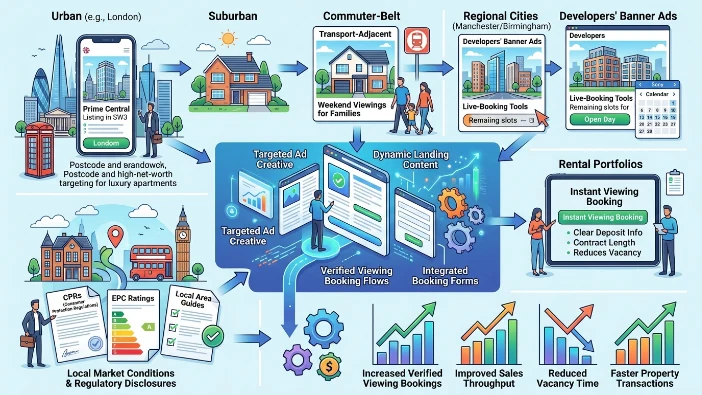
UK agencies use this approach in urban, suburban, and commuter-belt markets for new developments, resale stock, and rental portfolios to increase verified viewing bookings and improve sales throughput.
Examples: London estate agents use postcode and high-net-worth targeting for prime central listings; commuter-belt agencies focus on transport-adjacent messaging and weekend viewing slots for families; developers in regional cities use banner ads with live-booking tools to manage open-day capacity. For rental portfolios, agencies highlight deposit and contract length alongside instant viewing bookings to reduce vacancy time.
In all cases, campaigns match ad creative, landing content, and booking flows to local market conditions and regulatory disclosures required in the UK.
Explore:
How Real Estate Agencies Increase Site Visits Using Banner Advertising