
Banner advertising is a digital display ad format that shows visual ads on websites or apps to attract clicks and visits to property listings. Banner ads combine images, brief text, and a link. Real estate agencies use banners to send traffic to listing pages, neighbourhood guides, or contact forms.
Banner advertising uses standard ad sizes, such as 300×250, 728×90, and 160×600 pixels. Ads run on publisher networks, programmatic exchanges, or direct placements. Targeting parameters include geography, device type, browsing behaviour, and contextual relevance.
Agencies measure performance with impressions, click-through rate (CTR), cost per click (CPC), and conversions. Real examples include a London agency running a 300×250 display on local news sites and a regional developer using a 728×90 leaderboard on property portals.
How do agencies set campaign objectives for banner ads?
Agencies set clear objectives like increasing listing page visits, generating contact form submissions, or driving booking of viewings. Campaign objectives define ad creative, targeting, and metrics. Objective selection follows business goals: awareness uses viewable impressions and reach; consideration uses CTR and site visits; conversion uses leads and viewings booked.
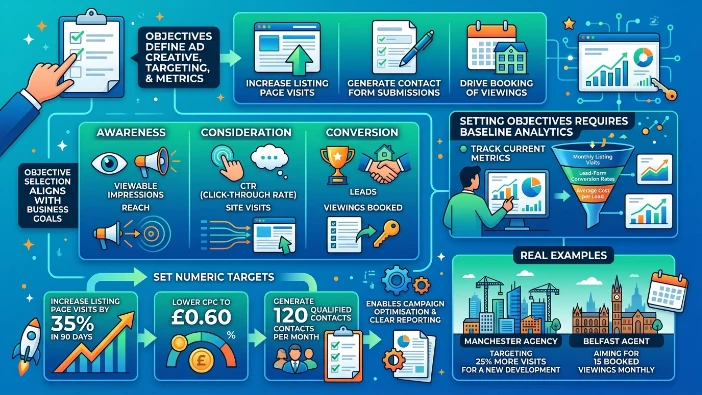
Setting objectives requires baseline analytics. Agencies track current monthly listing page visits, lead-form conversion rates, and average cost per lead. They set numeric targets, for example: increase listing page visits by 35% in 90 days, lower CPC to £0.60, or generate 120 qualified contacts per month. These numeric targets enable campaign optimisation and clear reporting. Real examples: a Manchester agency targeting 25% more visits for a new development; a Belfast agent aiming for 15 booked viewings monthly.
Which targeting methods increase relevant site visits?
Agencies use geographic targeting, contextual targeting, interest targeting, and retargeting to reach relevant audiences. Geographic targeting restricts ad delivery to specific postcodes, cities, or regions. Contextual targeting places ads on pages about property, mortgages, or local amenities. Interest targeting reaches users who previously searched or consumed property-related content. Retargeting shows ads to users who previously visited the agency website or specific listings.
Each method produces different visit quality. Geographic targeting increases local visit relevance. Contextual targeting improves thematic relevance and CTR. Interest targeting captures active home searchers across sites. Retargeting increases conversion probability because users already showed intent. Real examples: a Surrey agency targeting users within a 20-mile radius, a Yorkshire developer using contextual placements on estate planning articles, a Newcastle agent retargeting previous site visitors.
What creative elements drive clicks and visits?
High-contrast images, concise headlines, clear value propositions, and prominent calls-to-action increase clicks. Creative must show property photos, price, and a primary benefit such as “New 2‑bed apartments from £275,000.” Text must use a single, direct message limited to one action, like “View floorplans” or “See availability.” Use a clear logo and consistent brand colour palette. Animation can increase attention but must not exceed 15 seconds or multiple frames that distract from the call-to-action.
Design for mobile first. Ensure text remains legible at small sizes and that clickable areas follow accessibility best practices. Include microcopy for urgency when relevant, for example “Only 3 units left.” Real examples: a Cornwall holiday-home listing highlighting “Sea views” with a price band, a London flat ad showing a thumbnail interior photo and “Book viewing.”
How do agencies choose ad placements and networks?
Agencies select between direct publisher buys, programmatic exchanges, and social networks based on reach, control, and audience data. Direct buys provide control over site context and guaranteed inventory. Programmatic exchanges provide scale and dynamic bidding across thousands of sites. Social networks offer integrated targeting by profile and behaviour and often higher engagement from mobile users. Choose placements that align with objectives: use high-traffic local news sites for awareness, property portals for consideration, and search-partner sites for intent capture.
Placement choice affects pricing and performance metrics. Direct buys typically use flat CPMs; programmatic uses real-time bidding with dynamic CPCs; social platforms use CPC or cost per thousand impressions (CPM). Real examples: buying homepage slots on a regional paper for a development launch, using programmatic to reach buyers across multiple property blogs.
How do agencies measure and optimise banner campaigns?
Agencies measure impressions, CTR, CPC, bounce rate, session duration, and conversion rate to optimise toward site visits and qualified leads. Initial monitoring focuses on CTR and CPC to ensure creative and targeting work. Next, track on-site behaviour: bounce rate and pages per session indicate landing page relevance. Finally, measure conversions tied to objectives, such as contact form submissions or viewing bookings. Use conversion tracking pixels and UTM parameters for reliable attribution.
Optimisation steps include A/B testing creatives and headlines, adjusting bids for high-performing placements, shifting budget to best-performing geographic areas, and refining audiences based on conversion data. Set weekly performance reviews in the first 30 days and monthly after stabilisation. Real examples: pausing low-CTR placements in Glasgow and reallocating budget to a high-CTR regional news site; changing headline copy from “View homes” to “See floorplans” and improving CTR by 22%.
What landing page elements convert banner traffic into visits and leads?
Landing pages must match the ad message, load under 3 seconds, show clear listing details, and contain an obvious contact action. Message match maintains continuity from ad to landing page. If the ad promises floorplans, the landing page must show them near the top. Fast load times reduce bounce rates. Include a lead form with no more than five fields, a phone number, and a booking widget when applicable. Use visible trust elements: energy ratings, legal disclaimers, and photo galleries. For new developments, show availability and a price range.
Track landing page metrics: bounce rate, average time on page, form completions, and phone clicks. Implement simple UX fixes if mobile bounce rates exceed desktop by more than 30%. Real examples: a landing page that reduced form fields from eight to four and increased conversions by 48%; a listing page adding a prominent “Book viewing” button that raised phone calls by 30%.
What budgeting and bidding strategies produce efficient site visits?
Set a strict daily budget, use cost-per-click or cost-per-thousand strategies, and increase bids for high-intent audiences. Allocate budget by objective: 20–30% for awareness, 50–60% for consideration, 20–30% for retargeting when intent is high. Use CPC bidding for campaigns focused on site visits and CPM for brand reach. Increase bids by 15–30% for top-performing geographies or placements. Cap total cost per lead based on historical data, for example, £45 per qualified lead.
Use frequency caps to avoid ad fatigue: limit impressions to 3–5 views per user per week for standard campaigns and 5–8 for short-term promotions. Monitor spend pacing daily to ensure even delivery. Real examples: a regional campaign allocating £1,200 monthly with 60% to programmatic consideration placements and 30% to retargeting.
Explore More Expert Insights:
How Property Developers Nurture Leads Using Project Showcase Campaigns
How Real Estate Firms Build Buyer Interest Using Property Banner Ads
What legal and privacy requirements apply in the UK?
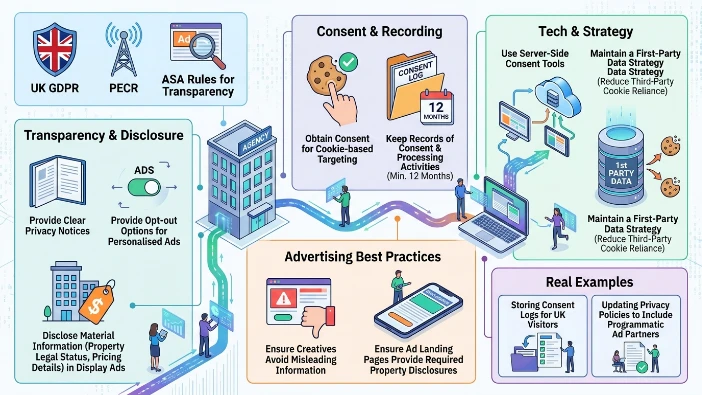
Agencies must comply with the UK GDPR, the Privacy and Electronic Communications Regulations (PECR), and the Advertising Standards Authority rules for transparency. Obtain consent for cookie-based targeting when required. Provide clear privacy notices and opt-out options for personalised ads. Disclose material information, such as legal status of the property and pricing details, in display ads when claims affect consumer decisions. Keep records of consent and processing activities for at least 12 months.
Use server-side consent tools and maintain a first-party data strategy to reduce reliance on third-party cookies. Ensure creatives avoid misleading information and that ad landing pages provide required property disclosures. Real examples: storing consent logs for UK visitors and updating privacy policies to include programmatic ad partners.
What are common use cases and outcomes for banner advertising?
Use cases include new development launches, seasonal promotions, off-plan pre-sales, and open-house bookings; outcomes include increased site visits, higher qualified leads, and measurable viewings booked. New development launches use banners to generate initial traffic and grow mailing lists. Seasonal promotions highlight reduced prices or incentives and drive immediate inquiries.
Off-plan campaigns gather reservations and deposits. Open-house campaigns boost attendance at scheduled viewings. Measure outcomes by visits attributable to banner ads and the conversion rate from visit to booked viewing or lead.
Real examples: a coastal developer using banners to collect 430 prospect emails in a 6-week launch; an urban agent increasing weekend viewing bookings by 18% after a targeted banner campaign.
Banner advertising provides a measurable channel to increase site visits for real estate agencies across the UK. Agencies use clear objectives, precise targeting, testable creatives, fast landing pages, and data-driven optimisation to turn impressions into qualified visits.
For a deeper campaign design and comparison of solution types, explore the following: How Real Estate Agencies Attract Buyers Using Banner Ads
For conversion-focused advertising strategies, see:
Real Estate Advertising That Drives Qualified Site Visit Conversions