Banner advertising uses visual web ads to display property headlines, images, and calls to action to generate awareness and drive clicks to property listings or landing pages. Banner ads consist of static or animated image files placed on publisher websites, mobile apps, and ad networks. Real estate agencies define ad specifications by size, file format, and placement type.
Common sizes include 300×250, 728×90, and 320×50 pixels. Delivery modes include programmatic display, direct publisher buys, and social platform placements. The campaign objective at the top of funnel is awareness and initial engagement rather than immediate sales.
What entities participate in banner campaigns?
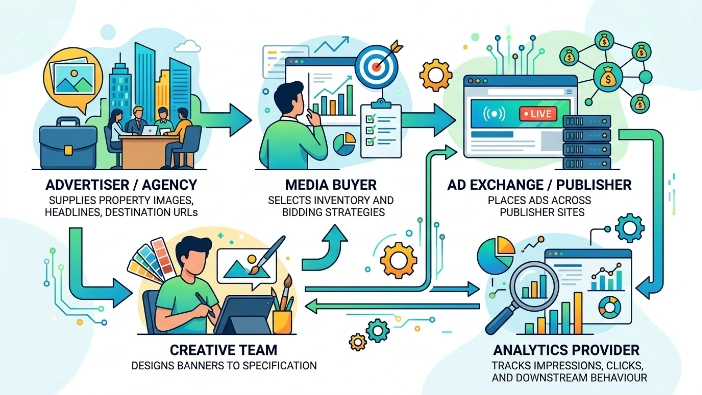
Entities include the advertiser (agency), creative team, media buyer, ad exchange or publisher, and analytics provider. The agency supplies property images, headlines, and destination URLs. Creative teams design banners to specification. Media buyers select inventory and bidding strategies. Ad exchanges place ads across publisher sites. Analytics providers track impressions, clicks, and downstream behaviour.
How do agencies plan a banner ad campaign?
Campaign planning sets target audiences, budget, key performance indicators, creative themes, and measurement methods before creative production and media buying. Planning begins with defining audience segments by geography, age range, household income band, and property intent signals. Budgets allocate across channels with daily or campaign lifetime caps. KPIs include impressions, click-through rate (CTR), and landing page engagement.
Agencies map creative themes to audience segments, for example first-time buyers view financing messages while upsizers receive space and school-zone messaging. Measurement plans include tagging, UTM parameters, and conversion tracking to attribute clicks to downstream actions.
How long do campaigns run?
Campaigns run from 2 weeks for short launches to 12 weeks for broader awareness phases. Short runs emphasise frequency to build recall. Longer runs rotate creatives every 2 to 4 weeks to reduce ad fatigue.
What creative elements do effective banners use?
Effective banners use a clear headline, a strong primary image of the property or neighbourhood, concise value text, and a prominent click destination. Headlines use 3–7 words and include transactional or contextual cues, for example “One-bedroom flats from £275,000.” Primary images show exterior context or key interiors at 1200×800 pixel source resolution.
Value text highlights selling points in 10–15 words. A visual cue indicates the destination: listing page, brochure download, or virtual tour. File formats include JPEG for static banners and GIF or HTML5 for animated banners. Ad sizes follow IAB standards to maximise available inventory.
How do agencies target audiences with banner ads?
Targeting uses geographic restrictions, contextual placement, demographic filters, interest segments, and behavioural retargeting to reach likely property buyers. Geographic targeting restricts impressions to specified postcodes, cities, or regions. Contextual placements place banners on pages about moving, local news, or property content.
Demographic filters use age bands and household income proxies. Interest segments include users who read property articles or search renovation topics. Behavioural retargeting uses pixel data to re-engage users who viewed listings or brochures within the last 30 days.
How are lookalike audiences created?
Lookalikes use first-party data such as email lists or high-intent lead cohorts to find similar users on ad platforms. Agencies upload hashed audience lists and set similarity thresholds of 1% to 5% to balance match quality and scale.
How are banner campaigns measured for effectiveness?
Effectiveness measures include impressions, CTR, landing page sessions, bounce rate, brochure downloads, and assisted conversions tracked through analytics. Impressions measure reach. CTR indicates creative relevance. Landing page sessions show click quality. Bounce rate and time-on-page measure content engagement. Brochure downloads and contact form completions register lead intent. Assisted conversions capture cases where a banner click contributed earlier in the funnel and another channel completed the conversion.
What attribution models are suitable?
Last-click attribution underestimates banner impact. Multi-touch or position-based attribution credits early touchpoints. Agencies often use view-through attribution to account for impressions that later generated conversions within a 7- to 30-day window.
How do agencies control budget and bid strategy?
Budget control uses daily caps, frequency caps, and bid strategies including CPM for reach and CPC for click objectives; programmatic buys use dynamic bidding. CPM bidding suits broad awareness goals and secures predictable impression volumes. CPC bidding ties cost to clicks when traffic quality is a priority. Frequency caps limit exposures per user to 3–7 impressions per week to avoid ad fatigue.
Programmatic buys use real-time bidding with floor prices and audience segment targeting. Campaigns monitor cost per thousand impressions and cost per click to maintain efficiency.
How are low-performing placements handled?
Low-performing placements receive automated rules that pause inventory when CTR falls below platform thresholds for 48 hours or when bounce rate exceeds 80% on landing pages. Media buyers reallocate spend to top-performing publishers and audiences.
What compliance rules apply in the UK?
UK rules require truthful pricing, clear property descriptions, energy performance indicators where applicable, and compliance with advertising standards and data protection laws. Property prices must include VAT where relevant and state whether prices are subject to change. Advertisements must avoid misleading claims about location, transport links, or planning permissions.
Personal data used for targeting follows the Data Protection Act 2018 and PECR rules; agencies require lawful bases for processing and provide clear privacy notices. Cookie banners and consent management handle tracking pixels for behavioural targeting.
How is sensitive targeting restricted?
Agencies do not target based on protected characteristics such as race, religion, or health. Platforms enforce policies that prevent discriminatory ad delivery. Targeting focuses on lawful demographic proxies and behavioural signals permitted by regulation.
What benefits do banner ads provide at the top of funnel?
Banner ads deliver scalable reach, rapid testing of creative messages, increased brand awareness, and first-party data capture for later nurturing. Reach expands visibility across relevant audiences. Rapid A/B testing allows message optimisation within 2 weeks. Brand awareness metrics such as ad recall lift assess topline impact. Banners that drive brochure downloads or newsletter sign-ups convert anonymous users into first-party contacts for retargeting.
Explore More Expert Insights:
How Property Developers Increase Sales Using Banner Advertising
How Real Estate Firms Generate High-Quality Leads Using Banner Ads
What use cases suit banner advertising for real estate?
Use cases include new development launches, area awareness for relocating populations, promotion of virtual open days, and brand-building for agency offices entering new regions. New development launches employ local geotargeting and contextual placements near planning or property news. Area awareness campaigns target commuting corridors and local amenities
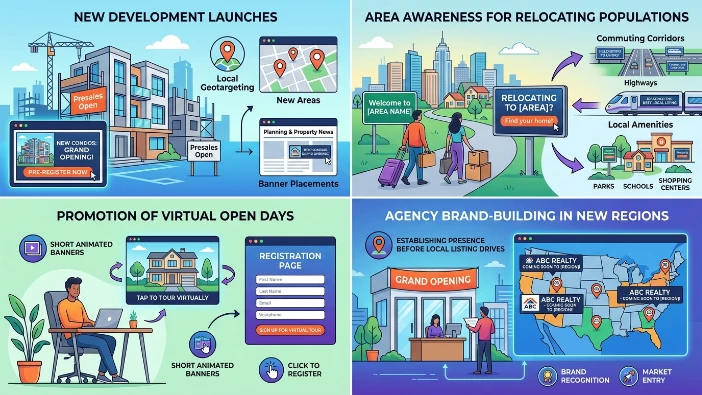
for relocating buyers. Virtual open day promotions use short animated banners linking to registration pages. Agency brand-building uses broad regional buys to establish presence before local listing drives.
What creative cadence works best?
Rotate creatives every 2 to 4 weeks and test 3–5 variations in parallel. Use a mix of static hero images and short animated messages to maintain engagement. Update copy to reflect seasonal trends and local market data.
Banner advertising provides measurable reach and initial engagement for real estate agencies at the awareness stage. Agencies plan campaigns with clear audience definitions, standardised creative assets, and tracking that captures first-party data for downstream nurturing.
For intermediate tactics on increasing site visits using banner advertising, see:
How Real Estate Agencies Increase Site Visits Using Banner Advertising
For conversion-focused tactics that drive qualified site visit bookings, see:
Real Estate Advertising That Drives Qualified Site Visit Conversions