
Display ads for conversion are targeted visual ads that drive users from consideration to appointment booking through clear offers, direct booking links, and measurable conversion events. These ads include static banners, HTML5 interactive creatives, and short in-banner videos. They run across websites, mobile apps, and connected inventory via programmatic platforms and publisher direct buys. Conversion-focused creatives contain specific service names, available appointment slots, booking links, and clear eligibility notes. Tracking records impressions, clicks, view-through conversions, form submissions, phone calls, and confirmed bookings.
How do display ads convert consideration into appointments?
Conversion uses targeted retargeting, high-intent messaging, friction-minimised booking flows, and real-time availability signals to convert engaged users into scheduled patients. Start with an audience of users who completed mid-funnel actions: visited service pages, downloaded brochures, or ran eligibility checks. Serve retargeting creatives that reference the viewed service and show next-available appointment times or booking incentives like same-week slots.
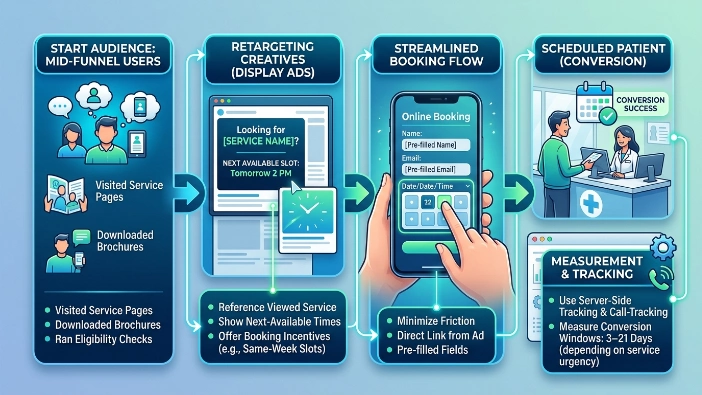
Link creatives directly to streamlined booking pages with pre-filled fields where possible. Use server-side tracking and call-tracking numbers to attribute phone bookings. Measure conversion windows of 3–21 days depending on service urgency.
What campaign components are required to drive confirmed bookings?
Campaigns require precise audience segments, conversion-optimised creatives, real-time booking integrations, analytics for attribution, and compliance controls. Audience segments include recent site visitors (7–30 days), brochure downloaders, and eligibility-check completers. Creatives emphasise availability, exact service names, clinician credentials, and one-click booking options. Integrations connect ad platforms to booking systems via APIs or redirect flows that preserve UTM parameters. Analytics combine web analytics, CRM, and call-tracking to measure CPA per confirmed appointment. Compliance controls ensure claims are factual and personal data collection follows UK GDPR.
How should targeting and segmentation be structured for highest conversion?
Segment by intent signals, recency, location, and clinical eligibility to prioritise users most likely to book within 3–14 days. Apply geo-fencing to a service catchment area, for example, a 15-mile radius around clinics. Layer demographic filters such as age bands relevant to the service. Allocate higher bids to high-intent and recent segments and test bid multipliers of 1.5–3x for those segments.
What creative elements drive appointment actions?
Use direct, time-bound messages, clear booking actions, trust signals, and minimal inputs on landing pages to prompt immediate appointments.
Headline length: 4–7 words stating service and availability, for example, “Knee Clinic—Next Slots This Week.” Body text: 10–18 words stating clinician accreditation, typical appointment length, and booking method. Include a prominent button with one action verb: “Book Now” or “Check Slots.” Add trust signals such as clinician qualifications, facility accreditation, and patient ratings. On landing pages use a one-step booking form or calendar widget with pre-selected service and time filters to reduce clicks to booking to 2–4 taps.
How do booking integrations and tracking support conversion measurement?
Integrate ad platforms with booking systems and CRM to capture UTM-tagged visits, form submissions, phone calls, and confirmed appointment records for accurate CPA calculation. Connect booking engines via API or use server-to-server tracking to confirm appointments. Implement call-tracking numbers per campaign to attribute phone bookings. Sync confirmed appointments back to ad platforms using conversion upload or API to measure outcomes. Use deterministic matching when possible (email or phone) and cohort-based attribution when privacy constraints limit direct matching. Set conversion windows by service type: 3 days for urgent care, 14 days for specialist consultations, 30 days for elective procedures.
How is bidding and budget allocation optimised for appointment yield?
Allocate budget by segment performance, increase bids for high-intent cohorts, and reserve 20–40% budget for retargeting that demonstrates highest conversion rates. Start with a split: 60% prospecting, 40% retargeting. Shift spend dynamically: increase retargeting to 50–70% when mid-funnel engagement rises. Use target CPA or ROAS bidding tied to confirmed appointment value when historical data exceeds 100 confirmed bookings.
Apply bid multipliers for recency (1.5x for visits within 7 days) and device (1.2x for mobile if booking flow is mobile-optimised). Monitor CPA and adjust bids weekly for initial 4–8 weeks, then move to biweekly optimisation.
What compliance and privacy practices must campaigns follow at BOFU?
Ensure all booking-related messaging follows UK advertising standards, obtain explicit consent before collecting health data, and secure data transfers under data processing agreements. Avoid unverified clinical claims and guaranteed outcomes. Use minimal personal data collection in ad landing pages and require consent for medical information collection.
Display privacy notices when asking for health details. Ensure vendors and booking providers sign UK GDPR-compliant data processing agreements. Maintain logs of creative approvals and targeting logic for audits. For sensitive services, use contextual targeting and explicit consent steps before any personalised outreach.
What optimisation tests improve appointment conversion rates?
Test booking flow variants, time-bound messaging, appointment incentives, and creative messaging to find combinations that reduce friction and increase confirmed bookings. Run A/B tests on two booking flows: a one-step calendar widget versus a two-step form. Test time-bound creatives showing “Next available: 3 slots this week” against non-time-bound versions.
Compare incentives such as priority scheduling for the first appointment versus informational add-ons like free pre-consultation guides. Test headline variants with clinician credentials versus availability-focused headlines. Measure lift by confirmed appointment rate and time-to-book metrics.
What benefits do healthcare brands gain from conversion-focused display campaigns?
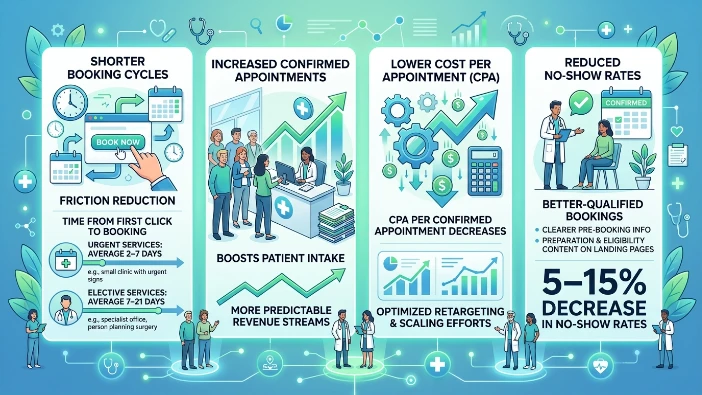
Conversion campaigns increase confirmed appointments, improve appointment yield per marketing pound, and reduce no-show rates through clearer pre-booking information. Confirmed bookings increase patient intake and revenue predictability. Conversion-focused creatives reduce friction, shortening time from first click to booking to an average of 2–7 days for urgent services and 7–21 days for elective services. Better-qualified bookings reduce no-show rates by 5–15% when landing pages include clear preparation and eligibility content. CPA per confirmed appointment decreases as retargeting and optimisation scale.
Explore More Expert Insights:
How Telemedicine Platforms Convert Trust Signals Into Active Patient Signups Using Banner Ads
How Dental Clinics Turn Treatment Interest Into Paid Procedures Using Retargeting Ads
What practical use cases demonstrate success at conversion stage?
Use cases include same-week urgent-care bookings, specialist clinic scheduling, elective-procedure bookings, and vaccination appointment drives.
Urgent care: retarget users who viewed symptom pages within 72 hours and offer next-day slots. Specialist clinics: retarget users who completed eligibility checks and show clinician availability for the next 2 weeks. Elective procedures: show financing options and link to pre-assessment booking. Vaccination drives: geo-target local populations and show immediate booking widgets for available clinics.
Read:
How Healthcare Businesses Drive Patient Growth Using Display Ads
How do display ads fit into a complete conversion funnel?
Display ads serve as conversion triggers that complement SEO, email nurture, and CRM follow-up to move considered users into confirmed bookings with measurable ROI. Top-of-funnel channels generate awareness. Mid-funnel banners educate and qualify. Conversion-focused display ads target engaged users with availability and booking steps.
Integrate with email reminders and SMS confirmations to reduce no-shows. Use CRM to track lifetime value of patients acquired via display and feed learnings back to audience segmentation.
For mid-funnel expansion tactics and landing-page guidance, see the internal reference on the following: How Healthcare Brands Improve Service Consideration Using Banner Ads