
Banner ads are visual digital advertisements placed across websites, mobile applications, news platforms, and healthcare-related content pages to increase awareness of telemedicine services, virtual consultations, remote healthcare access, and online patient communication platforms among internet users in the United Kingdom.
Telemedicine platforms use banner advertising to introduce virtual healthcare systems to broad online audiences. These advertisements appear in fixed sizes across desktop and mobile devices. Common formats include static image banners, animated display banners, responsive ads, and HTML5 visual advertisements.
In the United Kingdom, telemedicine adoption increased after healthcare providers expanded remote consultation systems. Patients now search for online GP consultations, prescription renewals, mental health appointments, and digital follow-up care. Banner ads support visibility during these searches and browsing activities.
Banner advertising works at the awareness stage of the marketing funnel. The objective focuses on education and visibility instead of direct conversion. Telemedicine platforms use banners to explain healthcare access, appointment flexibility, and remote consultation availability.
For readers exploring how awareness campaigns later support trust-building strategies, read:
How Telemedicine Platforms Build User Trust Using Display Remarketing Ads
For deeper insight into patient signup conversion strategies, explore:
How Telemedicine Platforms Convert Trust Signals Into Active Patient Signups Using Banner Ads
How do telemedicine platforms use banner ads to attract users?
Telemedicine platforms attract users through targeted banner advertisements that appear across healthcare articles, lifestyle websites, mobile applications, search partner networks, and digital publishing platforms frequently visited by potential healthcare consumers in the United Kingdom.
Banner campaigns begin with audience targeting. Platforms identify groups based on demographics, online behaviour, healthcare interests, device usage, and geographic location. Common targeting categories include working professionals, parents, elderly patients, university students, and mental health support seekers.
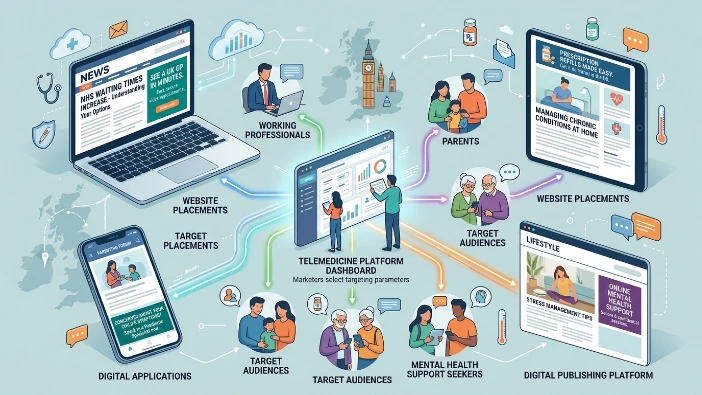
Telemedicine advertisements often appear beside healthcare-related content. Examples include articles about seasonal illness symptoms, prescription management, mental wellness, chronic condition monitoring, and NHS appointment waiting times.
The advertising process includes several operational stages. First, marketers define campaign objectives. Second, creative teams produce compliant healthcare visuals. Third, media buyers select placement networks. Fourth, campaigns launch across digital inventory.
Banner placements commonly appear on news websites, weather applications, health blogs, and mobile apps. These placements increase repeated visibility. Frequent exposure improves recognition of telemedicine terminology and remote healthcare concepts.
Visual clarity remains essential in healthcare advertising. Most telemedicine banner ads contain simple messaging, readable typography, mobile-responsive layouts, and healthcare-related imagery. Advertisements often include references to virtual appointments, online doctors, or digital consultations.
The United Kingdom has strict healthcare advertising standards. Telemedicine marketing materials follow medical advertising regulations, privacy standards, and consumer transparency requirements. Platforms avoid misleading medical claims and unclear treatment messaging.
Why do banner ads support awareness for telemedicine services?
Banner advertisements support telemedicine awareness because they expose healthcare concepts repeatedly across digital environments, helping internet users understand remote healthcare access, online consultations, appointment convenience, and digital patient communication systems through consistent visual messaging.
Many users remain unfamiliar with telemedicine terminology. Banner advertising introduces these concepts gradually. Repeated exposure improves recognition of virtual healthcare systems.
Awareness campaigns educate users before they actively search for healthcare providers. This process increases familiarity with digital healthcare delivery models. Educational visibility becomes important in regions where traditional in-person appointments remain dominant.
Telemedicine banners frequently highlight informational themes such as appointment accessibility, flexible consultation schedules, prescription support, and remote communication. These messages explain service functions without requiring immediate patient action.
Digital awareness also supports healthcare accessibility education. Many patients do not know that telemedicine platforms provide services for minor illnesses, follow-up care, mental health support, medication management, and specialist referrals.
Banner advertising allows broad audience reach across multiple devices. Desktop users encounter ads while browsing news sites. Mobile users view healthcare banners within applications and responsive websites. Tablet users see display campaigns during entertainment or information consumption.
Healthcare awareness campaigns also benefit from visual consistency. Repeated exposure to healthcare imagery, consultation interfaces, and digital appointment messaging improves understanding of remote healthcare systems.
What targeting methods do telemedicine banner campaigns use?
Telemedicine banner campaigns use demographic targeting, geographic targeting, behavioural targeting, contextual targeting, device targeting, and audience segmentation methods to display healthcare advertisements to internet users most likely to engage with digital healthcare information.
Demographic targeting focuses on age groups, occupation categories, and household structures. Telemedicine campaigns frequently target adults aged 25 to 54 because these groups regularly use online healthcare research tools and mobile health applications.
Geographic targeting allows campaigns to focus on specific UK regions. Urban areas with high internet penetration often receive larger campaign distribution. Regional targeting also supports local healthcare awareness initiatives.
Behavioural targeting analyses online activity patterns. Users reading healthcare articles, searching symptom-related content, or browsing pharmacy information pages often encounter telemedicine display advertisements.
Contextual targeting places ads beside relevant webpage content. For example, telemedicine banners appear near articles discussing cold symptoms, stress management, prescription refills, or online medical advice.
Device targeting optimises campaigns for smartphones, desktops, tablets, and connected devices. Mobile-focused campaigns dominate telemedicine advertising because healthcare searches frequently occur on smartphones.
Audience segmentation improves advertising relevance. Different banner messages target different healthcare concerns. One campaign focuses on mental health consultations. Another focuses on online GP appointments. Another highlights prescription management systems.
Advertising platforms also use frequency controls. These controls limit excessive exposure while maintaining repeated visibility. Balanced frequency improves awareness without causing advertisement fatigue.
What design elements improve telemedicine banner ad performance?
Effective telemedicine banner ads use readable typography, healthcare-focused imagery, mobile-responsive layouts, concise informational messaging, strong visual contrast, and structured spacing to communicate digital healthcare concepts clearly across different online environments and device screens.
Healthcare advertising requires visual simplicity. Users scan banners quickly while browsing content. Telemedicine campaigns therefore prioritise short headlines and clear layouts.
Most banner advertisements use healthcare-related visuals. Examples include video consultation screens, digital appointment calendars, online prescription interfaces, healthcare professionals using communication devices, and patient support imagery.
Typography selection affects readability. Sans-serif fonts dominate telemedicine banners because they remain visible on smaller mobile screens. Large font sizes improve message clarity during fast browsing behaviour.
Colour selection also influences healthcare perception. Blue, white, and green palettes frequently appear in telemedicine advertising because these colours connect with healthcare environments and digital trust associations.
Responsive design remains essential. Banner advertisements automatically adapt to smartphones, tablets, laptops, and widescreen displays. Responsive formatting improves visibility across multiple screen dimensions.
Healthcare compliance also shapes design choices. Telemedicine advertisements avoid exaggerated claims, misleading medical imagery, and unclear healthcare language. Compliance improves transparency and protects consumer understanding.
Animation appears in some campaigns. Short transitions highlight appointment availability, virtual communication features, or healthcare accessibility messaging. However, excessive animation reduces readability and distracts users from core healthcare information.
How do telemedicine platforms measure banner advertising success?
Telemedicine platforms measure banner advertising performance through impressions, reach, click-through rate, engagement duration, audience frequency, website traffic patterns, device interaction data, and healthcare-related audience behaviour analytics across digital advertising systems.
Impressions measure how many times advertisements appear online. High impression volume increases campaign visibility and awareness distribution.
Reach measures the number of unique users exposed to healthcare advertisements. Broad reach supports awareness-stage objectives because more users encounter telemedicine concepts.
Click-through rate evaluates how frequently users interact with advertisements after viewing them. Higher interaction rates indicate stronger relevance between healthcare messaging and audience interests.
Traffic analysis tools track visitor behaviour after advertisement engagement. Marketers analyse landing page visits, time spent on healthcare information pages, and navigation patterns.
Device performance analysis identifies which platforms generate stronger engagement. Many telemedicine campaigns report stronger interaction rates from mobile devices due to smartphone healthcare browsing habits.
Audience frequency analysis measures repeated exposure levels. Healthcare marketers balance visibility with user experience to prevent overexposure.
Telemedicine advertisers also monitor engagement by content category. Campaigns beside healthcare content often produce stronger relevance than campaigns placed beside unrelated entertainment material.
Campaign reporting helps marketers refine future healthcare awareness strategies. Data analysis improves targeting accuracy, placement selection, and messaging clarity over time.
Explore More Expert Insights:
How Dental Clinics Increase Bookings Using Banner Advertising
How Healthcare Providers Promote Services Using Banner Campaigns
What challenges affect telemedicine banner advertising campaigns?
Telemedicine banner advertising campaigns face challenges related to healthcare regulation compliance, advertising fatigue, privacy expectations, rising digital competition, mobile visibility limitations, and consumer scepticism regarding online healthcare communication systems and digital medical consultations.
Healthcare regulation creates strict advertising requirements in the United Kingdom. Campaigns follow standards related to transparency, medical claims, patient communication, and consumer safety messaging.
Advertising fatigue affects repeated exposure campaigns. Internet users encounter large numbers of digital advertisements daily. Overexposure reduces engagement and decreases visibility effectiveness.
Privacy expectations also influence healthcare marketing. Users remain sensitive about medical information and online health-related tracking systems. Telemedicine campaigns therefore prioritise privacy-focused messaging and transparent data communication.
Digital advertising competition continues increasing across healthcare sectors. Pharmacies, hospitals, clinics, wellness platforms, and insurance providers compete for online visibility within the same advertising environments.
Mobile screen limitations create design challenges. Smaller screens reduce available messaging space. Healthcare marketers therefore prioritise concise wording and simplified layouts.
Consumer scepticism remains another challenge. Some users continue preferring traditional in-person healthcare appointments. Awareness campaigns therefore focus on explaining how remote healthcare systems operate.
Internet accessibility differences also influence campaign performance. Regions with weaker connectivity experience reduced engagement with digital healthcare platforms and online consultation systems.
How are telemedicine banner ads evolving in the United Kingdom?
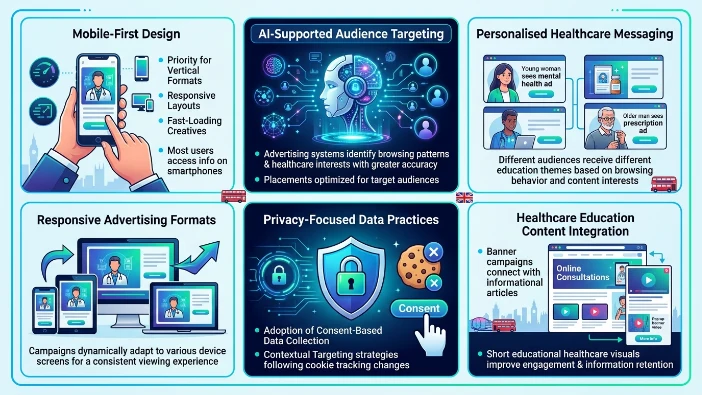
Telemedicine banner advertising in the United Kingdom is evolving through mobile-first design, AI-supported audience targeting, personalised healthcare messaging, responsive advertising formats, privacy-focused data practices, and increased integration with digital healthcare education content.
Mobile-first advertising now dominates campaign planning. Most telemedicine users access healthcare information through smartphones. Advertisers therefore prioritise vertical formats, responsive layouts, and fast-loading creatives.
Artificial intelligence improves audience analysis and placement optimisation. Advertising systems identify browsing patterns and healthcare-related interests with greater accuracy.
Personalised messaging also continues expanding. Different audiences receive different healthcare education themes based on browsing behaviour and content interests. Mental health campaigns target different users than prescription-related campaigns.
Privacy-focused advertising practices are becoming more important. Changes in cookie tracking systems encourage telemedicine advertisers to adopt consent-based data collection methods and contextual targeting strategies.
Healthcare education content integration also continues growing. Banner campaigns increasingly connect with informational articles about remote healthcare usage, digital appointments, prescription systems, and online consultation processes.