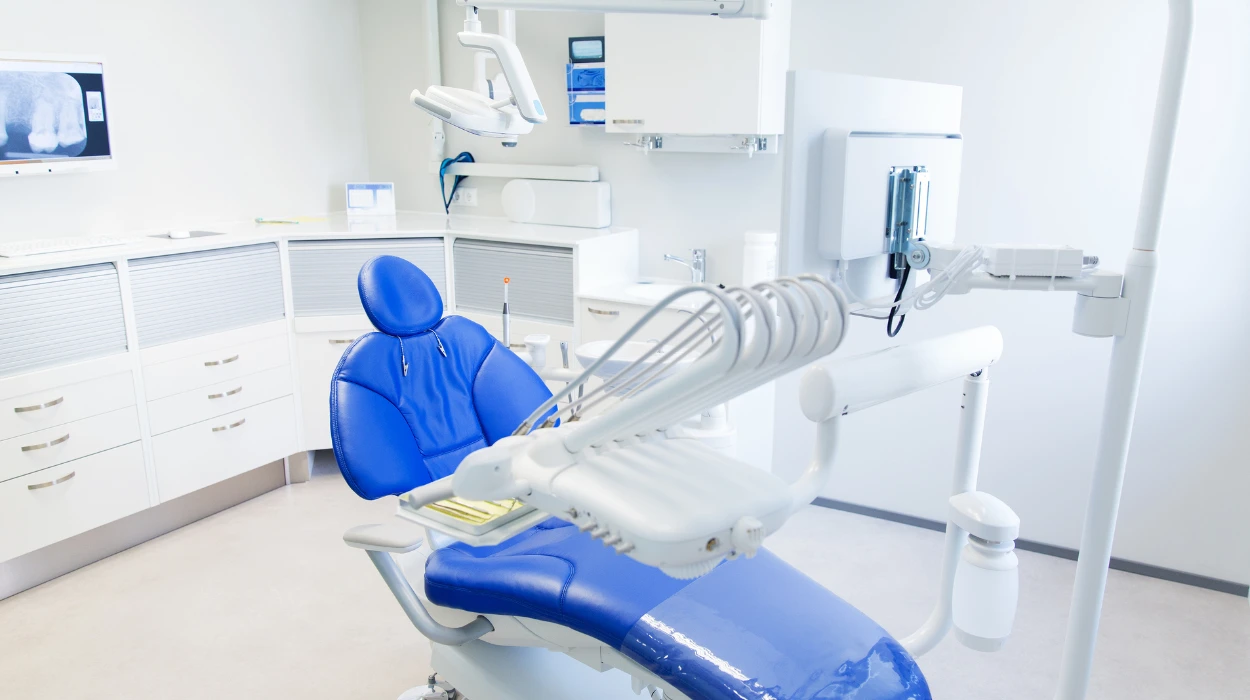
Treatment awareness ads are structured digital advertising messages that educate users about dental conditions, procedures, and oral health solutions before they develop booking intent. These ads focus on informing patients about treatments such as fillings, implants, orthodontics, and preventive care within a controlled online environment.
Treatment awareness ads operate in the middle stage of the patient decision journey. This stage is defined by interest formation without final commitment. Users already understand basic dental topics but require structured information to evaluate possible treatment paths.
In dental marketing, treatment awareness ads appear across websites, social platforms, and content networks. These ads do not directly request bookings. Instead, they focus on explaining clinical conditions in simplified informational formats.
Common examples include explanations of tooth decay stages, orthodontic alignment options, and gum disease progression. Each example connects a symptom to a structured treatment category.
This system supports education-driven engagement, where users transition from general awareness into structured consideration of dental solutions.
Read exploration line:
How Dental Clinics Increase Bookings Using Banner Advertising
How Dental Clinics Turn Treatment Interest Into Paid Procedures Using Retargeting Ads explains conversion-focused communication.
How do treatment awareness ads guide dental patients during decision-making?
Treatment awareness ads guide dental patients by presenting structured explanations of oral conditions, linking symptoms to clinical treatments, and creating informational clarity that helps users evaluate dental solutions before scheduling appointments or making final healthcare decisions.
Decision-making in dental care follows a progressive information model. Users first recognise symptoms, then explore conditions, and finally compare treatment options. Treatment awareness ads support the second stage of this process.
These ads introduce structured medical terminology in simplified formats. For example, users searching for tooth sensitivity content are exposed to explanations of enamel erosion and restorative treatments. This creates logical associations between symptoms and solutions.
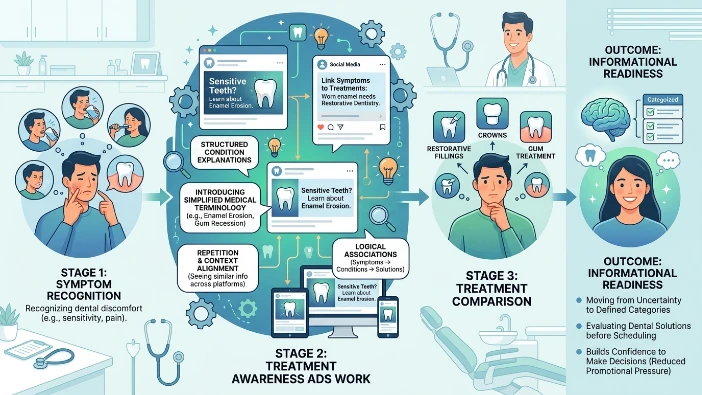
The guidance system works through repetition and context alignment. When users encounter similar treatment information across multiple platforms, comprehension increases.
This structured exposure builds informational readiness. Users move from uncertainty toward defined treatment categories without direct promotional pressure.
The result is a more informed audience that understands available dental procedures before entering the booking stage.
What role do education-based ads play in the dental patient journey?
Education-based ads play a central role in the dental patient journey by delivering structured oral health information at the consideration stage, bridging the gap between initial awareness and treatment evaluation through consistent exposure to clinically relevant educational content.
The dental patient journey consists of multiple stages. These include awareness, consideration, and decision. Education-based ads operate primarily in the consideration stage.
At this stage, users already recognise dental issues but lack detailed understanding of treatment pathways. Education-based ads provide structured explanations of dental procedures such as crowns, root canals, and aligners.
These ads also establish terminology familiarity. When users repeatedly see clinical terms, recognition improves, reducing confusion during later healthcare research.
An example includes users exploring missing tooth symptoms being exposed to implant restoration explanations. This connects condition awareness with procedural understanding.
Education-based ads also reduce informational gaps. Instead of fragmented online searches, users receive structured knowledge pathways that align symptoms with treatment categories.
This creates a more stable foundation for later decision-making stages where appointment selection becomes relevant.
Why do dental clinics use treatment awareness ads instead of direct booking ads?
Dental clinics use treatment awareness ads instead of direct booking ads because patients in early consideration stages require structured education about conditions and treatments before they reach readiness for appointment decisions or healthcare commitments.
Direct booking ads focus on immediate action. Treatment awareness ads focus on structured understanding. These two formats serve different stages of patient behaviour.
In the consideration stage, users do not yet have complete knowledge of dental procedures. Presenting booking requests too early reduces engagement effectiveness because informational readiness is incomplete.
Treatment awareness ads resolve this gap by delivering structured explanations. Users learn about procedures such as whitening, orthodontic alignment, and restorative treatments before being asked to take action.
This educational approach improves message alignment. Users receive information that matches their current knowledge level rather than advanced conversion prompts.
For example, a user researching gum discomfort receives content explaining periodontal conditions instead of appointment scheduling messages. This ensures relevance at the correct stage of understanding.
This structured sequencing improves long-term engagement consistency within dental communication systems.
How do treatment awareness ads improve lead quality in dental marketing?
Treatment awareness ads improve lead quality by educating users before conversion, ensuring that individuals entering the booking stage already understand treatment options, clinical terminology, and procedural expectations within structured dental care pathways.
Lead quality depends on user readiness. In dental marketing, readiness is defined by how well users understand their condition and available treatments.
Treatment awareness ads increase readiness by providing structured information. Users learn about procedures, recovery expectations, and treatment categories before contacting dental providers.
This reduces uncertainty during later decision stages. Users who understand treatments are more likely to complete appointment-related actions because informational barriers are already removed.
An example includes users exposed to orthodontic alignment education later engaging more confidently with consultation scheduling systems because they already understand treatment structure.
Improved lead quality also reduces irrelevant inquiries. Users self-filter based on their understanding of treatment relevance, leading to more accurate engagement patterns.
This creates a more efficient transition from interest to appointment readiness within dental communication frameworks.
What types of content are used in treatment awareness advertising?
Treatment awareness advertising uses structured educational content including symptom explanations, procedural breakdowns, preventive care information, and condition-based visuals designed to improve understanding of dental treatments across digital platforms.
Content structure in treatment awareness advertising follows clinical clarity principles. Each content type focuses on a specific layer of dental knowledge.
Symptom explanations describe oral health conditions such as sensitivity, swelling, or discoloration. These descriptions connect user experiences with possible dental causes.
Procedural breakdowns explain treatments such as fillings, crowns, implants, and orthodontics. These breakdowns define what each procedure addresses and how it functions.
Preventive care information focuses on oral hygiene practices that reduce treatment necessity. This includes structured explanations of brushing techniques and routine dental checkups.
Condition-based visuals present diagrams or illustrations of oral structures. These visuals support textual explanations and improve conceptual understanding.
Together, these content types create a structured educational environment that supports gradual progression through the dental knowledge journey.
Explore More Expert Insights:
How Healthcare Providers Increase Consultation Interest Using Banner Campaigns
How Clinics Guide Patients Using Mid-Funnel Healthcare Advertising
How does audience segmentation work in dental treatment awareness ads?
Audience segmentation in dental treatment awareness ads works by categorising users based on behavioural signals, location data, and content interaction patterns to deliver relevant dental education aligned with their current stage of oral health awareness.
Segmentation ensures that users receive relevant educational content. Dental advertising systems classify audiences based on online behaviour such as health content engagement and search history patterns.
Location-based segmentation ensures that users receive regionally relevant dental information. In the United Kingdom, this helps align content with local healthcare accessibility structures.
Behavioural segmentation groups users based on interaction patterns. Users reading symptom-related content receive different educational messages compared to users exploring procedural topics.
This structure ensures that dental awareness content matches user knowledge levels. Users at early awareness stages receive general explanations, while users in deeper consideration stages receive more detailed procedural information.
An example includes users reading about tooth loss receiving implant-related educational content, while users exploring general oral hygiene receive preventive care explanations.
This segmentation model ensures efficient information distribution across diverse user groups.
How do treatment awareness ads connect to the full dental marketing funnel?
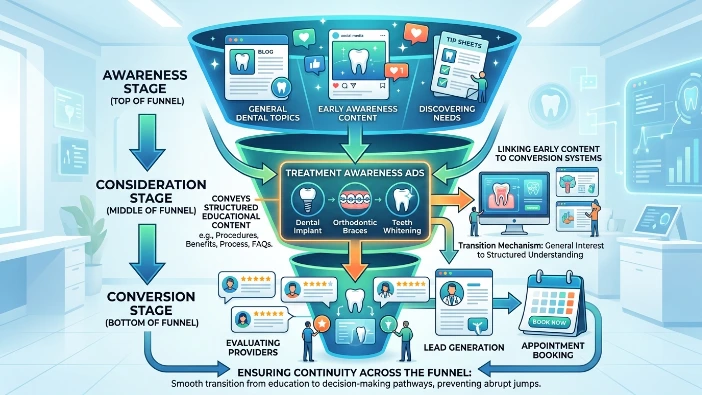
Treatment awareness ads connect to the full dental marketing funnel by operating in the middle stage, linking early awareness content with later conversion-focused advertising systems that guide users from education into structured decision-making pathways.
The dental marketing funnel consists of three stages: awareness, consideration, and conversion. Treatment awareness ads function within the consideration stage.
At the awareness stage, users are introduced to general dental topics. At the consideration stage, treatment awareness ads provide structured educational content. At the conversion stage, users evaluate providers and schedule appointments.
Treatment awareness ads act as a transition mechanism. They convert general interest into structured understanding of dental treatments.
This ensures continuity across the funnel. Users do not experience abrupt transitions between awareness and booking requests. Instead, they progress through information layers.