
Display advertising in healthcare refers to visual digital advertisements shown across websites, apps, and digital platforms to increase recognition of healthcare services, medical information, and public health messaging. It focuses on visibility, repetition, and audience reach at the earliest stage of awareness creation.
What is display advertising in healthcare awareness campaigns?
Display advertising in healthcare awareness campaigns is a digital marketing method that uses visual banners, images, and interactive media across websites and apps to present healthcare messages, increase recognition of medical services, and build early-stage audience awareness without requiring immediate engagement or appointment action.
Display advertising operates across a network of digital platforms where healthcare-related visuals appear in structured placements. These placements include news websites, health information portals, mobile applications, and general browsing environments. The main objective is visibility rather than immediate response.
Healthcare brands use display advertising to communicate broad health themes such as preventive care, symptom awareness, and general service categories. The content is designed to be simple, visually clear, and quickly understandable within seconds of exposure.
In the UK healthcare context, display advertising supports national health communication efforts by increasing exposure to information about clinics, hospitals, and public health initiatives. It functions as an early introduction point before deeper user engagement occurs.
This form of advertising does not require search intent from users. Instead, it introduces healthcare concepts passively while users browse unrelated content. This passive exposure creates foundational awareness that later supports more focused healthcare decision-making.
How does display advertising increase healthcare brand awareness?
Display advertising increases healthcare brand awareness by repeatedly exposing audiences to consistent visual messages across multiple digital environments, reinforcing recognition of healthcare providers, services, and medical topics through frequency, visibility, and structured audience reach across different browsing contexts.
The awareness effect is achieved through repeated exposure. When users see the same healthcare message across different websites and devices, recognition strengthens. This repetition builds familiarity, which is a key factor in awareness formation.
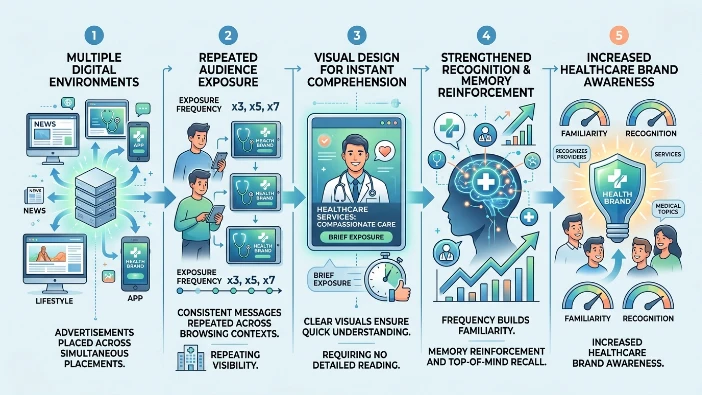
Healthcare display campaigns often operate across multiple placements simultaneously. A user may see the same visual message on a news platform, then again on a lifestyle website, and later on a mobile application. This repeated visibility creates memory reinforcement.
The design of display advertising focuses on clarity and instant comprehension. Visual elements communicate healthcare themes without requiring detailed reading. This ensures that even brief exposure contributes to awareness building.
In the UK healthcare environment, awareness campaigns often support public health priorities such as vaccination awareness, general practitioner services, and hospital information distribution. Display advertising ensures these messages reach large and diverse audiences.
Read & explore:
How Healthcare Brands Improve Appointment Intent Using Retargeting Ads
What formats are used in healthcare display advertising?
Healthcare display advertising uses multiple digital formats including static banners, animated graphics, responsive mobile ads, and interactive visual units designed to communicate healthcare messages clearly across desktop and mobile platforms while maintaining readability, accessibility, and consistent brand visibility.
Static banner formats present fixed visual messages that remain unchanged during viewing. These are widely used for simple healthcare awareness communication such as service introduction or health guidance themes.
Animated formats introduce motion elements such as transitions, sliding text, or sequential visuals. These formats increase attention capture by introducing movement within the user’s browsing environment.
Responsive formats automatically adjust size and structure based on device type. This ensures consistent healthcare message delivery across mobile phones, tablets, and desktop screens used throughout the UK population.
Interactive formats allow limited user engagement such as expanding information panels. These formats provide additional healthcare details without requiring users to leave the browsing page.
Each format serves the same awareness objective but adapts to different digital environments. The consistency of message across formats ensures uniform recognition regardless of device or platform.
How does audience targeting work in display advertising for healthcare?
Audience targeting in healthcare display advertising works by grouping users based on demographic data, browsing behaviour, geographic location, and health-related content interaction patterns to ensure healthcare messages reach relevant populations with increased likelihood of awareness development and information retention.
Targeting begins with demographic segmentation. Age groups, gender distribution, and location-based grouping define the initial audience structure. This ensures healthcare messages are shown to populations most likely to encounter relevant services.
Behavioural targeting uses browsing history patterns. Users who visit health-related websites or read medical content are grouped for increased exposure to healthcare awareness messaging.
Geographic targeting is particularly important in the UK healthcare system. Regional health services, local clinics, and NHS-related information are often displayed based on user location to maintain relevance.
Contextual targeting places healthcare ads on websites where related content exists. For example, medical articles or wellness information pages display healthcare awareness visuals to strengthen contextual alignment.
This structured targeting ensures healthcare display advertising does not rely on random exposure but instead uses data-driven distribution to increase awareness efficiency.
What role does frequency play in awareness building?
Frequency in healthcare display advertising refers to the number of times an individual user is exposed to the same healthcare message, reinforcing recognition, strengthening memory formation, and increasing the likelihood of awareness retention through repeated structured visual contact.
Frequency determines how often a user encounters a healthcare advertisement within a defined period. Higher frequency increases message familiarity, while controlled frequency prevents overexposure.
Repeated exposure creates cognitive reinforcement. When users see the same healthcare message multiple times, recognition becomes faster and more automatic. This supports awareness development without requiring active engagement.
Healthcare campaigns use frequency caps to manage exposure levels. These caps ensure that users see messages enough times to remember them without experiencing message fatigue.
In awareness campaigns across the UK healthcare environment, frequency plays a critical role in public health messaging consistency. Repeated visual contact ensures that healthcare information remains present in user memory during later decision-making stages.
The relationship between frequency and awareness is direct. Increased exposure leads to stronger recall, which supports transition into later healthcare engagement stages.
Explore More Expert Insights:
How Hospitals Attract Patients Using Local Banner Campaigns
How Clinics Increase Appointment Bookings Using Banner Ads
How is display advertising measured in healthcare awareness campaigns?
Display advertising in healthcare awareness campaigns is measured using metrics such as impressions, reach, viewability rate, and engagement indicators that evaluate how many users were exposed to healthcare messages, how long ads were visible, and how effectively awareness exposure occurred.
Impressions measure the total number of times a healthcare advertisement is displayed on screens. This metric indicates the scale of visibility achieved across digital platforms.
Reach measures the number of unique individuals exposed to the healthcare message. It focuses on audience diversity rather than repeated exposure.
Viewability rate measures whether the advertisement was actually visible on the user’s screen for a sufficient duration. This ensures exposure quality is considered alongside quantity.
Engagement indicators measure optional interactions such as clicks or expansions, although in awareness campaigns these are secondary to visibility metrics.
In the UK healthcare context, measurement systems focus heavily on visibility and reach because the primary objective is awareness creation rather than immediate conversion or appointment scheduling.
These metrics collectively determine how effectively display advertising contributes to early-stage healthcare awareness formation.
Why is display advertising important in early stage healthcare marketing funnels?
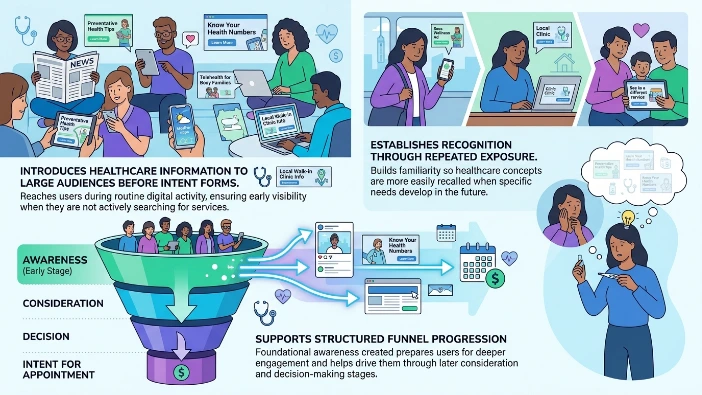
Display advertising is important in early stage healthcare marketing funnels because it introduces healthcare services and information to large audiences before intent formation, establishes recognition through repeated exposure, and creates foundational awareness that supports later consideration and decision-making stages.
In the early funnel stage, users do not actively search for healthcare services. Display advertising introduces healthcare concepts during routine digital activity, ensuring early visibility.
This early exposure builds recognition before users develop specific healthcare needs. When a need arises later, previously seen healthcare messages are more easily recalled.
Display advertising also supports structured funnel progression. Awareness created at this stage prepares users for deeper engagement in later stages such as consideration and appointment intent development.
Read & explore:
How Healthcare Brands Convert Appointment Intent Into Final Bookings Using Banner Ads
In healthcare communication systems, early funnel awareness ensures that public health messages, service availability information, and general medical guidance reach populations before urgency occurs.
This stage is entirely informational. It focuses on education, visibility, and familiarity without requiring immediate user response or action.
The effectiveness of early-stage display advertising depends on consistency, reach, and repetition. These elements ensure that healthcare information remains present in user awareness over time.
The overall function of display advertising in healthcare awareness is to establish a continuous visibility layer that supports all later stages of healthcare decision pathways.