
Healthcare brands move users from awareness to booking readiness using structured retargeting systems that reconnect with previously engaged audiences.
This article explains how retargeting ads increase appointment intent in healthcare marketing, how audience signals work, and how journey segmentation improves booking readiness in the United Kingdom healthcare environment.
What is retargeting ads in healthcare marketing?
Retargeting ads in healthcare marketing refer to digital advertising campaigns that re-engage users who previously interacted with healthcare websites, appointment pages, or medical content, using tracked data signals to display relevant messages that reinforce interest and encourage appointment intent formation.
Retargeting in healthcare works through browser cookies, pixel tracking, and platform-based identifiers that record user interaction with medical content. When a user visits a healthcare service page but does not book, retargeting systems store engagement signals and re-display relevant ads across search engines, social platforms, and display networks.
In the United Kingdom healthcare ecosystem, retargeting is widely used for services such as dental consultations, diagnostic scans, private GP appointments, and physiotherapy bookings. Each interaction builds a behavioural profile that indicates medical interest without requiring immediate conversion.
The system connects informational engagement with appointment pathways. Users who read treatment pages or pricing pages are reintroduced to structured reminders that guide them back toward booking interfaces. This creates continuity between early research behaviour and later appointment intent formation.
Retargeting also supports compliance-based messaging structures. Healthcare ads maintain clarity around service type, consultation availability, and eligibility criteria, ensuring that re-engaged users receive accurate and consistent medical information during repeated exposures.
How do retargeting ads increase appointment intent?
Retargeting ads increase appointment intent by repeatedly exposing users to relevant healthcare messages based on prior engagement, reinforcing service consideration, reducing decision delays, and guiding users back to booking pages through structured recall and contextual reminder mechanisms across digital platforms.
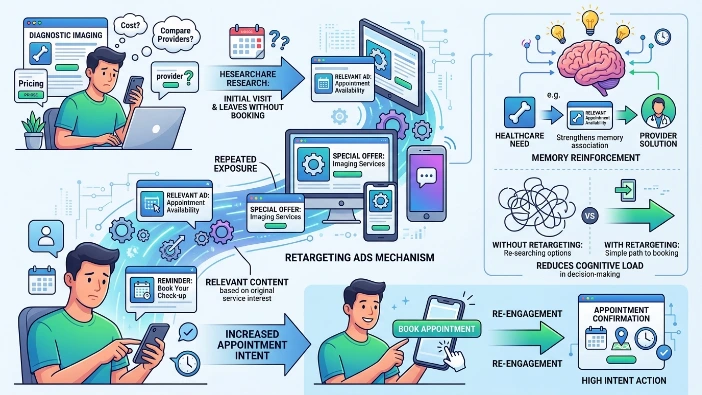
The mechanism works through repetition and relevance. Users who view healthcare content once often leave without taking action due to hesitation, cost comparison, or uncertainty. Retargeting reduces this gap by reintroducing structured reminders that align with the original service interest.
Repeated exposure strengthens memory association between healthcare need and provider solution category. A user researching diagnostic imaging, for example, receives follow-up ads that highlight appointment availability and service clarity, increasing the probability of returning to complete a booking action.
Retargeting also reduces cognitive load in decision-making. Instead of re-searching healthcare options, users are presented with familiar pathways that shorten the journey back to appointment pages. This directly increases appointment intent intensity over time.
How Healthcare Brands Improve Awareness Using Display Advertising
Which audience signals are used in healthcare retargeting campaigns?
Healthcare retargeting campaigns use audience signals such as page visits, appointment form interactions, time spent on treatment pages, service category interest, and repeat website visits to identify users with high intent and segment them for targeted re-engagement advertising delivery systems.
These signals originate from behavioural data collected during user interactions with healthcare platforms. Each signal reflects a different level of interest intensity. A simple page visit indicates awareness, while repeated visits to appointment pages indicate stronger intent formation.
Time-based signals are also important. Longer engagement on treatment explanation pages suggests deeper evaluation behaviour. Interaction with pricing sections or consultation pages signals readiness to compare or book healthcare services.
Form interactions provide one of the strongest intent indicators. Users who begin but do not complete appointment forms are classified as high-intent audiences. These users are prioritised in retargeting sequences because they have already demonstrated partial commitment.
Category-based interest tracking groups users into service clusters such as dermatology, orthopaedics, or general practice. This segmentation allows retargeting systems to maintain message relevance across different healthcare needs without mixing unrelated services.
These signals collectively build structured audience pools that represent different stages of appointment readiness, ensuring that healthcare messaging remains aligned with user behaviour patterns.
What role does user journey segmentation play in improving appointment intent?
User journey segmentation improves appointment intent by dividing healthcare audiences into awareness, consideration, and decision stages, allowing retargeting ads to deliver stage-specific messaging that aligns with patient information needs and progressively increases likelihood of booking healthcare appointments conversion readiness level.
Journey segmentation structures the healthcare funnel into measurable behavioural stages. Each stage reflects a different level of intent maturity, from initial content consumption to final booking action.
In the awareness stage, users consume general healthcare information without strong service commitment. Retargeting here focuses on reinforcing topic relevance and encouraging deeper exploration of healthcare solutions.
In the consideration stage, users compare services, review treatment details, and evaluate provider credibility. Retargeting at this stage focuses on clarity, service differentiation, and procedural understanding to reduce uncertainty.
In the decision stage, users are close to booking. Retargeting emphasises appointment accessibility, scheduling ease, and removal of friction points that may delay final conversion.
This structured segmentation ensures that healthcare messages do not overlap incorrectly across user stages. Instead, each user receives content aligned with their current level of readiness, improving overall appointment intent progression across the funnel.
Explore More Expert Insights:
How Hospitals Increase Treatment Consideration Using Display Advertising
How Clinics Educate Patients Using Service Awareness Banner Campaigns
How do healthcare brands measure appointment intent from retargeting ads?
Healthcare brands measure appointment intent from retargeting ads by tracking conversion indicators such as return visits, appointment page clicks, form submissions, and engagement depth metrics that reflect increasing readiness to schedule healthcare consultations or diagnostic services booking intent strength signals.
Measurement systems rely on behavioural analytics rather than single-event tracking. Return visits indicate renewed interest, especially when users revisit appointment or treatment pages after exposure to retargeting ads.
Appointment page clicks are a strong mid-funnel indicator. They show that users are actively evaluating scheduling options rather than passively consuming information. This metric is often combined with session duration analysis for accuracy.
Form submissions represent direct conversion intent. Even partial submissions provide insight into high-intent users who are close to booking but require additional reinforcement.
Engagement depth metrics include scroll depth, multiple page views, and repeated interaction with service descriptions. These patterns indicate increasing familiarity and confidence in healthcare offerings.
Together, these indicators create a structured intent measurement model that helps healthcare marketers understand how retargeting influences appointment readiness across different stages of the decision journey.
Explore:
How Healthcare Brands Convert Appointment Intent Into Final Bookings Using Banner Ads
How does retargeting connect awareness to appointment readiness in healthcare funnels?
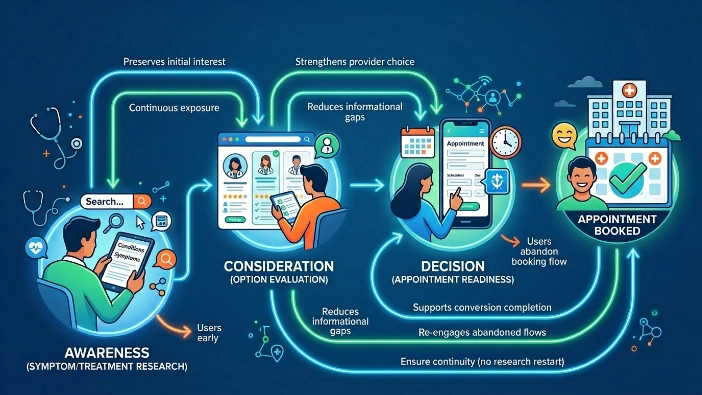
Retargeting connects awareness to appointment readiness by maintaining continuous exposure between initial healthcare research and final booking actions. Users often exit early during informational exploration, and retargeting reintroduces structured reminders that guide them back into the healthcare decision pathway.
At the awareness stage, users explore symptoms, treatments, or general healthcare topics. Retargeting preserves this engagement history and ensures users remain connected to relevant service categories during future browsing sessions.
During the consideration stage, users evaluate options and compare healthcare solutions. Retargeting strengthens this phase by reinforcing previously viewed services and reducing informational gaps that slow decision-making.
At the decision stage, retargeting supports conversion completion by re-engaging users who abandoned appointment flows. This ensures continuity between interest formation and booking execution without restarting the research cycle.
This structured flow increases efficiency in healthcare marketing funnels by reducing drop-off between stages and maintaining consistent user movement toward appointment intent completion.