
Local banner campaigns in hospital marketing are digital display advertisements shown to users within a defined geographic radius. These banners appear on websites and apps, delivering hospital-related informational content, service awareness, and healthcare navigation details to nearby audiences seeking medical understanding.
Local banner campaigns function as a geographic distribution method in digital advertising systems. They use location filters to restrict visibility to users within specific regions. Hospitals apply this method to organise awareness messaging at a community level rather than a national level.
These campaigns appear across news platforms, health portals, mobile applications, and general browsing environments. The format remains visual and static or animated, designed to communicate structured healthcare information in short viewing cycles.
The system depends on ad networks that map user IP signals and device location data. This mapping enables consistent delivery of hospital-related content to users physically located near healthcare facilities.
Local banner campaigns also support structured message repetition. Users repeatedly exposed to healthcare banners develop familiarity with service categories, hospital names, and general treatment pathways within their area. This repetition defines early-stage awareness in the patient information process.
How do local banner campaigns attract patients in the UK healthcare context?
Local banner campaigns attract patients in the UK healthcare context by delivering location-specific healthcare information, guiding awareness of available medical services, and presenting structured health content aligned with regional demand patterns across digital platforms used by UK residents daily online.
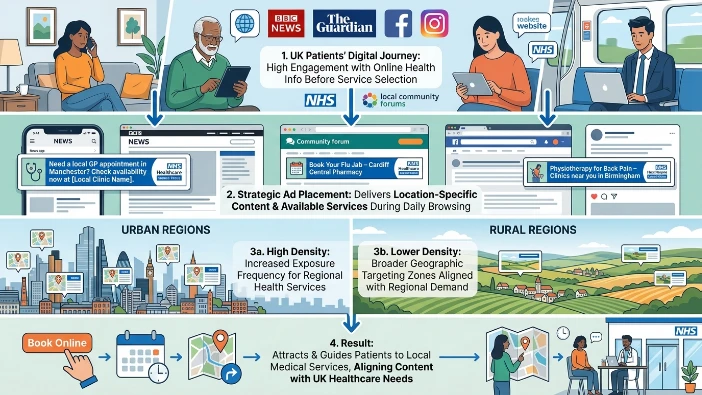
In the UK healthcare environment, digital behavior shows high engagement with online information before service selection. Local banner campaigns align with this behavior by placing informational healthcare content within everyday browsing activity.
These campaigns structure awareness around regional health needs. For example, urban regions with higher population density show increased exposure frequency, while rural regions experience broader geographic targeting zones.
The campaigns operate through programmatic advertising systems that distribute banners based on user location signals. These signals ensure that users within a defined healthcare catchment area receive relevant medical information exposure.
Hospitals use these systems to distribute standardized healthcare messaging. This ensures consistent communication of service categories across multiple digital environments accessed by UK users.
The result is structured awareness formation. Users develop recognition of healthcare options within their region before entering deeper evaluation stages in the patient journey funnel.
Read:
How Hospitals Increase Treatment Consideration Using Display Advertising
What elements make hospital banner ads effective for local audiences?
Hospital banner ads become effective for local audiences through geographic targeting, clear medical messaging, structured visual hierarchy, relevance to regional health needs, and consistent placement across high-traffic digital environments accessed by nearby populations seeking healthcare information in structured formats online.
Effectiveness depends on precision in message construction and audience filtering. Geographic targeting ensures exposure only within relevant service zones, reducing informational noise outside the hospital’s operational area.
Medical messaging uses simplified terminology aligned with general public understanding. This supports clarity in early-stage healthcare awareness where users seek basic informational structure rather than technical detail.
Visual hierarchy organizes content into readable components. Headings, service labels, and contact indicators follow structured layouts that improve scanning efficiency during short viewing periods.
Relevance to regional health needs increases engagement frequency. For example, seasonal illness awareness or chronic condition support information aligns with local population health patterns.
Consistent placement across digital platforms increases recognition cycles. Users encounter repeated exposure across multiple websites, reinforcing awareness of healthcare availability within their local environment.
How does targeting work in local banner advertising for hospitals?
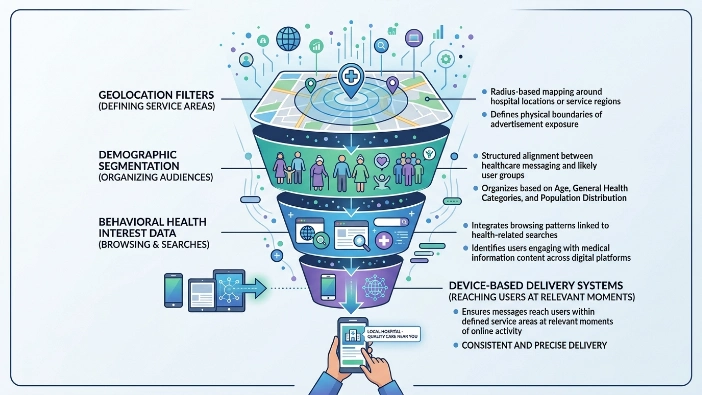
Targeting in local banner advertising for hospitals operates through geolocation filters, demographic segmentation, behavioral health interest data, and device-based delivery systems that ensure healthcare messages reach users within defined service areas at relevant moments of online activity consistently and precisely.
Geolocation filters define the physical boundaries of advertisement exposure. These boundaries are set using radius-based mapping around hospital locations or service regions.
Demographic segmentation organizes audiences based on age, general health categories, and population distribution data. This ensures structured alignment between healthcare messaging and likely user groups.
Behavioral data integrates browsing patterns linked to health-related searches. This allows systems to identify users engaging with medical information content across digital platforms.
Device-based delivery systems ensure cross-platform consistency. Users receive banner exposure across mobile devices, tablets, and desktop environments depending on browsing activity.
Targeting systems operate continuously through automated ad exchanges. These exchanges match healthcare banner content with eligible user profiles in real time, ensuring consistent exposure within defined geographic and behavioral parameters.
Why do hospitals use local banner campaigns for awareness building?
Hospitals use local banner campaigns for awareness building to increase visibility of healthcare services, standardize medical information delivery, strengthen recognition within local populations, and establish consistent digital presence across regionally accessed platforms where health-related searches frequently occur in urban networks.
Awareness building begins with visibility expansion. Local banner campaigns introduce healthcare institutions into daily digital environments where users consume general information content.
Standardization of messaging ensures that healthcare information remains consistent across multiple platforms. This reduces variation in service understanding among different audience groups.
Recognition development occurs through repeated exposure. Users encountering consistent banners associate healthcare services with specific geographic regions and service categories over time.
Digital presence establishment supports continuous informational availability. Hospitals maintain structured visibility without requiring direct user engagement at the initial stage.
Urban networks experience higher exposure density due to increased digital activity levels. This results in stronger awareness formation patterns in densely populated areas where online browsing frequency remains high.
Explore More Expert Insights:
How Clinics Increase Appointment Bookings Using Banner Ads
How Healthcare Providers Gain Patients Using Banner Advertising
How do patients interact with hospital banner ads during early research?
Patients interact with hospital banner ads during early research by viewing informational content, recognizing service availability, comparing healthcare options indirectly, and engaging with repeated exposure signals that reinforce awareness across multiple digital touchpoints during initial health information gathering process stages.
Interaction begins with passive viewing behavior. Patients encounter banner content during general browsing without active search intent for specific services.
Recognition develops through repeated exposure cycles. Users begin identifying healthcare providers and service types within their local area based on visual familiarity.
Indirect comparison occurs when users observe multiple healthcare messages across different platforms. This creates a structured understanding of available services without direct evaluation engagement.
Repeated exposure strengthens informational retention. Users encounter similar healthcare messaging across websites, applications, and digital platforms over time.
This early research stage defines initial awareness formation. Patients collect general healthcare information before entering deeper evaluation phases in their decision-making process.
What is the role of local banner campaigns in the patient journey funnel?
Local banner campaigns play a foundational role in the patient journey funnel by introducing healthcare awareness, supporting early-stage information discovery, and structuring geographic relevance that connects initial digital exposure with progressive healthcare decision-making stages within structured digital environments online systems.
In the patient journey funnel, the foundational stage focuses on awareness creation. Local banner campaigns establish this foundation through structured visual messaging.
Information discovery begins when users encounter healthcare content during everyday digital activity. This exposure introduces service categories and regional healthcare options.
Geographic relevance ensures that information aligns with user location. This connection strengthens the relationship between awareness and real-world healthcare accessibility.
Progression through the funnel occurs as users move from general awareness to deeper research stages. Local banners serve as the entry point into this structured progression.
Digital environments maintain continuous exposure cycles. These cycles ensure that healthcare awareness remains active as users transition through different stages of information gathering and evaluation.
Explore:
How Hospitals Drive Treatment Decisions Using High-Intent Display Campaigns