Seasonal admission banner ads are digital display advertisements used by institutes during high-enrollment periods to increase course awareness, application interest, and student engagement across websites, mobile applications, and online platforms. These advertisements appear during defined admission cycles and target specific student audiences based on age, interests, location, and online activity.
Institutes in the United Kingdom use banner ads during seasonal admission windows such as January intakes, September admissions, summer course registrations, and short certification enrollments. These campaigns focus on attracting prospective students when search activity and education-related browsing increase.
Banner advertisements use visual elements such as headlines, course imagery, admission dates, and program categories to communicate information quickly. Most campaigns appear on news websites, education blogs, video platforms, mobile apps, and search partner networks.
Seasonal campaigns differ from general awareness advertising because they operate within fixed timelines. Institutes structure these campaigns around application deadlines, scholarship periods, open house events, and enrollment announcements.
Students frequently encounter seasonal admission banners while researching university programs, comparing qualifications, or browsing academic content online. These repeated exposures improve recognition of admission opportunities during peak education search periods.
Readers exploring mid-stage admission engagement strategies can also read to understand:
How Institutes Strengthen Admission Intent Using Retargeting Campaigns
How do institutes use banner ads during admission seasons
Institutes use banner ads by identifying seasonal enrollment periods, selecting target student groups, designing visual advertisements, and distributing campaigns across websites and digital platforms with high student traffic. The process focuses on improving visibility during periods of increased academic research and application activity.
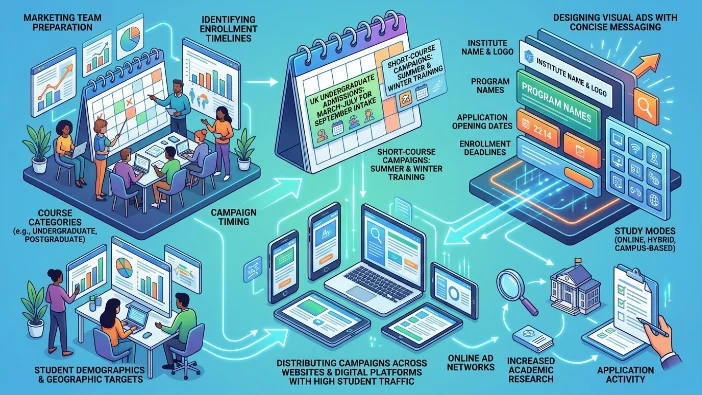
Most institutes begin campaign preparation several weeks before admission periods start. Marketing teams identify enrollment timelines, course categories, student demographics, and geographic targets before launching advertisements.
Campaign timing plays a central role in seasonal performance. For example, undergraduate admission campaigns in the United Kingdom often begin between March and July for September intake programs. Short-course campaigns commonly increase during summer and winter training periods.
Banner advertisements usually contain concise academic messaging. Common content includes program names, application opening dates, enrollment deadlines, and available study modes such as online, hybrid, or campus-based learning.
Institutes also adjust banner sizes and placements depending on the device type. Mobile banner formats receive significant attention because a large share of education-related browsing occurs through smartphones.
Digital advertising platforms distribute these banners across multiple online locations. Examples include education forums, examination websites, scholarship portals, student news platforms, and streaming applications.
Campaign performance improves when advertisements align with active student interests. A student researching engineering programs often receives engineering-related banner advertisements instead of unrelated academic categories.
Institutes also analyze engagement metrics throughout the campaign cycle. Common measurements include impressions, click-through rates, website visits, and application page traffic.
Students interested in advanced admission conversion methods can explore:
How Institutes Close Admission Leads Using High-Intent Retargeting Campaigns
Why do seasonal admission periods increase banner advertising activity?
Seasonal admission periods increase banner advertising activity because student search behavior rises sharply during enrollment windows, examination result announcements, and university application cycles. Institutes increase digital visibility during these periods to reach students actively researching educational opportunities.
Education-related online activity follows predictable annual patterns. Students typically intensify course searches after examination results, during gap-year planning, or before new academic sessions begin.
Search engines, education directories, and student forums experience higher traffic during these periods. Institutes respond by increasing advertising exposure across those channels.
Seasonal competition between educational institutions also contributes to increased advertising volume. Multiple institutes promote similar courses simultaneously during peak intake months. Banner advertising helps maintain visibility within crowded academic markets.
Certain program categories experience stronger seasonal demand than others. Examples include business management courses during autumn intakes, summer language programs, teacher training certifications before school hiring cycles, and technology bootcamps before graduate recruitment periods.
Banner campaigns also support international student recruitment. Many international applicants begin researching United Kingdom institutions several months before visa processing and application deadlines. Seasonal campaigns help institutes communicate deadlines clearly during this research phase.
Institutes frequently synchronize banner advertising with other digital communication activities such as webinar announcements, prospectus releases, and virtual campus events. This coordination strengthens overall admission awareness.
What components make seasonal banner ads effective for institutes?
Effective seasonal banner ads combine clear academic messaging, relevant visuals, defined enrollment timelines, audience targeting systems, responsive design formats, and consistent placement across high-traffic digital platforms. These components improve visibility and increase student engagement during admission cycles.
Visual clarity is one of the most important components. Students often view advertisements for only a few seconds before scrolling or navigating away. Clear headlines and recognizable course information improve comprehension speed.
Admission timelines also influence campaign performance. Advertisements containing exact enrollment dates, intake sessions, or application periods communicate urgency more effectively than generic awareness messaging.
Audience targeting systems determine which users receive advertisements. Educational campaigns commonly target users based on age groups, academic interests, browsing history, and geographic location.
Responsive banner formats improve campaign accessibility across different devices. Mobile-responsive advertisements display correctly on smartphones, tablets, and desktop browsers without reducing readability.
Consistent repetition across platforms increases recognition. Students often encounter the same institute advertisement on multiple websites during their research journey. Repeated exposure improves familiarity with academic offerings.
Landing page alignment also contributes to campaign effectiveness. When students click a banner advertisement, the destination page usually matches the promoted program or admission category directly. This reduces navigation confusion and improves information access.
Campaign analytics allow institutes to refine advertisements during active enrollment periods. Teams often replace underperforming banners with updated visuals, revised headlines, or different audience settings.
How do banner ads support student awareness during admission cycles?
Banner ads support student awareness by repeatedly presenting course information, admission dates, and enrollment opportunities across digital environments where students research academic options. This repeated exposure increases familiarity with programs and improves recognition of available admissions.
Many students begin academic research without selecting a final institution immediately. Banner advertisements maintain visibility throughout this decision-making period by appearing repeatedly across online platforms.
Awareness campaigns commonly focus on broad academic categories instead of detailed conversion messaging. Examples include undergraduate admissions, postgraduate opportunities, vocational certifications, and online learning programs.
Banner ads also simplify information discovery. Students searching for scholarships, accommodation, or course comparisons often encounter relevant admission promotions while browsing related content.
Institutes frequently use geographic targeting to increase regional relevance. A university in Manchester, for example, may prioritize advertising within northern England during local recruitment periods.
Awareness campaigns also support course diversification. Institutes promoting newer programs such as cybersecurity, data analytics, renewable energy, or digital health use banner advertising to introduce unfamiliar academic categories to broader audiences.
Seasonal banners often reinforce institutional timelines. Students repeatedly viewing the same enrollment dates become more aware of approaching deadlines and admission schedules.
Awareness-focused advertising differs from conversion-focused campaigns because its primary goal involves visibility rather than immediate applications. The strategy centers on educational discovery and information exposure.
Explore More Expert Insights:
How Education Brands Promote Courses Using Banner Campaigns
How Online Learning Platforms Drive Signups Using Banner Ads
How do institutes target students with seasonal banner advertisements?
Institutes target students through demographic filtering, behavioral analysis, location settings, academic interest categories, and browsing activity related to education research. These systems allow advertisements to reach audiences actively exploring study opportunities during admission seasons.
Digital advertising platforms categorize users based on online activity patterns. Students researching degree programs, examination preparation, scholarships, or university rankings often enter education-focused audience groups automatically.
Institutes define targeting parameters according to campaign objectives. Undergraduate campaigns commonly focus on students aged 16 to 21, while postgraduate advertisements target graduate-level learners or working professionals.
Geographic targeting improves regional campaign efficiency. Institutes frequently promote local campuses within nearby cities while also running international campaigns in countries with high student mobility.
Interest-based targeting also supports academic alignment. Users browsing engineering content receive engineering-related promotions, while healthcare students encounter nursing or medical course advertisements.
Seasonal campaigns often include device targeting as well. Mobile-first campaigns focus on smartphone users because younger audiences consume a large percentage of educational content through mobile applications and social media browsing.
Institutes also monitor audience engagement patterns during campaigns. High-performing student segments receive additional advertisement exposure, while lower-performing groups undergo targeting adjustments.
What benefits do institutes gain from seasonal banner advertising?
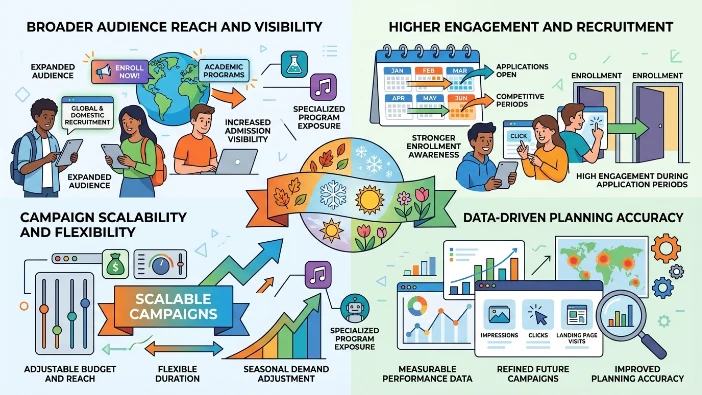
Institutes gain increased admission visibility, broader student reach, stronger enrollment awareness, improved campaign measurement, and higher engagement during competitive application periods through seasonal banner advertising. These campaigns support consistent communication throughout enrollment cycles.
Banner advertising expands audience reach beyond search engine traffic alone. Students who are not actively searching for specific institutions still encounter academic promotions while browsing related digital content.
Campaign scalability also benefits institutes. Advertising budgets, audience reach, and campaign duration can adjust according to enrollment priorities and seasonal demand levels.
Measurable performance data improves planning accuracy for future admissions. Institutes analyze metrics such as advertisement impressions, click behavior, geographic engagement, and landing-page visits to refine upcoming campaigns.
Seasonal advertising also improves visibility for specialized programs. Smaller departments or newly launched courses receive broader exposure through targeted banner distribution.
Digital banners support both domestic and international recruitment strategies. Institutions can run region-specific campaigns for different student populations simultaneously.
Another important benefit involves continuity. Banner campaigns maintain institutional presence across multiple stages of the student research journey, from early awareness to later enrollment evaluation.
As student research behavior continues shifting toward digital platforms, seasonal banner advertising remains a widely used communication method within higher education admissions across the United Kingdom.