
High-intent retargeting campaigns are advanced digital advertising systems that target students who already show strong enrollment behavior such as application starts, fee page visits, and program comparison activity. These campaigns focus on converting active admission leads into final submissions through precise and repeated messaging.
High-intent retargeting operates at the final stage of the student admission funnel in the United Kingdom. These systems activate when students demonstrate clear decision-making behavior rather than general browsing interest.
High-intent signals include actions such as starting an application form, revisiting course pages multiple times, checking tuition breakdowns, or viewing admission deadline pages. Each action indicates progression toward enrollment completion.
Institutes use these signals to categorize students into conversion-ready audiences. These audiences receive highly specific advertisements aligned with admission requirements, deadlines, and final submission steps.
High-intent retargeting differs from general awareness or mid-funnel campaigns because it focuses only on users closest to completing applications.
Readers who want to understand earlier funnel stages can review:
How Institutes Increase Seasonal Admissions Using Banner Ads for awareness strategies
How Institutes Strengthen Admission Intent Using Retargeting Campaigns for intent-building campaigns.
How do institutes close admission leads using retargeting campaigns?
Institutes close admission leads by delivering repeated, behavior-based advertisements to students who already initiated applications, visited final admission pages, or engaged with enrollment steps, reinforcing urgency, clarity, and completion actions across multiple digital channels.
High-intent retargeting begins when students enter final-stage admission pages. These pages include application submission forms, document upload sections, and payment instructions.
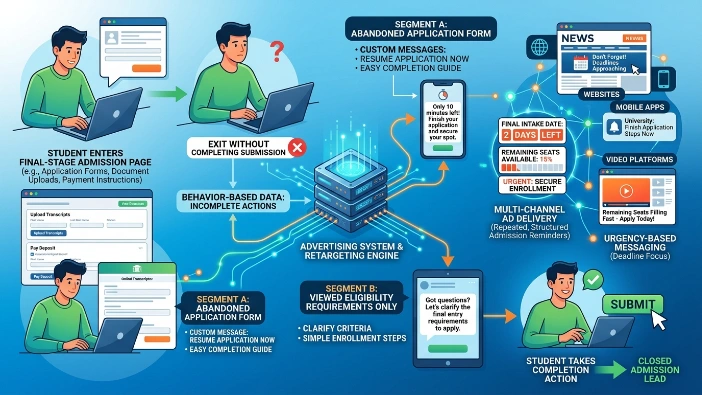
Once a student exits without completing submission, advertising systems trigger follow-up campaigns. These campaigns display structured admission reminders across websites, mobile apps, and video platforms.
Institutes segment students based on their incomplete actions. A student who abandons an application form receives different messaging than a student who only viewed eligibility requirements.
Advertising systems prioritize urgency-based delivery during this stage. Messages align with enrollment deadlines, final intake dates, and remaining seat availability cycles.
For example, a student applying for a postgraduate data science program may receive repeated reminders about application closure timelines and required document submission steps.
High-intent retargeting also reduces application abandonment rates. Students frequently delay submission due to missing documents, financial preparation, or decision uncertainty.
Repeated exposure to structured admission steps increases the likelihood of returning to complete the application process.
These campaigns also operate across multiple devices. A student browsing an application page on a mobile phone may later encounter reminder advertisements on a desktop browser during evening study sessions.
What actions define high-intent admission leads?
High-intent admission leads are defined by measurable student actions such as application initiation, repeated course page visits, tuition page engagement, document upload attempts, and admission deadline interactions, all indicating strong readiness to complete enrollment processes.
Institutes classify student behavior into structured intent levels. High-intent leads represent the final stage before application completion.
Application initiation is the strongest indicator. Students who begin filling admission forms demonstrate direct enrollment commitment even if they do not complete submission.
Repeated course page engagement also signals high intent. Students reviewing the same program multiple times compare entry requirements, course modules, and duration structures.
Tuition page interaction is another critical behavior. Students evaluating cost structures show active decision-making between multiple institutions or programs.
Document upload attempts represent advanced engagement. These students have already moved beyond general research and entered procedural steps of enrollment.
Deadline page visits further confirm urgency awareness. Students checking closing dates and intake schedules display time-sensitive decision behavior.
Institutes combine these actions into digital audience profiles. These profiles allow advertising systems to deliver precise retargeting messages aligned with completion probability.
Each behavior increases the likelihood of conversion when followed by structured retargeting communication.
How do high-intent retargeting systems function in admission funnels?
High-intent retargeting systems function by tracking student interactions, categorizing behavioral signals, segmenting conversion-ready audiences, and delivering targeted advertisements across digital platforms until application completion is achieved within the admission funnel structure.
Admission funnels contain sequential stages starting from awareness and ending in final enrollment submission.
High-intent retargeting activates only at the final stage when students have already evaluated multiple academic options.
Tracking systems record user interactions across institutional websites. These systems log page visits, form engagement, document uploads, and navigation patterns.
Once behavior is recorded, students are assigned to conversion-focused segments. These segments represent users with incomplete but advanced admission actions.
Advertising platforms then distribute targeted messages across digital ecosystems. These ecosystems include search engines, educational platforms, social media feeds, and video streaming services.
Messaging consistency remains structured across all platforms. Students receive aligned information regarding deadlines, submission requirements, and application completion steps.
Campaign systems continuously adjust exposure frequency based on user engagement levels. Higher engagement students receive more frequent reminders compared to lower engagement users within the same segment.
The system continues until one of two outcomes occurs: application completion or audience expiry after the admission cycle ends.
What components make high-intent retargeting effective for closing admissions?
High-intent retargeting effectiveness depends on behavioral tracking accuracy, audience segmentation precision, message timing alignment, cross-platform distribution systems, and structured admission data integration within digital enrollment frameworks.
Behavioral tracking systems identify student interactions across admission portals. These systems collect data points such as page views, clicks, and form interactions.
Audience segmentation organizes students based on final-stage actions. Segments differentiate between application starters, document upload users, and tuition reviewers.
Message timing plays a central role in conversion success. Advertisements delivered during deadline proximity periods show higher completion activity compared to early-stage reminders.
Cross-platform distribution ensures visibility across multiple digital environments. Students encounter admission reminders while browsing websites, using mobile applications, or watching educational content.
Admission data integration connects advertising systems with institutional enrollment databases. This ensures messaging accuracy related to deadlines, requirements, and application progress status.
Each component functions within a unified conversion system designed to minimize application drop-off at the final stage.
Institutes maintain structured synchronization between application portals and advertising systems to ensure real-time response to student actions.
How do institutes use urgency and deadline data in retargeting campaigns?
Institutes use urgency and deadline data by embedding enrollment timelines, application closure dates, and intake cycles into retargeting advertisements to encourage immediate student action during final admission stages.
Deadline-based messaging forms a core component of high-intent campaigns. Students at the final decision stage respond strongly to time-specific academic information.
Admission cycles in the United Kingdom often include fixed deadlines for undergraduate, postgraduate, and professional certification programs.
Retargeting systems integrate these deadlines into advertisement structures. A student viewing a data analytics program may receive messages indicating remaining days before application closure.
Urgency signals also include seat availability indicators and intake batch limitations. These signals reflect structured enrollment capacity constraints within academic programs.
Institutes align urgency messaging with academic calendars. For example, September intake reminders increase during mid-year periods when application submissions peak.
Time-sensitive advertisements are distributed more frequently during final application weeks. This increases visibility among students already engaged in submission processes.
Deadline integration ensures that students remain aware of remaining time windows for application completion.
Explore More Expert Insights:
How Online Learning Platforms Turn Course Viewers Into Paying Students Using Banner Ads
How Universities Convert Program Awareness Into Final Enrollments Using Display Retargeting Ads
What role does personalisation play in high-intent retargeting campaigns?
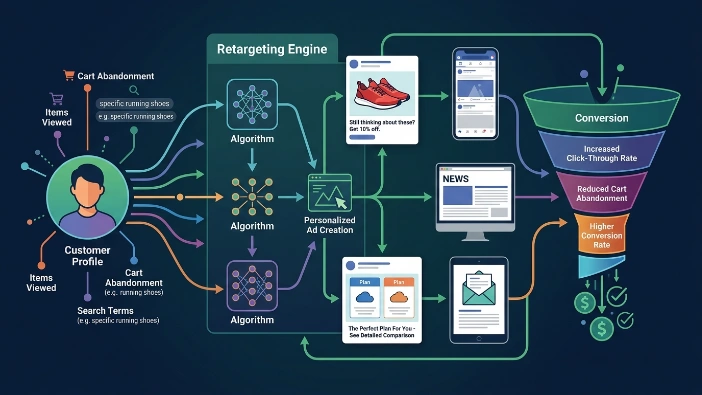
Personalization in high-intent retargeting campaigns involves aligning advertisement content with student behavior data, program interest, application stage, and academic preferences to deliver precise admission messaging that supports final enrollment completion.
Personalization increases conversion efficiency by matching advertisement content with specific student actions.
A student applying for engineering programs receives technical course reminders, while a student applying for business programs receives management-focused admission updates.
Behavior-based personalization also adjusts messaging intensity. Students who abandoned applications receive more detailed submission instructions compared to students who only viewed program pages.
Academic level personalization differentiates undergraduate, postgraduate, and professional course audiences. Each group receives tailored admission steps relevant to their application process.
Geographic personalization ensures alignment with domestic and international admission requirements. International students receive additional visa and documentation reminders during final stages.
Sequential personalization is also used in high-intent campaigns. Early reminders focus on incomplete applications, while later reminders focus on deadline proximity and submission completion.
This structured personalization ensures relevance across the entire final-stage admission cycle.
What benefits do institutes gain from high-intent retargeting campaigns?
Institutes gain improved application completion rates, reduced admission drop-off, stronger conversion efficiency, enhanced student engagement, and better visibility across final enrollment stages through high-intent retargeting campaigns.
High-intent retargeting increases completion rates by targeting students already engaged in application processes.
Drop-off reduction is another major benefit. Many students abandon applications due to incomplete steps, missing documents, or delayed decision-making.
Retargeting campaigns re-engage these students through structured reminders aligned with their previous actions.
Conversion efficiency improves because advertising focuses exclusively on users closest to enrollment completion rather than general audiences.
Engagement levels increase due to repeated exposure to relevant admission information during decision-critical periods.
Institutes also gain improved visibility during competitive admission cycles. Students comparing multiple institutions continue receiving consistent reminders throughout their decision process.
Campaign analytics provide detailed insights into final-stage behavior. These insights include application abandonment points, engagement timing, and completion patterns.
High-intent retargeting remains a key component of modern admission systems in the United Kingdom, supporting structured conversion of qualified student leads into completed enrollments during final decision stages.