
A banner advertising funnel for SaaS feature adoption is a structured marketing system that uses sequential banner exposure across digital platforms to guide users from awareness of a SaaS product to active understanding and consideration of specific features through controlled messaging stages.
A banner advertising funnel is a layered distribution system where users encounter different banner messages based on their position in the adoption journey. In SaaS environments, this system focuses on feature discovery rather than immediate conversion. Each banner represents a controlled information unit designed to introduce functionality step by step.
At the initial stage, banners present general product visibility and category relevance. In later stages, messaging shifts toward specific features such as automation tools, analytics modules, or collaboration systems. Each stage aligns with user familiarity levels and engagement depth.
Read:
How Software Companies Boost Lead Generation Using Banner Ads
The funnel structure ensures repeated exposure across multiple platforms including websites, applications, and content networks. This repetition builds recognition and prepares users for deeper evaluation. The system works by gradually increasing informational complexity while maintaining consistency in messaging logic.
How does banner advertising increase feature adoption in SaaS products?
Banner advertising increases SaaS feature adoption by repeatedly exposing users to structured feature messaging, improving awareness, reinforcing value recognition, and guiding users toward deeper product interaction through sequential informational touchpoints across digital environments.
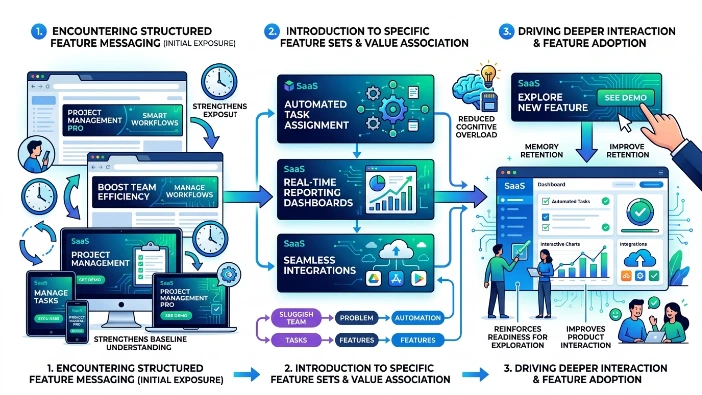
Feature adoption in SaaS depends on visibility and comprehension. Banner advertising supports both by distributing feature-focused content in controlled stages. Users first encounter simplified explanations of core capabilities. These messages establish baseline understanding without requiring product access.
As exposure continues, banners introduce more specific feature sets. For example, workflow automation, reporting dashboards, or integration capabilities are presented in isolated messaging units. This segmentation ensures cognitive clarity and reduces information overload.
Repeated exposure strengthens memory retention of feature value. Users begin associating specific problems with corresponding SaaS functionalities. This association improves readiness for product exploration.
Banner advertising also connects users to deeper content environments such as product documentation or feature walkthrough pages. This structured movement from awareness to exploration increases adoption probability across SaaS platforms.
What stages exist in a SaaS banner advertising funnel?
A SaaS banner advertising funnel consists of awareness, consideration, and adoption stages, each delivering progressively detailed feature messaging designed to move users from general recognition of the SaaS product to structured evaluation and eventual feature engagement.
The awareness stage introduces the SaaS product category and basic value proposition. Banner messages at this level focus on high-level outcomes such as efficiency, automation, or data organization. Users encounter these messages across broad digital placements.
The consideration stage focuses on structured feature introduction. At this level, banners highlight specific SaaS capabilities such as task automation, collaboration tools, or reporting systems. Messaging becomes more detailed and comparison-oriented.
The adoption stage delivers feature-specific reinforcement. Users receive banners tied to functionalities they have previously engaged with or shown interest in. This stage strengthens intent alignment and encourages deeper interaction with product environments.
Each stage operates as part of a continuous funnel system where messaging complexity increases gradually. This progression ensures that users develop structured understanding before reaching active feature engagement.
How does user segmentation improve feature adoption through banners?
User segmentation improves feature adoption by dividing SaaS audiences into defined groups based on behavior, role, and interaction history, enabling banner messages to deliver relevant feature information aligned with each group’s specific functional needs and usage expectations.
Segmentation organizes users into categories such as new visitors, active users, and previously engaged prospects. Each group receives different banner messaging aligned with their familiarity level. This prevents irrelevant exposure and increases message relevance.
Behavior-based segmentation tracks user interactions such as page visits, feature clicks, and content engagement. These signals determine which features are most relevant to each user segment. For example, users interacting with analytics content receive banners focused on reporting tools.
Role-based segmentation separates users based on professional context such as operations, marketing, or technical roles. Each role interacts with different SaaS features, and banner messaging reflects these functional differences.
Segmentation improves efficiency by reducing unnecessary impressions and increasing feature relevance per exposure. This leads to stronger engagement with specific SaaS functionalities and improves structured adoption pathways across the funnel system.
What role does behavioral data play in banner-based feature adoption?
Behavioral data defines how users interact with SaaS content and interfaces, enabling banner advertising systems to deliver feature-specific messaging based on observed actions such as clicks, navigation patterns, and engagement duration across digital platforms.
Behavioral data includes measurable user actions such as page visits, feature exploration, time spent on product pages, and interaction sequences. This data identifies which SaaS features attract user attention.
Banner systems use this information to align messaging with user interest patterns. For example, users exploring collaboration pages receive banners highlighting team-based functionality. This alignment increases relevance and improves engagement rates.
Behavioral tracking also identifies drop-off points in user journeys. If users disengage after viewing certain features, banners are adjusted to reinforce those areas with simplified messaging.
This data-driven structure ensures that banner advertising is not static. It evolves based on user behavior, creating adaptive feature promotion systems that respond to real engagement signals.
How do SaaS companies design messaging for feature adoption banners?
SaaS companies design feature adoption banner messaging by structuring content into clear functional statements, isolating individual features, and aligning messaging with user intent levels to ensure clarity, relevance, and progressive understanding of product capabilities.
Messaging design begins with feature isolation. Each banner focuses on a single functionality rather than multiple features. This ensures cognitive clarity and prevents information dilution. For example, one banner may focus on automation while another focuses on reporting.
Language structure remains factual and descriptive. Messages describe what the feature does rather than promotional interpretations. This approach supports clarity and improves comprehension across diverse user groups.
Messaging also adapts to funnel position. Early-stage banners focus on general capability introduction, while later-stage banners present detailed feature breakdowns. This progression supports structured learning.
Visual hierarchy plays a role in message design. Key feature terms are emphasized through layout structure, ensuring users quickly identify relevant information. This design logic improves recognition and strengthens feature association.
Explore More Expert Insights:
How Tech Startups Educate Prospects Using Solution-Based Banner Ads
How SaaS Businesses Strengthen Consideration Using Retargeting Banner Ads
How is performance measured in banner advertising funnels for SaaS features?
Performance in SaaS banner advertising funnels is measured using engagement rate, feature click-through rate, adoption progression, and user activation metrics that collectively evaluate how effectively banner exposure drives feature awareness and product interaction.
Engagement rate measures how users interact with banner content across impressions. It reflects initial interest in SaaS feature messaging. Click-through rate measures how often users move from banners to deeper content environments.
Feature click-through rate isolates interactions tied specifically to SaaS functionalities. This metric identifies which features attract the most user attention. Adoption progression tracks movement from awareness to repeated feature exposure.
User activation metrics measure how many users begin interacting with SaaS features after exposure to banner campaigns. This includes sign-ups, feature trials, or interface interactions.
Together, these metrics provide a structured evaluation system that connects banner exposure to feature-level engagement outcomes. This ensures continuous optimization of messaging and segmentation strategies within SaaS funnel systems.
Why do banner advertising funnels improve SaaS product engagement?
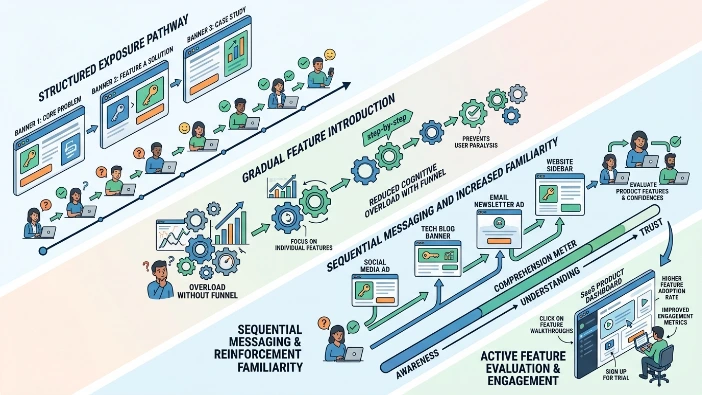
Banner advertising funnels improve SaaS engagement by delivering structured, sequential exposure to product features, increasing familiarity, reducing cognitive overload, and guiding users through a controlled journey from awareness to active feature evaluation across multiple digital touchpoints.
Funnels create structured exposure pathways where users encounter information in controlled stages. This prevents overwhelming users with full product complexity at once. Instead, features are introduced gradually.
Sequential messaging improves comprehension by reinforcing individual features through repeated exposure. Users develop clearer understanding of SaaS functionality over time.
Funnels also improve consistency across marketing channels. Users receive aligned messaging across websites, content platforms, and digital networks. This consistency strengthens recognition of SaaS features.
Explore:
How SaaS Companies Increase Paid Conversions Using High-Intent Feature Retargeting Ads
The structured nature of banner advertising funnels ensures that feature awareness progresses logically. Users move from general understanding to detailed evaluation in a controlled system designed for sustained engagement and feature adoption.