

SaaS businesses use retargeting banner ads during the consideration stage to maintain visibility, reinforce product value, support feature evaluation, and guide returning visitors toward deeper engagement. These campaigns help potential buyers compare solutions, review functionality, and continue research after initial website interactions.
The consideration stage begins after a visitor understands a software category and starts comparing available solutions. At this stage, buyers examine product functionality, integrations, onboarding requirements, reporting systems, pricing structures, and workflow compatibility.
Retargeting banner ads keep the software visible during this evaluation process. A visitor who explored reporting features often receives banner ads focused on analytics dashboards, automation capabilities, or operational efficiency.
SaaS businesses use these campaigns because software decisions involve multiple sessions. Buyers frequently revisit websites several times before starting a trial or scheduling a product demonstration.
Consideration-stage retargeting also improves message continuity. A visitor reading about customer management features later sees banner ads connected to the same topic. This alignment strengthens message relevance and supports product understanding.
How do retargeting banner ads support SaaS product evaluation?
Retargeting banner ads support SaaS product evaluation by presenting relevant features, highlighting operational benefits, and reconnecting users with educational resources. These campaigns help decision-makers continue research activities without restarting the discovery process from the beginning of the buyer journey.

Product evaluation depends on repeated exposure to useful information. Banner ads deliver focused messages based on prior website behavior.
A visitor who viewed integration pages receives ads discussing compatibility with accounting systems, CRM platforms, or collaboration tools. A visitor who explored analytics sections receives banners focused on reporting accuracy and dashboard visibility.
These ads direct users toward comparison pages, case-study content, onboarding guides, or feature demonstrations. Each destination supports additional evaluation instead of pushing immediate conversion.
Retargeting also improves information recall. Buyers comparing several SaaS platforms remember product functionality more clearly after repeated visual exposure.
Many SaaS businesses structure retargeting campaigns around engagement depth. Visitors who spent five minutes on feature pages receive more detailed banner messaging than visitors who left after a homepage session.
This layered communication structure improves relevance across different consideration-stage audiences.
Explore advanced conversion journeys in:
How SaaS Businesses Close Trial Users Into Paid Subscriptions Using Retargeting Funnels
What types of audiences are targeted during SaaS consideration campaigns?
SaaS consideration campaigns target engaged website visitors who already understand the software category and actively evaluate solutions. These audiences include pricing-page visitors, feature-page readers, returning users, integration researchers, webinar attendees, and trial-interest visitors showing measurable engagement signals.
Pricing-page audiences represent high-value consideration-stage traffic. These visitors compare subscription structures, licensing models, and feature access levels.
Feature-page visitors form another major audience segment. Their browsing activity reveals operational priorities such as automation, analytics, project management, or customer support functionality.
Returning visitors also receive specialized retargeting campaigns. Multiple sessions indicate sustained evaluation behavior and stronger purchase intent.
Webinar attendees and downloadable-resource users often enter consideration-focused retargeting sequences. These users already invested time reviewing educational material related to the SaaS solution.
Some SaaS campaigns also segment audiences by company size. Small business visitors receive messaging focused on simplicity and cost efficiency. Enterprise-focused visitors receive messaging related to scalability, security, and workflow integration.
Audience segmentation increases message precision. More relevant banner ads generate stronger engagement and longer website sessions.
How do SaaS businesses personalize retargeting banner ads?
SaaS businesses personalize retargeting banner ads using behavioral segmentation, engagement history, device activity, and content interaction patterns. Personalized campaigns improve message alignment by showing visitors banner content directly connected to their previous website actions and research interests.
Behavioral personalization begins with visitor tracking. Website activity identifies which pages users viewed, how long they stayed, and which resources they accessed.
Banner messaging then adapts to that behavior. A visitor researching workflow automation receives banners focused on task management efficiency. A visitor reviewing reporting features receives ads emphasizing dashboard visibility and performance tracking.
Some campaigns personalize ads by funnel depth. First-time returning visitors receive educational messaging. High-intent visitors receive banners connected to feature comparisons, onboarding processes, or implementation timelines.
Device personalization also affects campaign structure. Mobile visitors often see simplified banner formats with concise messaging. Desktop campaigns usually contain more detailed product information.
Geographic targeting supports regional personalization. United Kingdom SaaS campaigns frequently reference compliance standards, local business operations, or region-specific workflows relevant to UK-based organisations.
Personalization improves relevance without changing the educational structure of the campaign.
Why does message consistency matter in SaaS retargeting?
Message consistency matters in SaaS retargeting because repeated alignment between banner ads, landing pages, and website content improves understanding, reduces confusion, and strengthens product recognition. Consistent messaging supports smoother movement through the software evaluation process and increases informational clarity.
SaaS buyers interact with multiple digital touchpoints before making decisions. Inconsistent messaging creates friction during that process.
A banner promoting workflow automation must direct users toward automation-related landing pages. A mismatch between ad messaging and destination content reduces engagement quality.
Consistent terminology also improves product comprehension. If a SaaS business uses “project analytics” in banner ads, landing pages and educational content must maintain the same terminology structure.
Visual consistency supports recognition as well. Similar layouts, dashboard visuals, icons, and messaging structures improve familiarity across sessions.
Retargeting campaigns often run across display networks, mobile apps, blogs, and video platforms. Consistency ensures users immediately recognize the software product during repeated exposure.
This continuity supports stronger consideration-stage engagement because users spend less time reinterpreting product positioning.
For earlier-stage educational strategies, explore:
How SaaS Businesses Retarget Website Visitors Using Banner Ads
How do retargeting banner ads compare with standard display advertising?
Retargeting banner ads differ from standard display advertising because they target previous website visitors instead of broad cold audiences. Retargeting campaigns focus on users with existing interest, while standard display campaigns prioritize visibility and initial awareness among larger audience groups.
Standard display advertising introduces products to users without prior website interaction. These campaigns focus on broad reach and category awareness.
Retargeting campaigns focus on visitors who already interacted with the SaaS website. This audience already understands the software category and actively researches solutions.
Consideration-stage retargeting produces more relevant engagement because messaging connects directly to prior activity.
A cold display campaign promoting collaboration software targets general business audiences. A retargeting campaign targets visitors who already viewed collaboration features, onboarding systems, or integration documentation.
Retargeting also supports sequential messaging more effectively. The campaign evolves as visitors progress deeper into product evaluation.
Standard display campaigns prioritize exposure volume. Retargeting prioritizes audience precision and continued engagement.
Many SaaS marketing strategies combine both approaches. Display campaigns build awareness. Retargeting campaigns strengthen consideration and evaluation.
What challenges affect SaaS consideration-stage retargeting campaigns?
SaaS consideration-stage retargeting campaigns face challenges related to audience fatigue, weak segmentation, repetitive messaging, tracking restrictions, and low-quality landing experiences. Effective campaign management depends on relevant messaging, controlled ad exposure, and accurate alignment between audience behavior and advertisement content.
Audience fatigue reduces banner performance over time. Visitors repeatedly exposed to identical creatives stop engaging with advertisements.
Creative rotation helps maintain engagement. SaaS campaigns frequently update visuals, messaging structures, and feature highlights every few weeks.
Weak audience segmentation also reduces effectiveness. A pricing-focused visitor requires different messaging than a visitor researching integrations or compliance standards.
Tracking limitations affect audience accuracy as browser privacy restrictions reduce cookie visibility across some platforms.
Landing page quality strongly influences campaign results. A banner promoting operational analytics must lead users toward analytics-focused content instead of a general homepage.
Campaign timing also matters. Extremely long retargeting windows reduce relevance because user intent declines over time.
Frequency controls help maintain balance. Excessive ad exposure increases irritation and lowers click-through rates.
Successful consideration-stage campaigns maintain informational relevance while limiting unnecessary repetition.
Explore More Expert Insights:
How Software Companies Increase Demo Engagement Using Banner Campaigns
How SaaS Platforms Move Users From Awareness to Trial Using Display Ads
How do SaaS businesses measure consideration-stage retargeting performance?
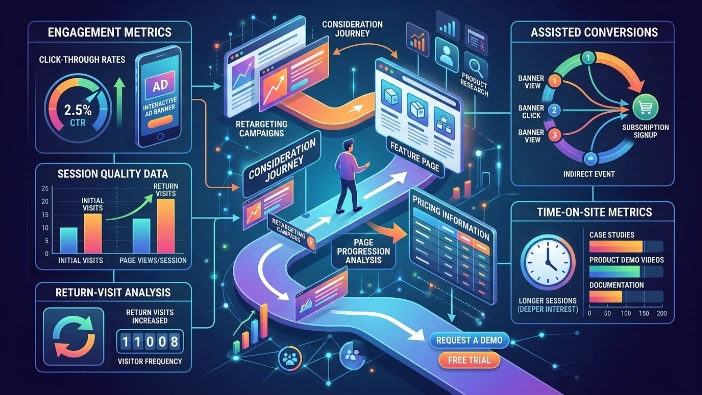
SaaS businesses measure consideration-stage retargeting performance using engagement metrics, return-visit analysis, session quality data, assisted conversions, and progression tracking. These measurements show whether banner campaigns successfully move visitors deeper into product evaluation and subscription research activities.
Return-visit tracking measures how often users revisit the SaaS website after viewing banner ads.
Time-on-site metrics evaluate engagement depth. Longer sessions often indicate stronger interest in product evaluation content.
Page progression analysis measures how users move through the website. A visitor who transitions from a feature page to pricing information demonstrates increased consideration-stage engagement.
Click-through rates measure banner interaction frequency. Higher engagement often reflects stronger audience relevance and clearer messaging alignment.
Assisted conversions also matter during consideration campaigns. Many visitors see retargeting ads, return later through direct traffic, and continue the evaluation process without immediately converting from the advertisement itself.
Some SaaS businesses also measure resource engagement. Webinar registrations, comparison-page visits, documentation downloads, and onboarding-guide interactions indicate deeper consideration-stage activity.
These measurements help marketing teams refine audience segmentation, creative messaging, and landing-page alignment.
What role do retargeting banner ads play in SaaS buying journeys?
Retargeting banner ads play a central role in SaaS buying journeys by maintaining engagement between awareness and conversion stages. These campaigns reconnect interested visitors with product information, reinforce solution relevance, and support ongoing evaluation across long software purchasing timelines.
SaaS buying journeys involve research, comparison, internal discussions, and technical evaluation. Buyers rarely convert after a single website session.
Retargeting maintains communication throughout that extended process. Banner ads keep the software visible while buyers compare functionality, pricing, onboarding systems, and operational fit.
Consideration-stage campaigns focus on clarity and product understanding. These campaigns explain capabilities, workflows, reporting structures, and compatibility features in a gradual sequence.
As visitors progress deeper into the funnel, retargeting messaging becomes more specific. Early banners focus on education. Later banners focus on evaluation support and onboarding readiness.
This transition creates continuity between awareness-stage learning and decision-stage conversion activity.



